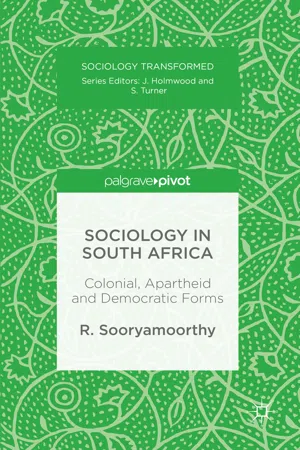
This book is the first comprehensive account of the history and current state of South African sociology. Providing a holistic picture of the subject both as it is taught in universities and as a field of research, it reveals the trajectories of a discipline in a challenging socio-political context. With the support of historical and scientometric data, it demonstrates how the changing political situation, from colonialism to apartheid to democracy, has influenced the nature, direction and foci of sociological research in the country. The author shows how, during the apartheid era, sociology was professionally fragmented and divided along language and race lines. It was, however, able to flourish with the advent of democracy in 1994 and has become a unique academic movement. This insightful work will appeal to students and scholars of the social sciences, and all those interested in the history and society of South Africa.
- English
- ePUB (mobile friendly)
- Available on iOS & Android
eBook - ePub
About this book
Information
© The Author(s) 2016
R. SooryamoorthySociology in South AfricaSociology Transformed10.1007/978-3-319-40325-0_11. South African Sociology in Context
R. Sooryamoorthy1
(1)
School of Social Sciences, University of KwaZulu-Natal, Durban, South Africa
Abstract
South African sociology has several distinctive features. It has developed a strand of its own, transforming from the colonial and apartheid periods. Under different phases in its history—colonial, apartheid and democratic—sociology in the country passes through exacting times. The political conditions are antagonistic towards an integrated sociology in the apartheid period. Some support the separatist apartheid regime while others oppose it. Some sociologists are in the forefront of promoting apartheid policies with the support of the discipline. There are contrasting views on the state of sociology in the three clearly marked phases. Different forms of sociology co-exist in South Africa over these years. This chapter presents some of the characteristic features of South African sociology that are examined in the book.
Keywords
South AfricaSociologyApartheidHistoryGlobally, sociology has passed through challenging times and continues to do so. Sociologists often ask questions about its existence and survival, in both its structural and intellectual aspects (Abbott 2000). Some have been sceptical, predicting a dim future for sociology (Stinchcombe 1994). Others have thought that sociology will not lose its relevance at all, but rather that it is capable of making a greater impact than other social science disciplines are currently having on society (Turner 2006). The discipline is surviving nevertheless. This is so even when market forces sway and determine the purposes, functions and raison d’être of universities and other centres of knowledge production where sociology has a home. In many societies, sociologists have survived against the forces of privatization and the commodification of knowledge (Burawoy 2011).
Sociology remains very much alive although the pressures facing it come from different directions, often from unexpected quarters. The lack of supportive patronage from political leaders and policy-makers works against the discipline. Structural changes in academia and curricula add to the current woes of sociology. Evidence from several countries where sociology exists is not easy to reject. 1
Africa is yet to appear prominently on the international sociological scene. This is more so for South Africa. The presence of African sociology , and its South African form, in particular, has not been adequate to create the impression that sociology exists on the continent. This certainly appears to be the case when the research publications carried in prominent sociological journals are taken into account. Only three articles about Africa appeared in two distinguished sociology journals between 1990 and 2005. 2 Debates on African sociology , despite its potential for the discipline globally, eluded scholarly contemplation for a very much longer period of time. This is a missed opportunity, not only for African sociology, but specifically for sociology in South Africa . However, it has now turned the corner and matters are moving towards change. Sociology in Africa has entered the global stage.
As a young and dynamic democracy, South Africa is a prominent country on the continent. It is striving to revive from its troubled past of colonialism and apartheid. 3 The legacy of its past is intertwined with its sociology. South Africa can claim to have a strand of its own sociology and has a shared identity among the community of thousands of sociologists in the world. It was South Africa that led other African countries in introducing sociology to the universities. 4 It is credited with being the strongest sociology in the global South, following only India and Brazil, and of leading on the African continent 5 (Alexander and Uys 2002; Burawoy 2009).
Differing in key respects from sociology in other countries, South African sociology possesses its own characteristic features. However, its subjects and topics are not totally dissimilar to other societies. They are manifest in its abundance of social issues and phenomena, and is evident in the rainbow 6 of sociologists and their approaches to study. Spread across nine provinces in an area of 1,219,090 km2, it is the home to 54.96 million people (RSA 2015) of different ethnic and racial backgrounds. 7
Like any society, South Africa has good reasons for having a sociology of its own. South Africa went through a devastating past, a past that tore apart its social fabric. Its past fragmented the society and gave rise to problems of varying magnitudes that were presented to sociologists to address. Sociology thus came into being in the early years of the twentieth century. Any examination of the discipline in South Africa unavoidably has to be related to the society’s past (Schutte 2007).
Sociology in South Africa formed and developed with some salient characteristics (Pavlich 2014). It evolved from the racial differentiation and linguistic separation which continued to influence the nature of sociology and the sociological research produced in the country. Like the society, South African sociology was also highly racialized (Hendricks 2006) and divided. The division was obvious in the methodological preferences and the types of sociologies pursued and practised in universities and research institutes. The main sources of the division were language (Afrikaans and English) and the varying resources. The historically white universities (HWUs) were long favoured while historically black universities (HBUs) were disadvantaged.
This book is concerned with sociology in South Africa, its past and present. It traces the history of sociology in distinctive phases. The history of sociology is a main field of enquiry in social science research (Maia 2014). It focuses on the questions asked and the answers given (Lyon 2015). Sociology is deeply rooted in its historical moorings precisely because the discipline was created by its founders to study historical changes (Lachmann 2013). Why is this history important? The concerns and methods of historical sociology can serve to invigorate the broader discipline of sociology as a discipline of social change (Lachmann 2013). In looking into the history of sociology and its contemporary state, this book generates more questions than answers, but this is to be expected. Such questions are pertinent and are part of the process of achieving a better understanding.
Historical sociology employs a range of perspectives, either stressing the linearity of time and the progressive order of history or attempting to study it non-linearly and in the uneven stages of history (Lundborg 2016). In this book a clear linearity of time and order is stressed, covering three marked phases: the colonial, apartheid and democratic. As in other social realities, both colonialism and apartheid have embedded their perspectives and structures in knowledge production (Schutte 2007).
As to why we should undertake such an exercise, Fanning and Hess (2015) in their study of Irish sociology eloquently state the need for historical understanding. They maintain that an understanding of the pluralist disciplinary history is unavoidable for those who study and practice sociology. The issues and contemporary debates on South African sociology , as Mapadimeng (2009) remarks, help understand not only the historical evolution but also the nature and challenges sociology faces in the society. This book therefore presents sociology in South Africa and the historical paths it has traversed in the past 100 years. The intention is not to analyse the works of individual sociologists but to gather the collective and cohesive works of sociologists, past and present. They have all contributed to South African sociology in various ways. It is their teaching and research that made South African sociology develop through the first two phases and enter the current democratic phase. Whether South Africa n sociology, in these phases, has declined, stagnated or grown is pertinent and needs to be considered with the support of evidence. The evidence presented here is gathered from several sources. The writings of scholars that include both South Africans and non-South Africans, reports, records and figures are indispensable in this analysis. More importantly, new empirical evidence has been relied on, drawing from the bibliometric records of the publications of scholars during all three phases.
South African sociology emerged and gained acceptance in response to nationalist sentiments. South Africa had episodes that were strong enough to evoke and disturb the very structure of the society and sociology is intertwined with t...
Table of contents
- Cover
- Frontmatter
- 1. South African Sociology in Context
- 2. The Beginning: Sociology in Colonial Times
- 3. In Apartheid Times, 1948–1993
- 4. Sociology in Democratic South Africa, 1994–2015
- 5. Sociological Research: Contemporary Characteristics
- 6. Current and Future Prospects
- Backmatter
Trusted by 375,005 students
Access to over 1.5 million titles for a fair monthly price.
Study more efficiently using our study tools.
Frequently asked questions
Yes, you can cancel anytime from the Subscription tab in your account settings on the Perlego website. Your subscription will stay active until the end of your current billing period. Learn how to cancel your subscription
No, books cannot be downloaded as external files, such as PDFs, for use outside of Perlego. However, you can download books within the Perlego app for offline reading on mobile or tablet. Learn how to download books offline
Perlego offers two plans: Essential and Complete
- Essential is ideal for learners and professionals who enjoy exploring a wide range of subjects. Access the Essential Library with 800,000+ trusted titles and best-sellers across business, personal growth, and the humanities. Includes unlimited reading time and Standard Read Aloud voice.
- Complete: Perfect for advanced learners and researchers needing full, unrestricted access. Unlock 1.5M+ books across hundreds of subjects, including academic and specialized titles. The Complete Plan also includes advanced features like Premium Read Aloud and Research Assistant.
We are an online textbook subscription service, where you can get access to an entire online library for less than the price of a single book per month. With over 1.5 million books across 990+ topics, we’ve got you covered! Learn about our mission
Look out for the read-aloud symbol on your next book to see if you can listen to it. The read-aloud tool reads text aloud for you, highlighting the text as it is being read. You can pause it, speed it up and slow it down. Learn more about Read Aloud
Yes! You can use the Perlego app on both iOS and Android devices to read anytime, anywhere — even offline. Perfect for commutes or when you’re on the go.
Please note we cannot support devices running on iOS 13 and Android 7 or earlier. Learn more about using the app
Please note we cannot support devices running on iOS 13 and Android 7 or earlier. Learn more about using the app
Yes, you can access Sociology in South Africa by R. Sooryamoorthy in PDF and/or ePUB format, as well as other popular books in Social Sciences & Education Theory & Practice. We have over 1.5 million books available in our catalogue for you to explore.