This book constitutes the first full volume dedicated to an academic analysis of horseracing in British cinema. Through comprehensive contextual histories of film production and reception, together with detailed textual analysis, this book explores the aesthetic and emotive power of the enduringly popular horseracing genre, its ideologically-inflected landscape and the ways in which horse owners and riders, bookmakers and punters have been represented on British screen. The films discussed span from the 1890s to the present day and include silent shorts, quota quickies and big-budget biopics. A work of social and film history, The British Horseracing Film demonstrates how the so-called "sport of kings" functions as an accessible institutional structure through which to explore cinematic discussions about the British nation—but also, and equally, national approaches to British cinema.
eBook - ePub
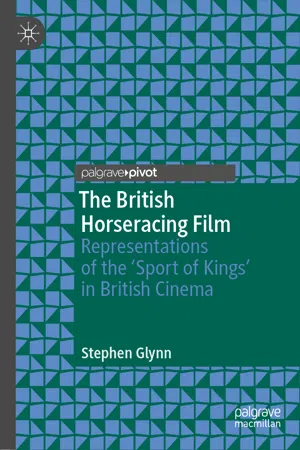
The British Horseracing Film
Representations of the ‘Sport of Kings’ in British Cinema
- English
- ePUB (mobile friendly)
- Available on iOS & Android
eBook - ePub
About this book
Information
Subtopic
Film & Video© The Author(s) 2019
Stephen GlynnThe British Horseracing Filmhttps://doi.org/10.1007/978-3-030-05180-8_11. Introduction
Abstract
This chapter offers a brief history of horseracing, considered to be Britain’s first national sport, and a definition of the distinctively British horseracing film genre. It argues especially that, alongside aesthetic and economic factors, the horseracing film constitutes a viable source for social history, with the on- and off-field re-presentations of the sport and its associated gambling culture an ideological metonym for the concerns of wider British society. It sketches out the enduring preoccupations of the genre which depicts a rigidly ranked society in miniature, with individuals accepting their place in a hierarchy stretching from lordly horse-owners to lowly stable workers, and from the Royal Enclosure to the popular stands, playing out the narrative polarities of (higher class) romance and (lower class) corruption.
Keywords
British horseracingGenre life-cycleSocial historyIn Warner Brothers ’ My Fair Lady (George Cukor, 1964), set in Edwardian London and everywhere displaying its unprecedented $17 million production budget, phonetics expert Professor Henry Higgins (Rex Harrison) looks for a suitable environment to test whether his speech training on lowly Covent Garden flower seller Eliza Doolittle (Audrey Hepburn ) will allow her to pass as a member of British high society. He chooses to take her to the opening day of Royal Ascot in Berkshire, Europe’s best-attended horseracing meeting, but also, more pertinently, one of the most exclusive events in Britain’s social calendar, noted for its haute couture and restricted enclosures—‘everyone who should be here is here’, they sing in the ‘Ascot Gavotte’. Following Henry’s advice to restrict conversation to health and the weather, Eliza’s poise and pronunciation lead to initial acceptance, even admiration for her use of the ‘latest small talk’, until her enthusiasm during a close race finish prompts the distinctly unladylike demotic of ‘come on, Dover, move your bloomin’ arse!’—much to Higgins’ amusement, but general consternation (one woman even faints). Although Hepburn cannot escape the impression that her Cockney accent is the one practised with an elocutionist, the scene is consummately executed, ‘a smashing, positively dashing spectacle’ as the Gavotte confidently underlines. Both Cukor’s film and its source text, Alan Jay Lerner and Frederick Loewe’s 1956 hit Broadway musical, were based on the 1913 play Pygmalion by George Bernard Shaw —a piece containing no comparable Ascot set-piece sequence. Nonetheless, with its intersection of rigid social hierarchies and relaxed sporting excitement, the US addition of a central horseracing meet to demonstrate the quintessence of British cultural values made perfect sense: with the film winning eight Academy Awards including Best Picture and an international box office of $72 million, the interpolated sequence clearly met both critical and public expectations, demonstrating how, at home and abroad, British society’s sporting passion is primarily equated with horseracing.
And not without good cause, since horseracing is widely acknowledged as ‘the first truly national sport in Britain’ (Vamplew and Kay 2005: vi). Its long history stretches back to the Roman Empire, while the first recorded race takes place at a Smithfield horse fair in 1174. Its appellation as ‘the Sport of Kings’ begins with James I who, coming across amateur racing at the Suffolk village of Newmarket in 1605, became so smitten with sporting interests that he was reprimanded by Parliament for neglecting his regal duties. Royal patronage was secured as James’ successor Charles I , equally enamoured, inaugurated the Gold Cup, Britain’s first cup race, in 1634; in 1671 Charles II became the first (and only) reigning monarch to ride the winner of the Newmarket Town Plate, a race he founded six years earlier (and won again four years later); horse-owning Queen Anne founded the Ascot Racecourse in Berkshire in 1711 with Her Majesty’s Plate and a generous purse of 100 guineas. Until this point racing had mostly been a two horse event, motivated by large wagers between noblemen owners, who often rode their own horses across private grounds or open land. The introduction of Arabian bloodstock from the late-seventeenth century propelled the evolution of the thoroughbred racehorse, while the publication from 1727 of a Racing Calendar, the creation of racecourses (initially open with free entry) near thriving towns, and the 1752 formation of the Jockey Club , a regulatory authority comprising racing’s elite (so not including mere jockeys), all worked to transform British horseracing into a highly organised sport, but one still firmly under aristocratic control. The establishment of the first classic races, the St Leger in 1776, the Oaks in 1779 and the Derby in 1780, though created over dinner by gentlemen of leisure as competition for their thoroughbreds, nonetheless set the framework for modern horseracing. The latter race (apocryphally named on the toss of a coin between the 12th Earl of Derby and his party guest Sir Charles Bunbury), quickly became the pretext for a mass exodus from London, with estimates of over 100,000 gathering on Epsom Downs, some to witness the new racing spectacle, most to indulge in a traditional country fair. The popular holiday atmosphere and sheer scale of operation is impressively recreated in Wessex Films’ Esther Waters (Ian Dalrymple, Peter Proud, September 1948), adapted from George Moore’s 1894 novel, when the titular ex-housemaid (Kathleen Ryan) and her publican/bookmaker husband William Latch (Dirk Bogarde) honeymoon by joining the horizon-stretching crowds to the 1881 Derby. With an ailing William losing everything on a subsequent Derby , forcing Esther to return to domestic service, the film offers an opposite social angle and ultimately more sombre sporting treatment to that displayed in My Fair Lady . Both films demonstrate, though, Epsom’s continuation of the medieval tradition of Carnival, a London-based exception for race meetings until the arrival of the railways allowed horses to move around the country and transformed racing from sporadic and parochial events for landed gentry into a regular and nationwide entertainment open to all sections of British society and thus ripe for commercialisation (Vamplew 2016: 29–37).
The sport’s attraction to the visual arts followed a parallel trajectory (Budd 1997; Pickeral 2009). Horses have been drawn, painted and sculpted for millennia, with competitive racing first depicted in Roman chariot scenes found on mid-first century circus cups excavated at Colchester. Britain’s earliest (surviving) picture of horseracing is August 24 1684, The last horse race run before Charles II of Blessed Memory at Dorsett Ferry near Windsor Castle, an etching from 1687 by the ‘father of British sporting art’, Francis Barlow . Much in the image remains familiar, with a weighing scales and clerk in attendance, the (late) monarch and his court viewing from the royal box, while trackside crowds cheer the peaked cap and breeches-clad riders towards the winning post (actually at Datchett). Barlow’s Flemish influence continued through artists such as Peter Tillemans , who painted several panoramas of racecourses at Newmarket Heath, before depictions advanced with the mimetic accuracy of George Stubbs , a student of equine anatomy who skillfully integrated his horse subjects with a natural landscape. William Frith’s The Derby Day (all human life is here), exhibited to great acclaim at the Royal Academy in 1858—and carefully recreated in a tableau for Esther Waters —portrayed in detailed ‘widescreen’ the crowded saturnalia on Epsom Downs, with thimble-riggers, pickpockets, acrobats and courtesans all to the fore. As the sport’s accessibility increased, hand-wrought racing prints enjoyed a century of popularity, until superseded by cheaper reproduction techniques such as line engravings, mezzotints, photography—and then cinema. Indeed, films about horseracing became so plentiful that, in November 1931, John Grierson , leading advocate of a socially purposeful filmmaking, decried what he perceived as the pervasive triviality of popular British cinema: ‘We need something better to build with than racing scandals and the campaigns of silly asses against impossible Bolsheviks ’ (Hardy 1981: 118). Cinema featuring Grierson’s ‘silly asses’ aka the British espionage film has received plentiful and regular academic consideration spanning Bulldog Drummond and Richard Hannay to James Bond and beyond (Wark 1991; Miller 2003; Burton 2016), but far less attention has been paid to the popularity of that other staple, especially of interwar cinema, those ‘racing scandals’ aka the British horseracing film: it is an imbalance this study intends to address.
Horseracing constitutes British cinema’s primary sporting mount, a symbiotic partnership whereby both forms of mass entertainment developed in tandem. In his study of early film Luke McKernan has stressed the seminal importance of horseracing to the British social and cinematic landscape, arguing that, much as boxing and its myths of self-improvement had defined America and catalysed its publicly exhibited cinema, so Britain primarily ‘saw itself’ at the races on film (1998: 97). This socio-historic re-presentation will prove a key component of the genre’s significance, functioning as a cohesive cultural forum wherein ‘industry and audience shared beliefs and values, helping to maintain the social order and assisting it in adapting to change’ (Feuer 1992: 145). Any UK adapting would never be sudden: with the sport ‘naturally’ and undemocratically run by elite amateur bodies such as the National Hunt Committee, Mike Huggins notes how ‘Attitudes to power in British racing showed an acceptance of the status quo, an unwillingness to change accepted procedures, but also an expectation that power should be exercised only reluctantly, an attribute also found more broadly in British opposition to all forms of political extremism, whether from left or right. Racing was a socially ranked and ordered micro-society which made clear to individuals their place in the social hierarchy, from the Royal Enclosure, to the Club stands, or the stands and enclosures further down the rankings. But such divisions, embedded within racing, generated very little evidence of resentment or antagonism between classes’ (2003: 208). Extrapolating from this easy national coexistence of the privileged with the proletarian, the glamour of the flat and the grit of jumps racing, Christine Gledhill adumbrates the narrative permutations in horseracing’s progression to film: ‘From nineteenth-century genre painting through popular fiction, the racetrack has always held a special place in English culture as a meeting place of different classes and types of men and women. It thus provides exciting material for melodramas of class-based financial corruption, opposed by honest stable lads and lasses as well as the spectacle of thundering horses and nefarious attempts to nobble them’ (Gledhill 2007: 6–7). By the time of the Great War this union was so fully cemented that cinema’s early trade magazine The Bioscope could confidently predict a box-office ‘winner’ in genre pieces such as A Gamble for Love (1917) since they treated ‘a subject which has never yet failed to commend itself to a British audience’, an audience envisaged as all-encompassing since horseracing was defined as ‘the sport of kings in which the democracy can participate’ (23 August 1917: 825).
Alongside this (perceived) inclusiveness, with horseracing an atypical shared pursuit allowing representations of the nation’s full socio-geographical gamut, resides the genre’s (at times problematic) aesthetic appeal. Britain’s cinema, seen to possess an overriding literary heritage, has been categorised as relying on plot and c...
Table of contents
- Cover
- Front Matter
- 1. Introduction
- 2. The Silent Age—1896–1926
- 3. The Golden Age—1927–1939
- 4. The Contemporary Age—1940–Present
- 5. Conclusion
- Back Matter
Trusted by 375,005 students
Access to over 1.5 million titles for a fair monthly price.
Study more efficiently using our study tools.
Frequently asked questions
Yes, you can cancel anytime from the Subscription tab in your account settings on the Perlego website. Your subscription will stay active until the end of your current billing period. Learn how to cancel your subscription
No, books cannot be downloaded as external files, such as PDFs, for use outside of Perlego. However, you can download books within the Perlego app for offline reading on mobile or tablet. Learn how to download books offline
Perlego offers two plans: Essential and Complete
- Essential is ideal for learners and professionals who enjoy exploring a wide range of subjects. Access the Essential Library with 800,000+ trusted titles and best-sellers across business, personal growth, and the humanities. Includes unlimited reading time and Standard Read Aloud voice.
- Complete: Perfect for advanced learners and researchers needing full, unrestricted access. Unlock 1.5M+ books across hundreds of subjects, including academic and specialized titles. The Complete Plan also includes advanced features like Premium Read Aloud and Research Assistant.
We are an online textbook subscription service, where you can get access to an entire online library for less than the price of a single book per month. With over 1.5 million books across 990+ topics, we’ve got you covered! Learn about our mission
Look out for the read-aloud symbol on your next book to see if you can listen to it. The read-aloud tool reads text aloud for you, highlighting the text as it is being read. You can pause it, speed it up and slow it down. Learn more about Read Aloud
Yes! You can use the Perlego app on both iOS and Android devices to read anytime, anywhere — even offline. Perfect for commutes or when you’re on the go.
Please note we cannot support devices running on iOS 13 and Android 7 or earlier. Learn more about using the app
Please note we cannot support devices running on iOS 13 and Android 7 or earlier. Learn more about using the app
Yes, you can access The British Horseracing Film by Stephen Glynn in PDF and/or ePUB format, as well as other popular books in Media & Performing Arts & Film & Video. We have over 1.5 million books available in our catalogue for you to explore.