- English
- ePUB (mobile friendly)
- Available on iOS & Android
eBook - ePub
About this book
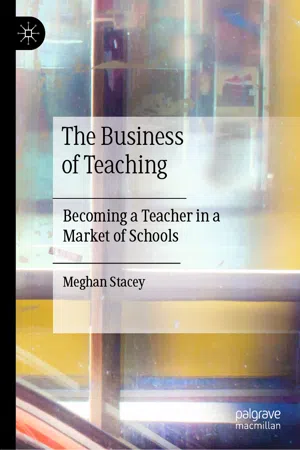
This book explores the experiences of early career teachers in a profession that has become highly stratified by market processes. The author presents New South Wales, Australia as a case study: a state with a long history of academically selective and private sector schooling, which has become increasingly segregated under a series of neoliberalised policy reforms since the 1980s. The experiences of teachers in this book are rich and varied, from a variety of different contexts – ranging from public schools enrolling students experiencing significant educational disadvantage to elite independent schools serving much more advantaged student cohorts. Highlighting teachers' experiences in themselves rather than their impact on students, this timely book will be of interest and value to scholars of sociology of education, teachers' work and education policy.
Information
Topic
EducationSubtopic
Education General© The Author(s) 2020
M. StaceyThe Business of Teachinghttps://doi.org/10.1007/978-3-030-35407-7_11. Born into the Business: A Study of the Early Career Teacher as Market Native
Meghan Stacey1
(1)
School of Education, UNSW Sydney, Sydney, NSW, Australia
In 2006, I began the first year of my initial teacher education. I brought with me an ‘apprenticeship of observation’ (Lortie, 1975) in secondary teaching from a public, academically selective school located in suburban Sydney, where I had witnessed and been subject to particular examples of the kind of work that I was now looking to undertake myself. White, female and very much middle-class, I was in many ways a fairly typical candidate for the teaching profession.1 But I was also something that generations of teachers before me had not been: a product of the market.
The past 50 years has been a time of political, social and cultural change around the world. In education, schools are ‘chosen’ by parents and students, operating with more or less resources in their navigation of new and complex systems. These are the systems within which many teachers in the process of beginning their careers have grown up; they are, quite literally, the systems within which they have been schooled. Teaching is and probably always has been a difficult job, and to some degree it is difficult wherever it is done. The evidence presented in this book bears out that fact. But teaching, while always challenging, does not look the same everywhere. In a market-oriented2 system where concentrations of student population are becoming increasingly polarised (Bonnor & Shepherd, 2016b) and the ‘quality’ of teachers and their work is under increasing scrutiny (Mockler, 2018), there is a growing need to look at teaching in context. In this book, I examine the process of becoming a teacher specifically in relation to the system-wide, marketised hierarchy of schools in which teachers now work, with the aim of drawing out often unseen, unacknowledged and under-appreciated connections between system, structure, student and teacher.
This opening chapter fulfils a number of functions. First, I explore the unique historical position that early career teachers around the world, and in Australia and the state of NSW particularly, are currently in, having been produced by the market-oriented systems of schooling in which they now seek to find work. I outline the broad dimensions of this system as well as the effects it is known to have on educational equity. These effects can be termed ‘second-order effects’, a conceptual structure taken from the work of Stephen Ball which I introduce here and use throughout the book to examine the implications of a market-based system for teachers and their work. Following this, I discuss the current positioning of teachers in Australia as a focus of policy intervention. The chapter then presents the complementary theoretical tools of the work of Pierre Bourdieu, also used throughout the book, before outlining the methodological approach taken in the study.
Teachers and Markets in Australian Schooling
Teachers in Australia have a wide and complex employment terrain to navigate. With the states retaining responsibility over education after Federation (Cranston, Kimber, Mulford, Reid, & Keating, 2010), public education has historically been a state-based endeavour. The federal government , on the other hand, came to assume primary responsibility for the private sector, although this settlement has been eroding, with growing federal intrusion into a range of schooling matters since the 1970s (Campbell & Proctor, 2014). The private sector consists of both systemic Catholic schools and independent schools , with most of the latter also having religious affiliations. Overall, school education in Australia is therefore a shared responsibility between federal and state governments as well as private concerns, in particular the Catholic Church. A divided schooling system since its inception, this has been exacerbated over the past 50 years with the rise of neoliberal ‘choice’ policy leading to growing diversification of both private3 and public school ‘options’. Today, Australia is known as an extreme case of marketisation when considered on a global scale (Windle, 2015). It is this system within which Australia’s new teachers, by and large, have grown up. It is this system within which they have conducted their ‘apprenticeship of observation’ (Lortie, 1975), picking up on what schooling is and should be; its purpose, role and function.
Teachers are likely to have experienced particular extremes within this market landscape because, especially when compared internationally, the Australian private schooling sector is quite large (Nous Group, 2011). It is therefore unusual in its scale, but it is also unusual in its nature. With virtually all schools subsidised to some extent by federal and state governments , the private sector remains largely government-dependent. More than half of private sector schools have been shown to rely on the government for more than 50% of their funding (Musset, 2012). Recently, and since the move to a new, shifting and supposed-to-be ‘needs-based’ funding model in 2013, independent and Catholic sector schools in the state of NSW actually receive a higher percentage of the base Schooling Resource Standard4 through combined government funding than public sector schools (Goss & Sonnemann, 2016); a recent analysis by the national Australian Broadcasting Corporation or ABC, highlights the enormous disparities in wealth between the sectors, and also finds that public funding for some advantaged private schools has been increasing much more than for some public schools (Ting, Palmer, & Scott, 2019). These details are important as although many countries have shifted to choice systems, they differ greatly according to the way in which their private school ‘options’ are situated in relation to government requirements and funding (Dronkers & Avram, 2015; Koinzer, Nikolai, & Waldow, 2017). In some ways Australia could be described, using the categorisations of Dronkers and Avram (2015), as having a relatively strict form of control of private sector schools through adherence to a national curriculum and all teachers needing to be accredited.5 Australian private schools do, however, have greater flexibility related to staffing decisions and pay. It is also important to note that despite being publicly subsidised, the private sector is not subject to governmental constraints in relation to the charging of student fees. These fees can be substantial and are also growing, with the cost of education for the consumer reported to be “outstripping inflation” over the past ten years (Rowe, 2017a, p. 89). While generally enrolling relatively more advantaged students than the public sector (Lamb, Jackson, Walstab, & Huo, 2015), however, the private sector nevertheless consists of a wide variety of schools, including older private schools known to be highly exclusive, newer Christian schools which can be lower-fee and Catholic schools which range from those which are elite, independent and high-fee, to those which are local, systematised and often relatively low-fee (Campbell et al., 2009). As noted above, the sector has also been growing: while approximately 73% of students were enrolled in public schools in 1988, this market share had shrunk to around 66% by 2018 (Australian Bureau of Statistics, 2019). Overall, there is greater differentiation within the secondary school market, with the proportion of public school enrolment more like 59% (Rowe, 2017b). As such, the study presented in this book focuses only on secondary teachers.
Differentiation in the employment landscape of secondary schooling is also a feature of the public sector, which despite the increasing popularity of private schooling remains the most common employment context. Although teachers generally apply to the public sector overall rather than particular schools, recent devolutionary initiatives are opening this up considerably (se...
Table of contents
- Cover
- Front Matter
- 1. Born into the Business: A Study of the Early Career Teacher as Market Native
- 2. Who Are Our Teachers?
- 3. Teachers’ Work Within the Market: Cases from Schools in the Lower-Tier
- 4. Teachers’ Work Within the Market: Cases from Schools in the Mid-Tier
- 5. Teachers’ Work Within the Market: Cases from Schools in the Upper-Tier
- 6. Supporting Early Career Teachers Across the Market
- 7. A Bad Business: Implications of the Market for Teachers and Systems
- Back Matter
Trusted by 375,005 students
Access to over 1.5 million titles for a fair monthly price.
Study more efficiently using our study tools.
Frequently asked questions
Yes, you can cancel anytime from the Subscription tab in your account settings on the Perlego website. Your subscription will stay active until the end of your current billing period. Learn how to cancel your subscription
No, books cannot be downloaded as external files, such as PDFs, for use outside of Perlego. However, you can download books within the Perlego app for offline reading on mobile or tablet. Learn how to download books offline
Perlego offers two plans: Essential and Complete
- Essential is ideal for learners and professionals who enjoy exploring a wide range of subjects. Access the Essential Library with 800,000+ trusted titles and best-sellers across business, personal growth, and the humanities. Includes unlimited reading time and Standard Read Aloud voice.
- Complete: Perfect for advanced learners and researchers needing full, unrestricted access. Unlock 1.5M+ books across hundreds of subjects, including academic and specialized titles. The Complete Plan also includes advanced features like Premium Read Aloud and Research Assistant.
We are an online textbook subscription service, where you can get access to an entire online library for less than the price of a single book per month. With over 1.5 million books across 990+ topics, we’ve got you covered! Learn about our mission
Look out for the read-aloud symbol on your next book to see if you can listen to it. The read-aloud tool reads text aloud for you, highlighting the text as it is being read. You can pause it, speed it up and slow it down. Learn more about Read Aloud
Yes! You can use the Perlego app on both iOS and Android devices to read anytime, anywhere — even offline. Perfect for commutes or when you’re on the go.
Please note we cannot support devices running on iOS 13 and Android 7 or earlier. Learn more about using the app
Please note we cannot support devices running on iOS 13 and Android 7 or earlier. Learn more about using the app
Yes, you can access The Business of Teaching by Meghan Stacey in PDF and/or ePUB format, as well as other popular books in Education & Education General. We have over 1.5 million books available in our catalogue for you to explore.