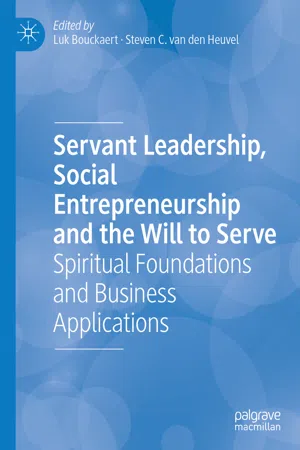
This book brings together a number of important essays on the intersection of servant leadership and social entrepreneurship, examining them through a shared focus on 'the will to serve'. This combination bears out the insight that inspiring social and economic leaders are able to transform a conflictual human settlement into a collaborative and caring human community. The book seeks to answer the question of whether we can induce from their 'way of doing things' a model of civic entrepreneurship and leadership that can inspire people in profit, non-profit and public organizations. It also examines the extent to which the will to serve is compatible with the will to maximize profit or the will to gain economic, political or religious power. Furthermore, it asks how far different spiritual traditions create different models and examples of servant leadership and social entrepreneurship. This book will be of interest to researchers working in the fields of business ethics, business spirituality and corporate social responsibility.
eBook - ePub
Servant Leadership, Social Entrepreneurship and the Will to Serve
Spiritual Foundations and Business Applications
- English
- ePUB (mobile friendly)
- Available on iOS & Android
eBook - ePub
Servant Leadership, Social Entrepreneurship and the Will to Serve
Spiritual Foundations and Business Applications
About this book
Information
© The Author(s) 2019
L. Bouckaert, S. C. van den Heuvel (eds.)Servant Leadership, Social Entrepreneurship and the Will to Servehttps://doi.org/10.1007/978-3-030-29936-1_11. The Will to Serve: An Anthropological and Spiritual Foundation for Leadership
Patrick Nullens1
(1)
Evangelische Theologische Faculteit, Leuven, Belgium
1.1 Introduction
The will to serve is the “rock on which a good society is built” (Greenleaf 2002, p. 62), according to Robert K. Greenleaf (1904–1990), founder of the Servant-Leadership (SL ) model.1 Service precedes leadership, and what we urgently need are servant leaders in serving institutions. This “serving first” is a radical moral position, a powerful paradox which needs to penetrate different leadership roles, styles, and cultural contexts. In this sense, SL functions as a metatheory at best, or a moral corrective for other leadership models at worst.2 I position myself in the latter group, considering SL to be a moral corrective while not excluding the wisdom of other leadership models. Good leadership is moral leadership (Ciulla 2003; Johnson 2009) and nowadays there are quite a few valid models of moral leadership of which SL is one.3 Like every other model, SL is not gospel and has its limitations,4 yet its daring prioritization of “the will to serve” is inspiring. This applies particularly to the present, in light of the way in which our leaders are selected and the way that institutions operate in a highly competitive market. SL is like a prophetic voice, a word of wisdom that needs to be heard.
From the outset, Greenleaf positioned his views more in the area of practical wisdom than in the domain of scholarship. SL is the result of a unique interaction between deep thinking and practical experience on the work floor. These are different approaches, and a subtle interaction between the two turned out to be fruitful. But, ultimately, his views are based on a long and broad international experience, watching and talking to able practitioners, rather than engaging with academia (Greenleaf 2002, pp. 15–17). This has to be borne in mind when reading and evaluating the ideas expressed in his book on SL that has the telling subtitle: A Journey into the Nature of Legitimate Power & Greatness. It is a journey, a search for the essence of power that is morally legitimate and great or good.5
This essay is a conceptual reflection on the primacy of the “will to serve.” I will engage with this theme as a theological ethicist from an evangelical Protestant tradition. For this critical engagement, I use a dialogical method called “eristic theology” by the German theologian Emil Brunner (1889–1966). The term eristic derives from the Greek erizein, which means “to wrangle,” “to debate,” or “to agree and disagree.” In this method, theological anthropology forms the main point of connection, or starting point [Anknüpfungspunkt] (Brunner 1981, pp. 171–193).6
The outline of my argument is the following. First, I give a short introduction to the foundations of SL according to Greenleaf. Second, I point out that the willingness to serve as an indispensable qualification to lead is a valid theological position. Third, after having set this basic framework, I will engage from the perspective of theological anthropology whereby I expose SL’s overconfidence in altruism. Finally, I address the spiritual dimension of SL, yet largely neglected by later more evidence based SL models.
1.2 “Serving First,” the Key to Greatness
Servant Leadership: Practical Wisdom and a Journey
During his earlier studies as an engineer, Greenleaf had become interested in larger institutions and their potential to become forces for the common good. He believed that this much-needed ethical change could only happen through the way in which these institutions were led (Greenleaf 2002, p. 16). This is partly why Greenleaf opted to work in a large business context, since companies were at the frontier of society. For 40 years he worked at AT&T, at the time the world’s largest telephone and cable television company. When he joined the company in the 1920s, more people were employed by AT&T than by any other business in the world: more than a million people (Greenleaf 2002, p. 16). It is noteworthy that the origins of the SL movement are in commercial business and not, as one might expect, in the softer nonprofit sector.
The inspiration and narrative paradigm of Greenleaf’s work was provided by Herman Hesse’s novel Journey to the East (1932) and its main character Leo. It is a story about a group called “the league,” which goes on a pilgrimage. Leo takes care of the luggage, cooks the meals, does the cleaning, and serves in all kinds of practical ways. One day Leo disappears and, as a result, the group disperses and the pilgrimage becomes a failure. In desperation, the narrator, a member of the group, starts to look for Leo in the desert. When he finally finds him, he discovers that Leo is actually the leader of the mystical order that sponsored their pilgrimage. This humble servant was the guiding spirit, the noble leader of the whole enterprise. It is remarkable that through the device of a simple narrative a whole paradigm on leadership and authority emerges. The simple fact that the leader was at first a servant became the key to his greatness (Greenleaf 2002, p. 21).7
Serving First
SL can be categorized as an ethical leadership theory, which means that morality is not just an a posteriori corrective concept or a set of deontological boundaries but is central to leadership itself. SL is boldly altruistic, as it puts the needs of the follower(s) before the needs of the leader(s). It starts from a natural desire to serve and, only secondly, a conscious choice to lead. This order is crucial for the theory. SL is more an attitude or a lifestyle than a model. Servant leaders can be spotted by the fact that the people around them grow as persons and become servants themselves (Trompenaars and Voerman 2009). Terms such as civility, community, trust, and even love characterize the working relationship between leader and follower.
Greenleaf does not offer us all the characteristics of SL neatly in bullet point format. However, the ten attributes listed by Larry Spears (1998) are commonly used as a summary, even though they partially overlap sometimes: (1) listening, (2) empathy, (3) healing, (4) awareness, (5) persuasion, (6) conceptualization, (7) foresight, (8) stewardship, (9) commitment to growth of people, and (10) building community. To these “humility” can be added, which is mentioned in other surveys.8
Greenleaf was as much interested in “followership” as in leadership. He complains that insufficient attention is given to the topic of followership in general education, and as a consequence, leadership is accorded to the wrong people. Another consequence of this lack of education is that “the outlook for better leadership in our leadership-poor society is not encouraging” (Greenleaf 2002, p. 18). What is actually needed is a culture shift. Yet, Greenleaf (2002, pp. 23–24) is hopeful and can observe a change:
A new moral principle is emerging, which holds that the only authority deserving one’s allegiance is that which is freely and knowingly granted by the led to the leader in response to, and in proportion to, the clearly evident servant stature of the leader. Those who choose to follow this principle will not casually accept the authority of existing institutions. Rather, they will freely respond only to individuals who are chosen as leaders because they are proven and trusted as servants.
The Legacy of SL
Greenleaf’s SL model has been around for almost 50 years and continues to be discussed in leadership textbooks as a valid model (Hackman and Johnson 2009; Northouse 2018), even though the empirical research is limited (Van Dierendonck 2011; Parris and Peachey 2013). This altruistic model has also earned its place as a respected management model within the world of corporate businesses and large organizations. An important reason for renowned companies such as Starbucks, Herman Miller, Service Master Company, Southwest Airlines, and AT&T choosing to implement many aspects of SL is that it delivers durable profits while creating a congenial workplace. The SL model is widely taught in colleges, business schools, and universities. SL is combined with many different aspects of leadership. For example, there is an important link between SL and a learning and innovative organization (Rai and Prakash 2012).
In the foreword to Greenleaf’s SL 25th anniversary edition (2002), Steven Covey praises the model as the best management style in the competitive reality of today’s global marketplace. In a context which “absolutely insists on quality at low costs … the only way to do that is through empowerment of people” (p. 2). According to Covey (Greenleaf, 2002, pp. 3–4), the underlying idea is that the SL model is in accordance with common sense: natural laws that are self-evident and universal. Accordingly, companies that follow these principles are efficient and competitive, and therefore endure. This economic and functional appreciation might be valid and is indeed a powerful argument. Yet the utilitarian argumentation based solely on efficiency and results reduces the profound meaning of SL as a radical social counterforce. Its case is built too exclusively on the idea that “ultimately, ethics pays,” where “paying” means “maximizing profit.”
1.3 “Thou Shalt Serve,” a Moral Code
Serving First in Judeo-Christian Ethics
As just another model in leadership studies, using the tools of social sciences and organizational studies, SL is one option among many. But there are good reasons for this model gaining so much currency, at least in theory, among Christians, (Agosto 2005; Moore 2005; Blanchard and Hodges 2008; Shirin 2014; Roberts 2016).
The primacy of agape (love) forms the foundation of all Christian ethics. There is this one summary, one double commandment which summarizes the whole Torah:...
Table of contents
- Cover
- Front Matter
- Part I. Philosophical and Spiritual Foundations
- Part II. Social Entrepreneurship: Serving the Common Good
- Part III. Servant Leadership in the Context of Business
- Back Matter
Trusted by 375,005 students
Access to over 1.5 million titles for a fair monthly price.
Study more efficiently using our study tools.
Frequently asked questions
Yes, you can cancel anytime from the Subscription tab in your account settings on the Perlego website. Your subscription will stay active until the end of your current billing period. Learn how to cancel your subscription
No, books cannot be downloaded as external files, such as PDFs, for use outside of Perlego. However, you can download books within the Perlego app for offline reading on mobile or tablet. Learn how to download books offline
Perlego offers two plans: Essential and Complete
- Essential is ideal for learners and professionals who enjoy exploring a wide range of subjects. Access the Essential Library with 800,000+ trusted titles and best-sellers across business, personal growth, and the humanities. Includes unlimited reading time and Standard Read Aloud voice.
- Complete: Perfect for advanced learners and researchers needing full, unrestricted access. Unlock 1.5M+ books across hundreds of subjects, including academic and specialized titles. The Complete Plan also includes advanced features like Premium Read Aloud and Research Assistant.
We are an online textbook subscription service, where you can get access to an entire online library for less than the price of a single book per month. With over 1.5 million books across 990+ topics, we’ve got you covered! Learn about our mission
Look out for the read-aloud symbol on your next book to see if you can listen to it. The read-aloud tool reads text aloud for you, highlighting the text as it is being read. You can pause it, speed it up and slow it down. Learn more about Read Aloud
Yes! You can use the Perlego app on both iOS and Android devices to read anytime, anywhere — even offline. Perfect for commutes or when you’re on the go.
Please note we cannot support devices running on iOS 13 and Android 7 or earlier. Learn more about using the app
Please note we cannot support devices running on iOS 13 and Android 7 or earlier. Learn more about using the app
Yes, you can access Servant Leadership, Social Entrepreneurship and the Will to Serve by Luk Bouckaert, Steven C. van den Heuvel, Luk Bouckaert,Steven C. van den Heuvel in PDF and/or ePUB format, as well as other popular books in Business & Business Ethics. We have over 1.5 million books available in our catalogue for you to explore.