This book identifies, in contemporary fiction, a new type of novel at the interface of science and the humanities, working from the premise that a shift has taken place in the relations between the two cultures in the last two or three decades. As popular science comes to assume an ever greater cultural significance, contemporary authors are engaging in new ways with ideas that it disseminates. A new literary phenomenon is emerging, in which the focus on language-based theories of the self and the world that has been predominant in the latter half of the previous century is making way for a renewed commitment to the material facts, both of human existence and the universe beyond subjectivity. The book analyses the work of Martin Amis, William Boyd, David Lodge, Richard Powers, Michel Houellebecq, Jonathan Franzen, Margaret Atwood, and Ian McEwan, revealing the ways in which these 'third culture novels' negotiate the relationship between literature and science.
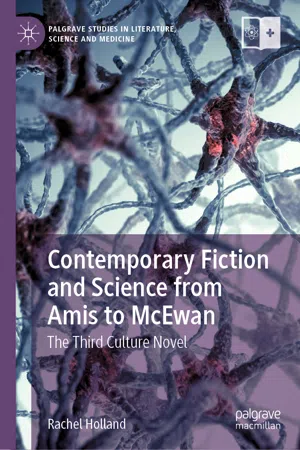
eBook - ePub
Contemporary Fiction and Science from Amis to McEwan
The Third Culture Novel
- English
- ePUB (mobile friendly)
- Available on iOS & Android
eBook - ePub
About this book
Information
© The Author(s) 2019
R. HollandContemporary Fiction and Science from Amis to McEwanPalgrave Studies in Literature, Science and Medicinehttps://doi.org/10.1007/978-3-030-16375-4_11. Introduction
The novel is a medium which is constantly adapting. It possesses the ability to absorb material from an array of sources, incorporating and modifying this material to suit its purposes. Perhaps more so than any other art form, the novel has roamed across discursive boundaries throughout its history, stretching, yet never quite undermining, the definitions which sustain it. Mikhail Bakhtin, in his work in the 1930s, famously outlined the impurity and omnivorousness of novelistic discourse. His concept of heteroglossia describes the ceaseless variety of different types of languages which circulate in culture—languages which are informed by diverse world views, values and meanings, always existing in dialogue with each other. The novel, for Bakhtin, allows this dialogue to take place within its pages, where the languages of heteroglossia ‘all may be juxtaposed to one another, mutually supplement one another, contradict one another and be interrelated dialogically’.1 In contrast to this plurality, ‘the entire methodological apparatus of the mathematical and natural sciences is directed toward mastery over mute objects, brute things, that do not reveal themselves in words, that do not comment on themselves’ [italics in original].2
This book will trace the emergence of a new phenomenon in contemporary Western fiction, one in which authors attempt to incorporate scientific conceptions of mute objects and brute things into the space of the novel, in a manner and to an extent not previously witnessed. What I am calling the third culture novel is, in part, a response to the upsurge in interest, most apparent in the last two to three decades, in popular science. Associated with the work of Martin Amis, William Boyd, Richard Powers, David Lodge, Michel Houellebecq, Jonathan Franzen, Margaret Atwood and Ian McEwan, this new strand of fiction engages with elements of popular science in a number of ways. These include: researching and relaying information gleaned from scientific publications; challenging or promoting ideas presented by science writers; exploring the moral and ethical implications of these ideas; and testing the limits and capabilities of the novel in relation to scientific discourse.
This study will argue that the status and significance of science have undergone a marked and ongoing process of change in the period under discussion, and that this change has impacted upon the novel, particularly the serious literary novel, to a large degree. As elements of science mutate and expand to trespass upon the territory of the novel, the novel conducts a form of counter-attack through its requisitioning of certain aspects of science. The third culture novel incorporates material from neuroscience, genetics, artificial intelligence, pharmacology, cosmology, mathematics and physics, but it also conducts a dialogue with a particular conception regarding the claims to certainty and objectivity associated with science, sometimes over-simplifying or subsuming all of science under this interpretation. The more radical concepts emerging from quantum theory in the twentieth century are largely overlooked or sidelined in the third culture novel, and instead, it is the more traditional truth claims of science which are of interest to these authors.3 Dominic Head notes the presence in contemporary fiction of ‘an anxiety about the function of the novel that has been brewing for a significant period of time, through modernity and into postmodernity’.4 I would suggest that this anxiety is intensified by the increasing and altering social significance of science, which, while on the one hand offering creative opportunities for writers, threatens to appropriate the traditional concerns of the novel on the other.5
The term ‘third culture’ is one which originates, it seems, with C. P. Snow as a response to criticism of his lecture, outlined below, on the lack of understanding between the two cultures of science and the humanities as they stood in 1959. The social sciences, for Snow, represented an opportunity for combining aspects of what he had previously characterized as two cultures. The term did not, despite Snow’s wishes, become associated with the social sciences, and since Snow’s initial postulating of it, the label ‘third culture’ has resurfaced numerous times as something of a utopian ideal, in which a discourse is imagined based on combining the strengths and capabilities of the traditional two cultures. The term has been used by Charles Davy, John Brockman, E. S. Schaffer, Kevin Kelly and Curtis D. Carbonell, in each case as a title for a book or essay, and in each case also as a label designed by these writers to describe a vision of a future direction (perhaps already in its nascent stages) which will, in their view, benefit our too-rigidly binary culture. The novelists studied here do not consciously or intentionally ally themselves with these various attempts at achieving and labelling a third culture, yet the urge to create a new, less-restricted discourse, one that draws on elements of science and the humanities, is the same.
The third culture novel is engaged in a discursive tussle with certain aspects of science, which are in turn competing with elements of humanities culture. The prize for both disciplines is what they perceive to be a third space which encompasses important ideas from both cultures, yet transcends the limits associated with either one in isolation. Third culture novels attempt to constitute this separate, omniscient space, asserting their belief in the unique capabilities of literature in the process. This introduction will provide an outline picture of some important aspects of the relationship between science and humanities culture as it stands at present, revealing the ways in which this relationship informs the themes and concerns of the third culture novel. It will also interrogate and problematize some of the ways in which the term ‘science’ is being used, and some of the uses to which the term is being put, in contemporary culture.
Two Cultures Revisited
The sciences and the humanities have not always been conceived in terms of the binarism to which we have now become accustomed. Various cultural commentators date the commencement of tensions between the two cultures at differing times, but what they agree upon is, in Stefan Collini’s words, that ‘throughout the Middle Ages and Renaissance the interpretation of nature was generally regarded as but one element in the all-embracing enterprise of “philosophy”’.6 In fact, the term ‘scientist’ was not a part of common usage until as late as the 1830s or 1840s, when it came to represent specialized practice in the natural sciences. John Cartwright and Brian Baker focus on the relations between science and literature in particular, suggesting that ‘the very boundaries between [the two] shift and weaken as we travel back earlier than the eighteenth century’, when both disciplines operated under a broader conception of knowledge.7 Most commentators mirror Cartwright and Baker’s approach, which is to posit the existence of several ‘episodes’ in which ‘the sense of a fundamental opposition’ between the two cultures has been ‘felt and aired’ (p. 265). The five most important of these episodes can be summarized, in very simplified terms, as follows:
- The Quarrel of the Ancients and the Moderns in the late seventeenth century, which Jonathan Swift satirized in his 1704 Battle of the Books. Swift depicted a tale of anthropomorphized tomes in St. James’s Library, which he set at war with one another in order to represent the opposing viewpoints of the scientifically minded ‘moderns’, such as Francis Bacon, who championed new discoveries and the power of reason, versus the classically trained ‘ancients’ who stood for the wisdom and insights of the past.
- The Romantic revolution of the late eighteenth and early nineteenth centuries, wherein a cultural anxiety could be detected regarding the growing influence of the utilitarian preference for measurement and practicality, perceived as being the enemy of imagination and natural morality. A certain romantic concern about science is expressed by Wordsworth’s description of ‘our meddling instinct’ which would ‘murder to dissect’ in his poem “The Tables Turned” (1798).
- The debate between Matthew Arnold and T. H. Huxley concerning the relative value of an education focussed on the sciences or the humanities in the second half of the nineteenth century. Arnold responded to assertions from the well-known biologist that training in the sciences was more desirable for society than the prevailing classicism which he saw Arnold as representing by claiming that all of the most worthwhile scientific texts fell under the rubric of literature.
- The Snow/Leavis controversy of the late 1950s and early 1960s, which, for most, encapsulates the major issues surrounding any historical or ongoing debate between the two cultures. C. P. Snow, a physical chemist as well as a novelist, sparked an unintended row with the literary critic F. R. Leavis when he bemoaned, in a public lecture at Cambridge in 1959, the lack of communication and understanding between the sciences and the humanities. Snow and Leavis both made exaggerated and, at times, inaccurate claims in a series of lectures and essays, but, as the first chapter of this study will outline, their debates struck a cultural chord which continues to resonate.
- The Science Wars of the 1990s in which a small number of the scientific community took issue with what they regarded as the fashionable but risible claims of a small number of scholars from the broadly postmodern humanities, which would relegate the truth claims of science to an equal (and equally constructed) status with all other forms of discourse. In a similar manner to the Snow/Leavis controversy, the significance of the science wars has tended to become over-inflated, and the viewpoints from either side of the two cultures divide over-simplified.
What all of the above examples reveal is best described by Patricia Waugh’s assertion that relations between the two cultures have, historically, been the most strained when ‘one form of knowledge lays claim to the exclusive title to all knowledge’.8 Each of these ‘episodes’ is undergirded by fear on the part of representatives of one or both of the two cultures concerning what they perceive to be the imperialist ambitions of their counterparts. This book will argue that the contemporary moment is witnessing a further such episode, in which members of the scientific community are appropriating methods and concepts more traditionally associated with humanities culture in order to aid the creation of a system of values and beliefs based on the ennoblement of science.
Transcendental Scientism
When asked by the Guardian Weekend Magazine, in an interview carried out in October 2014, what his chosen superpower would be, the physicist and media don Professor Brian Cox replied that he would wish ‘to make everyone think rationally’.9 The most cursory interrogation of this statement serves to highlight the many ethical and practical issues raised by Cox’s choice (a Marxist, e.g., might suggest that it would be rational for the successful television presenter to redistribute his wealth a...
Table of contents
- Cover
- Front Matter
- 1. Introduction
- 2. Two Cultures in Competition: Martin Amis’s The Information and Brazzaville Beach by William Boyd
- 3. The Postneuronovel: Galatea 2.2 by Richard Powers and Thinks… by David Lodge
- 4. Michel Houellebecq and the Possibilities of Fiction
- 5. Scientific Transcendentalism: Jonathan Franzen’s The Corrections and Oryx and Crake by Margaret Atwood
- 6. Ian McEwan and the Aeroplane View
- 7. Conclusion
- Back Matter
Trusted by 375,005 students
Access to over 1.5 million titles for a fair monthly price.
Study more efficiently using our study tools.
Frequently asked questions
Yes, you can cancel anytime from the Subscription tab in your account settings on the Perlego website. Your subscription will stay active until the end of your current billing period. Learn how to cancel your subscription
No, books cannot be downloaded as external files, such as PDFs, for use outside of Perlego. However, you can download books within the Perlego app for offline reading on mobile or tablet. Learn how to download books offline
Perlego offers two plans: Essential and Complete
- Essential is ideal for learners and professionals who enjoy exploring a wide range of subjects. Access the Essential Library with 800,000+ trusted titles and best-sellers across business, personal growth, and the humanities. Includes unlimited reading time and Standard Read Aloud voice.
- Complete: Perfect for advanced learners and researchers needing full, unrestricted access. Unlock 1.5M+ books across hundreds of subjects, including academic and specialized titles. The Complete Plan also includes advanced features like Premium Read Aloud and Research Assistant.
We are an online textbook subscription service, where you can get access to an entire online library for less than the price of a single book per month. With over 1.5 million books across 990+ topics, we’ve got you covered! Learn about our mission
Look out for the read-aloud symbol on your next book to see if you can listen to it. The read-aloud tool reads text aloud for you, highlighting the text as it is being read. You can pause it, speed it up and slow it down. Learn more about Read Aloud
Yes! You can use the Perlego app on both iOS and Android devices to read anytime, anywhere — even offline. Perfect for commutes or when you’re on the go.
Please note we cannot support devices running on iOS 13 and Android 7 or earlier. Learn more about using the app
Please note we cannot support devices running on iOS 13 and Android 7 or earlier. Learn more about using the app
Yes, you can access Contemporary Fiction and Science from Amis to McEwan by Rachel Holland in PDF and/or ePUB format, as well as other popular books in Literature & Literature General. We have over 1.5 million books available in our catalogue for you to explore.