- English
- ePUB (mobile friendly)
- Available on iOS & Android
eBook - ePub
About this book
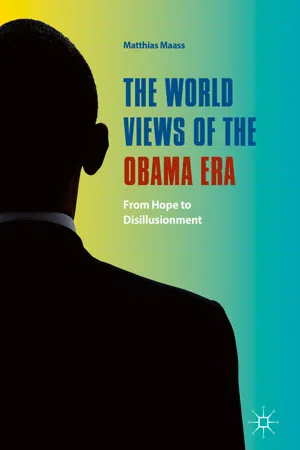
This book presents selected non-US views of the Barack Obama administration. Each chapter investigates eight years of the Obama presidency from a different national perspective. By bringing together fourteen country studies from all regions of the world, this volume offers an accumulative global view of the Obama White House's foreign policies and bilateral affairs. It provides an outside perspective on a presidency that was initially greeted with much enthusiasm world-wide, but seemed to fall out of favor over time in most countries. The overwhelming hope that was associated with the election of Obama in 2008 turned to disillusionment world-wide; the changes in US external affairs he promised were only partially fulfilled and the world was reminded that America's place and role in the world would not change dramatically, not even under the inspirational Obama.
Information
© The Author(s) 2018
Matthias Maass (ed.)The World Views of the Obama Erahttps://doi.org/10.1007/978-3-319-61076-4_11. “The World Views” of Barack Obama
Matthias Maass1
(1)
Yonsei University, Seoul, Korea
Matthias Maass
From Hope and Anticipation to Disillusionment and Disappointment
The Plan of the Book
Road Map
Matthias Maass
is Associate Professor of International Relations at Yonsei University’s Graduate School of International Studies in Seoul, Korea, where he teaches International Relations Theory and International Public Law. He has held professorial positions in Singapore, Hawai’i, France, and Vietnam. He received his PhD from the Fletcher School of Law and Diplomacy/Tufts University. He is the author of a monograph and editor of two multi-author volumes and has written articles for a variety of academic journals worldwide. In addition to Northeast Asian security, he is interested in the small state, US politics, and international law.
In late 2008, the US chose Barack Obama as its 44th president and, as I observed then, “[t]he world approved.”1 This current volume is the analytical “bookend” to the previous cooperative study. Then, the task was to capture the world views on the US presidential election. The claim was that the US-American election was indeed a global election in the sense that it was watched and evaluated across the world. Its anticipated effects globally made it in fact a global event.
In early 2017, the Obama presidency ended, and now the task is to evaluate the Obama era. As before, the task is to judge the Obama presidency from foreign, non-US perspectives. To be sure, each country is different and its bilateral relations with the US have its unique features. Moreover, different countries can or even must be studied differently and the analytical focus can or must be placed individually. And this is certainly reflected in the chapters below, which use a spectrum of methods, frameworks, and foci. They all, however, speak to the bilateral praxis of relations with the US during the Obama era and evaluate the Obama White House from one particular, foreign perspective.
In fact, over a dozen case studies are compiled here. But they not only offer insights into foreign views on the Obama White House but, when considered collectively, offer a worldview, an outside-in perspective on eight years of US external interactions under President Obama. The claim is that each country studies in itself is valuable, but taken together, they amount to more than the sum of the parts.
In the end, a picture emerges of the world viewing Obama’s record positively but with a sense of disillusionment. Despite much international enthusiasm, Obama was not in a position to effect international change on the scale and with the speed initially hoped for. Much has to do with the “indifferent”2 and “disappointing”3 Obama complained about. Equally, much is due to the limitations to and restrictions of even most well-intended statecraft. Hence, the sober world view that he performed well, and much of any disappointment is due to overly optimistic expectations at the beginning.
From Hope and Anticipation to Disillusionment and Disappointment
When Obama was elected to his first term, he certainly had “the overwhelming support”4 of the world in addition to most of the US electorate’s votes. The international support was to no small degree an expression of disproval of Obama’s predecessor, George W. Bush. As a result, the change of leaders in the White House led to a remarkable improvement in “America’s reputation abroad.”5 Moreover, many foreign observers were looking at the new president as somebody who would now return the US to the benevolent superpower they wished it to be. As The Economist reported in 2009: “Around the world the young new president has become a symbol of what people think American should be.”6
And in fact, Obama seemed to be off to a good start. Once in office, he extended many of his promises of “change”7 to the international world. In his first year, he promised to undo what the world had been most critical of during the Bush administration: ending the wars in Afghanistan and Iraq, closing the prison in Guantanamo Bay, and repairing the relationship with the Arab world. His promises culminated in his speech in Cairo on 4 June 2009, where he laid out a vision for a new foreign policy, leading to a better world. His vision seemed honest and, for many, idealistic but feasible. And in October, after less than a year in office, he received the Nobel Peace Prize.
However, the promises he made and the hopes that he symbolized soon became a burden. Realistically, there was no way he could fulfill all these international expectations. And he had many domestic issues to tackle as well. As a result, reality settled in after the global excitement over his election had settled down. His first year’s record was mixed. Abroad, people were uncertain what to make of it.8 Soon, the realization set in that after all was said and done, Obama was still just a normal president in the historical tradition of the US.9
Uncertainty soon turned into disillusionment. Not only did Obama appear not to return the international affection,10 but he did not live up to expectations. To be sure, keen observers at the time noted that he faced truly “inflated”11 and “absurd expectations.”12 Nevertheless, the expectations were real and he had fostered them himself with speeches, writings, and campaign slogans. But now, global disillusionment began to set in.
The evaporation of hope and anticipation that had followed the election in 2008 was particularly notable in Europe and Africa. In Europe, the highly inflated expectations about how much change new leadership in the White House could bring had to lead to disappointment.13 In a similar fashion, the African hope for a pivot to Africa was overblown. Such optimism stemmed from Obama having a Kenyan father but “was always misplaced.”14 For many African states, the actual record of their bilateral relations with the US and of Obama’s overall Africa policy was twice as disappointing because of the high hopes they had placed in him.15
As Obama steered the US toward normalcy, the world disengaged. In 2011, the Arab Spring largely disregarded the US, its historical role in the region, and its ideological prescriptions.16 The US under Obama was neither the evil force behind all the region’s ills nor the “shining city on a hill”17 to aspire to. And this reflected the overall American attitude quite well. The ideas and ideals the US traditionally stands for remain popular and remain part of America’s self-identity, although US foreign policy continues to favor power and power politics.18
Although hopes were dashed and promises left unfulfilled, and although Obama scaled down America’s involvements and entanglements, worldwide disillusionment did not turn into hostility. In many ways, an underperforming US on the global stage was still much more acceptable than an overambitious and overaggressive America. In this spirit, the world expected Hillary Clinton to accept and protect Obama’s legacy and continue on his international course. In light of this assumption, the election of Donald Trump instead of Clinton in 2016 was the ultimate disappointment.
In fact, most of the world not only disapproved but fell into a state of shock over Trump’s election. It seemed certain that Obama’s legacy would not be handed over to a safe-keeper but would fall into the hands of a political charlatan.
But what is Obama’s legacy? In 2009, when he took office, the US economy and with it the global economy were in danger of sliding toward a worldwide depression. Obama was instrumental in steadying the US economy and preventing a global economic disaster. The dangers were real but his economic achievements can be easily overlooked since success came in the form of preventing something from happening.
Similarly, Obama was successful in rejecting isolationist impulses and keep the US engaged on the world stage. Although it had to pull back in a number of areas, the US did not withdraw from the world stage. Under Obama, the US did not repeat the beggar-thy-neighbor economic policies of the Great Depression of the 1930s. Nor did it give in to isolationist temptations in the international political realms as it had done in the 1920s. Again, Obama’s policy was in line with the expectations of his domestic bases. During the Obama administration, most Americans rejected outright isolationism but were expecting that transatlantic friends and global allies would pick up a larger share of security burden, in particular with respect to military expenditures and potentially humanitarian intervention.19
In two critical areas, the jury is still out: Whether Obama’s decision to keep the US out of the Syrian conflict prevented the US from being sucked into another endless conflict or whether his passivity in the early 2010s made things even worse remains to be seen.20 In a similar way, the evaluation of the Obama White House’s so-called pivot to Asia must wait. The rise of China constitutes a challenge to the US, and whether the pivot to Asia and a re-balancing in the region is the proper response remains to be seen.
Overall, the notion of being seen as a benevolent superpower and cooperative leader remains an attractive and popular idea among Americans,21 and in this sense Obama’s foreign policies had domestic support. America’s military commitments overseas during the first decade of the twenty-first century made it disinclined to entangle itself in new conflicts.22 From the perspective of foreign countries, however, Obama’s refusal to lead a coalition against Muammar Gaddafi’s Libya in 2011 and his unwillingness to commit major US forces to the emerging civil war in Syria of the same year in particular were widely seen as disappointments.
In some areas, Obama failed in or came up short of his own ambition. He failed to end the wars in Afghanistan and Iraq as quick...
Table of contents
- Cover
- Frontmatter
- 1. “The World Views” of Barack Obama
- 2. The Barack Obama Presidency: Cuba
- 3. Nigeria: Views from the Hegemon in West Africa on the Obama Administration
- 4. Obama Delivers for Kenya: On Business
- 5. Egypt and Obama: Turbulent Times, Bouncy Relations
- 6. A Bilan of Eight Obama Years: Between Bush and Trump
- 7. Russia’s View on Obama’s Presidency: From Hope to Disappointment
- 8. Turkish Perceptions of Turkey–US Relations During Obama’s Presidency: Dialectics of Expectations/Partnership and Disappointments/Estrangement
- 9. Israeli View of the Obama Era: A Relationship Reexamined
- 10. Obama’s Legacy: The View from Persia
- 11. Chinese Views of US Foreign Policy under the Obama Administration
- 12. South Korea’s Perceptions of Obama’s Foreign Policy Toward Northeast Asia
- 13. The Obama Era: The View from Indonesia
- 14. Obama and the United States–Pakistan Marriage of Convenience
- 15. India’s Views of the Obama Era: Maturing Defense Partners but Reluctant Asia-Pacific Friends
- 16. The Obama Era in the Eyes of the World: From High Hopes Back to Normalcy
- Backmatter
Trusted by 375,005 students
Access to over 1.5 million titles for a fair monthly price.
Study more efficiently using our study tools.
Frequently asked questions
Yes, you can cancel anytime from the Subscription tab in your account settings on the Perlego website. Your subscription will stay active until the end of your current billing period. Learn how to cancel your subscription
No, books cannot be downloaded as external files, such as PDFs, for use outside of Perlego. However, you can download books within the Perlego app for offline reading on mobile or tablet. Learn how to download books offline
Perlego offers two plans: Essential and Complete
- Essential is ideal for learners and professionals who enjoy exploring a wide range of subjects. Access the Essential Library with 800,000+ trusted titles and best-sellers across business, personal growth, and the humanities. Includes unlimited reading time and Standard Read Aloud voice.
- Complete: Perfect for advanced learners and researchers needing full, unrestricted access. Unlock 1.5M+ books across hundreds of subjects, including academic and specialized titles. The Complete Plan also includes advanced features like Premium Read Aloud and Research Assistant.
We are an online textbook subscription service, where you can get access to an entire online library for less than the price of a single book per month. With over 1.5 million books across 990+ topics, we’ve got you covered! Learn about our mission
Look out for the read-aloud symbol on your next book to see if you can listen to it. The read-aloud tool reads text aloud for you, highlighting the text as it is being read. You can pause it, speed it up and slow it down. Learn more about Read Aloud
Yes! You can use the Perlego app on both iOS and Android devices to read anytime, anywhere — even offline. Perfect for commutes or when you’re on the go.
Please note we cannot support devices running on iOS 13 and Android 7 or earlier. Learn more about using the app
Please note we cannot support devices running on iOS 13 and Android 7 or earlier. Learn more about using the app
Yes, you can access The World Views of the Obama Era by Matthias Maass in PDF and/or ePUB format, as well as other popular books in Politique et relations internationales & Gouvernement américain. We have over 1.5 million books available in our catalogue for you to explore.