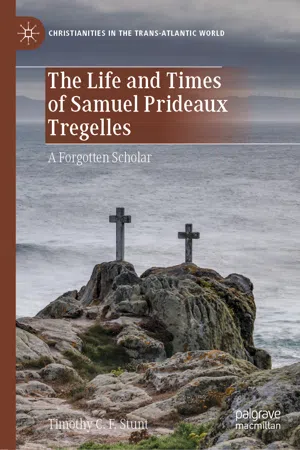
- English
- ePUB (mobile friendly)
- Available on iOS & Android
eBook - ePub
About this book
This book sheds light on the career of Samuel Prideaux Tregelles, and in doing so touches on numerous aspects of nineteenth-century British and European religious history. Several recent scholars have celebrated the 200th anniversary of the German textual critic Tischendorf but Tregelles, his contemporary English rival, has been neglected, despite his achievements being comparable. In addition to his decisive contribution to Biblical textual scholarship, this study of Tregelles' career sheds light on developments among Quakers in the period, and Tregelles's enthusiastic involvement with the early nineteenth-century Welsh literary renaissance usefully supplements recent studies on Iolo Morganwg. The early career of Tregelles also gives valuable fresh detail to the origins of the Plymouth Brethren, (in both England and Italy) the study of whose early history has become more extensive over the last twenty years. The whole of Tregelles's career therefore illuminates neglected aspectsof Victorian religious life.
Information
© The Author(s) 2020
T. C. F. StuntThe Life and Times of Samuel Prideaux TregellesChristianities in the Trans-Atlantic Worldhttps://doi.org/10.1007/978-3-030-32266-3_11. A Falmouth Childhood
Timothy C. F. Stunt1
(1)
Naples, FL, USA
Timothy C. F. Stunt
1.1 Falmouth
When the news of the battle of Trafalgar and the death of Lord Nelson reached England in November 1805, it was the people of Falmouth, in Cornwall, who were the first to learn the news. It may well be asked why a little town like Falmouth was distinguished in this way, rather than one of the great ports like Bristol or Plymouth. The simple answer is that not only is Falmouth the third deepest natural harbour in the world, but it was also the first port of safety available to a British ship entering the English channel in an Easterly direction, especially if it was being chased by a larger French ship —a familiar situation in the eighteenth century and early nineteenth century as the French and the English were at war for much of that period . In fact, on that day in 1805, a larger French vessel was pursuing Captain Lapenotiere, who was carrying the Trafalgar dispatches in a very small schooner, the HMS Pickle, and for him, Falmouth was indeed a place of safety.
But Falmouth was more than just a haven in wartime. During the previous two centuries, it had grown sufficiently in importance to have become the first port of call for the packet service, carrying mail from the United States and other countries. In fact, Falmouth’s distinction as a port had resulted in a significant growth in the town’s trading wealth and prosperity and one family that participated in this process with great success is of particular interest for our purposes.
From the mid-seventeenth century, the Fox family increasingly dominated the commercial and industrial life of Falmouth.1
1.2 Quakers in Falmouth
Although they were not related to George Fox, the founder of the Quaker movement, the family of that name in Falmouth was deeply committed to the principles of the Society of Friends and to their pacifist ideals, which forbad their producing materials that would be used in warfare. Their reputation for probity meant that they were respected as a pre-eminently reliable family with whom to have good commercial dealings, and George Croker Fox’s 2 shipping business was so successful that members of his family acted continuously, from 1792 to 1905, as consuls in Falmouth for the United States as well as a number of other countries.
In examining life in Falmouth during the late eighteenth century and the part played in it by the Quaker element in its population, we are considering the world into which the subject of this book was born in 1813. There is a dearth of contemporary material relating to the early life of Samuel Prideaux Tregelles and his family, but by investigating the society in which he grew up, we can usefully discover something about the circumstances that influenced his early development.
On a smaller scale than the Fox dynasty but nevertheless with some success , the old Cornish family of Tregelles was one of several other Quaker families that throve in Falmouth. In the South West of England, one of the earliest followers of the founder-Quaker, George Fox, had been a tailor John Tregelles (?1627–1706), who in 1676 had married Honoria the daughter of a Spanish immigrant, Nicholas José.3 Imprisoned on more than one occasion in Pendennis Castle and Launceston gaol, for his Quaker convictions,4 Tregelles and his family faithfully maintained the Quaker tradition and the ‘Tregelles meeting house’ is mentioned in the Falmouth records of the late seventeenth century.5
One of John’s great-grandsons was Samuel Tregelles ,6 our subject’s grandfather, who established a rope factory in Ashfield, Budock, on the outskirts of Falmouth, and whose links with the Fox family are well illustrated by the marriage of two of his younger sisters, Elizabeth (1768–1848) and Mary (1770–1835), to Robert Were Fox (1754–1818) and Thomas Were Fox (1766–1844), brothers of George Croker Fox II, whose father’s shipping business we mentioned earlier. It is apparent from the minutes of the Quaker regional monthly meetings that when Samuel Tregelles (the owner of the rope factory) was about thirty-five years old, he was in trouble with the Quaker authorities. In October 1801, he ‘came forward and declared that he had departed from the standard of truth and rectitude’. On consideration of the circumstances, details of which were not recorded, the Quakers disowned him in December for ‘grossly immoral conduct’. When more than two years later, in March 1804 he asked for readmission to the Society, the application remained a matter for discussion for a further six months.7
Of his many children, the eldest son Samuel (1789–1828), the father of our subject, is an elusive figure about whom there is little recorded information. However, his standing among the Falmouth Friends doesn’t seem to have been affected by his father’s misconduct and, a few years later, when he announced (21 November 1810) his intention of marrying Dorothy Prideaux (1790–1873), the Friends monthly meeting (19 December 1810) raised no objection and gave their approval.8
Dorothy Prideaux, whose father George (1744–1815) was a solicitor,9 came from an old Cornish family living in Kingsbridge, Devon. Like the Tregelles family, her ancestors were also Quakers and it was in their meeting house at Kingsbridge that the Quakers regularly held one of their quarterly divisional meetings.10 It is clear therefore that although we have scant information about the childhood of Samuel Prideaux Tregelles, who was born at Wodehouse Place, Falmouth on 30 January 1813, he was from the very outset of his life part of an extended family with long-established Quaker roots, and indeed, the town in which he grew up was significantly characterized by Quaker culture and practice.
A few years before SPT’s birth, his father, together with Lord Wodehouse, planned to build an Almshouse on some land provided by the baron, at the foot of Mount-Sion in Porhan Lane, Falmouth. It was a typically Quaker work of philanthropy, and in 1810, the building was erected, consisting of a row of small tenements, which provided accommodation for ten widows ‘of good character, who have not received parochial relief’.11
Whether this act of conspicuous charity on the part of SPT’s father was an attempt to redeem the family’s reputation is far from clear, especially as we are ignorant of the nature of the older Samuel’s indiscretions, but at this stage, the newly married Samuel Tregelles (SPT’s father) was living up to the expectations to which other worthy Quakers in Falmouth had given rise. The shadow of a future bankruptcy was not yet hanging over the family.
1.3 Years of Uncertainty
On the wider canvas of national and international events, Samuel Prideaux Tregelles was born into a world of anxiety. England had been at war with France for the best part of twenty years, and people who lived on the South Coast could not but be aware of the hostilities. In addition to the possibility that the press gang could arrive at any moment and seize able-bodied men for the naval forces, the war itself was on their doorstep. Quite apart from ships putting into Falmouth, seeking refuge from French men-of-war, there had been the liability of French invasion. The mother of Benjamin Newton, later to be SPT’s close friend and confidante, recalled how when she was living in Falmouth in 1803, many had fled the town, fearing a French raid. Newton himself was five years older than Tregelles, but he too had grown up in a Quaker family on the South Coast of Devon and Cornwall and vividly recalled returning from school, in February 1815, to find his mother, having learnt of Napoleon’s escape from Elba, wringing her hands in despair and exclaiming, ‘Now torrents of blood will be shed’.12
Although Napoleon was finally defeated in 1815 when SPT was only two years old, the post-war years were similarly difficult times. For years, the economy had been on a war-footing and the end of the ...
Table of contents
- Cover
- Front Matter
- 1. A Falmouth Childhood
- 2. A Welsh Interlude
- 3. A Significant Change
- 4. Brethren in Plymouth and Wales
- 5. Textual Criticism and Its Importance for SPT: A Necessary Digression
- 6. Roman Frustrations and European Research
- 7. An Embarrassed Advocate of Brethren in Italy
- 8. Tregelles and Roman Catholicism
- 9. Tregelles and Scripture
- 10. Tregelles and Tischendorf
- 11. Recognition, Controversy and Crisis (1850–1861)
- 12. The Later Years
- 13. A Muted Finale
- Back Matter
Trusted by 375,005 students
Access to over 1.5 million titles for a fair monthly price.
Study more efficiently using our study tools.
Frequently asked questions
Yes, you can cancel anytime from the Subscription tab in your account settings on the Perlego website. Your subscription will stay active until the end of your current billing period. Learn how to cancel your subscription
No, books cannot be downloaded as external files, such as PDFs, for use outside of Perlego. However, you can download books within the Perlego app for offline reading on mobile or tablet. Learn how to download books offline
Perlego offers two plans: Essential and Complete
- Essential is ideal for learners and professionals who enjoy exploring a wide range of subjects. Access the Essential Library with 800,000+ trusted titles and best-sellers across business, personal growth, and the humanities. Includes unlimited reading time and Standard Read Aloud voice.
- Complete: Perfect for advanced learners and researchers needing full, unrestricted access. Unlock 1.5M+ books across hundreds of subjects, including academic and specialized titles. The Complete Plan also includes advanced features like Premium Read Aloud and Research Assistant.
We are an online textbook subscription service, where you can get access to an entire online library for less than the price of a single book per month. With over 1.5 million books across 990+ topics, we’ve got you covered! Learn about our mission
Look out for the read-aloud symbol on your next book to see if you can listen to it. The read-aloud tool reads text aloud for you, highlighting the text as it is being read. You can pause it, speed it up and slow it down. Learn more about Read Aloud
Yes! You can use the Perlego app on both iOS and Android devices to read anytime, anywhere — even offline. Perfect for commutes or when you’re on the go.
Please note we cannot support devices running on iOS 13 and Android 7 or earlier. Learn more about using the app
Please note we cannot support devices running on iOS 13 and Android 7 or earlier. Learn more about using the app
Yes, you can access The Life and Times of Samuel Prideaux Tregelles by Timothy C. F. Stunt in PDF and/or ePUB format, as well as other popular books in History & British History. We have over 1.5 million books available in our catalogue for you to explore.