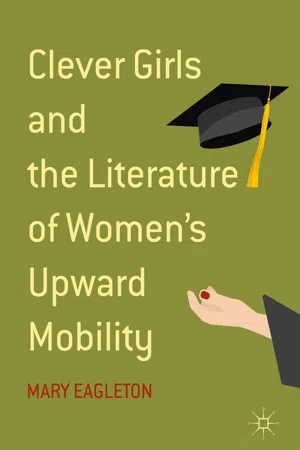
This book follows the figure of 'the clever girl' from the post-war to the present and focuses on the fiction, plays and memoirs of contemporary British women writers. Spurred on by an ethic of meritocracy, the clever girl is now facing austerity and declining social mobility. Though suggesting optimism, a public discourse of 'opportunity', 'aspiration' and 'choice' is often experienced as an anxious and chancy process. In a wide-ranging study, the book explores the struggle to move away from home and traditional notions of femininity; the persistent problems associated with women's embodiment; the pressures of class and racial divisions; the new subjectivities of the neoliberal era; and the generational conflict underpinning austerity. The book ends with a consideration of feminism's place as a phantom presence in this history of clever girls. This study will appeal to readers of contemporary women's writing and to those interested in what has been one of the dominant social narratives of the post-war period from upward to declining mobility.
- English
- ePUB (mobile friendly)
- Available on iOS & Android
eBook - ePub
Clever Girls and the Literature of Women's Upward Mobility
About this book
Information
Topic
LetteraturaSubtopic
Storia sociale© The Author(s) 2018
Mary EagletonClever Girls and the Literature of Women's Upward Mobilityhttps://doi.org/10.1007/978-3-319-71961-0_11. Introduction: The Language of Upward Mobility
Mary Eagleton1
(1)
York, UK
Upward mobility, driven in large measure by education, has been a defining feature of the post-war period in Britain. When Richard Hoggart published The Uses of Literacy in 1957, a figure he considered was someone he called ‘the scholarship boy’.1 To a great extent, Hoggart was drawing on his own experience. Born into poverty in Leeds in 1918, he was orphaned by the age of eight and yet, helped by his elementary school headmaster and a series of scholarships, he went to grammar school, achieved a first-class degree from the University of Leeds and a career of international recognition. In Hoggart’s case, ‘scholarships’ meant hardship grants from the Board of Guardians and the Royal British Legion and an award from the Local Education Authority to attend university. By the time Hoggart’s study was published, though, ‘scholarship’ had a rather different meaning. The Education Act of 1944 had defined secondary education as between the ages of eleven and fifteen, and had established a free tripartite system of grammar schools, a small number of technical schools, and secondary moderns.2 ‘Scholarship’ then came to signify the examination taken at the age of eleven to determine entrance to the grammar schools and this was referred to interchangeably as ‘the scholarship’ or ‘the 11-plus’ or ‘the 11+’. Private schooling continued alongside state provision and, though non-selective comprehensive schools were in existence earlier, it was not until the mid-1960s that their numbers expanded considerably. At this stage, grammar schools became private or were incorporated into the comprehensive system. The figure Hoggart did not think about, however, as many readers have subsequently remarked, is the figure of ‘the scholarship girl’. Morag Shiach’s comment on Raymond Williams—‘Feminists can find much of use to them in the work of Raymond Williams; they cannot, however, find many women’—could easily be transposed to Hoggart.3
It is this female figure who is the focus of this study. She is the scholarship girl, the clever girl, the professional woman or, in some guises, the ‘superwoman’ who ‘has it all’.4 In her millennium and post-millennium incarnations, she is the ‘future girl’ or the ‘top girl’ and now, maybe, the ‘austerity girl’ or the ‘have-not girl’.5 In following this figure from the immediate post-war to the present, I concentrate on the work of British women writers or writers who have made Britain their home, though, as globalisation increases, their focus is sometimes elsewhere. They are, to an extent, telling their own story, not only in the memoirs I discuss but in their novels and plays. Hilary Mantel, Janice Galloway, Andrea Levy and Zadie Smith, for example, have moved from working-class childhoods to middle-class professionalism, and aspects of that experience feature in their work. Equally, all my authors know intimately the role of education in upward mobility or in formulating a new model of femininity and would probably agree with Bruce Robbins’s description of university as ‘the privileged mediator of postwar upward mobility’.6 The hope is that a university degree can lead to professional success, economic stability, even, as in Hoggart’s case, public regard. One version of this narrative, supported by public policies, sees upward mobility as a steady, virtuous, ascending climb. Myth and fairy-tale, on the other hand, delight in magical leaps and transformations; by the end of the story, the girl sweeping the hearth has married the Prince. In our texts, however, we are left in no doubt that the journey is long, arduous, frequently uncertain and at the nexus of challenging and troubled emotions—though, in hard times, characters might cling to the optimism of the fairy-tale.
Like Hoggart , some of our protagonists went to university before the introduction in 1962 of mandatory, but means-tested, student grants. Until then, students without family support pieced together scholarships from various sources, charitable grants and loans. In 1955 there were 22 UK universities. There was some small expansion in higher education at the end of the 1960s with the building of the ‘plate-glass’ universities and a much larger expansion as a result of the 1992 Further and Higher Education Act when the former polytechnics and, later, some colleges of education became universities. By 2017, Universities UK, composed of the heads of UK universities, listed 135 members.7 Equally, there has been a significant change during the period covered by this study in the gender composition of higher education. When the clever girls were going to university in the mid-1950s, women constituted about 25 per cent of the student population and it remained like that until the 1970s. Hilary Land recounts how, in 1961 nine out of ten girls would leave school before the age of eighteen and only one in fifteen went from school to higher education.8 One of the concerns of the Robbins Report in 1963 was that so few girls stayed on at school to take ‘A’ levels even though their performance in exams at sixteen was equal to that of boys. Amongst those girls who did continue at school, half went into teacher training, at that stage a non-graduate profession. In 1950, the overall participation rate in higher education constituted 3.4 per cent and 13,398 men were awarded degrees and 3,939 women.9 But, by 2014, the participation rate generally in higher education had risen to 47 per cent and 184,130 men were awarded degrees against 237,690 women.10 This increase is despite the replacement of grants with a loan system in 1990.
Yet the story of expansion in one sphere confronts contraction in another. Neoliberal governments, from Margaret Thatcher’s onwards, have aimed to reduce government intervention and reduce taxes. Increasingly we have been told that mobility will happen not through any action of the state but through a neoliberal ethic of self-making or through a trickle-down effect from those who have already prospered. This is despite repeated evidence to the contrary. For example, the 2016 State of the Nation report of the Social Mobility and Child Poverty Commission uncompromisingly affirms that ‘[t]he twentieth-century expectation that each generation would be better off than the preceding one is no longer being met’.11 For those, like some of our clever girls, looking for entry to élite professions, the commission’s reports offer no comfort. The 2015 study illustrates that the dominance of people from privileged backgrounds has become more pronounced over the last thirty years rather than less, while the 2016 report points out that ‘only 4 per cent of doctors, 6 per cent of barristers and 11 per cent of journalists are from working-class origins’ (p. xvii).12 David Willetts has a neat way of putting the point: ‘The competition for jobs in the professions is like English tennis, a competitive game, but largely one the middle classes play against each other.’13 Levels of employment have increased since the crash of 2008, but levels of earnings have stagnated and, in an economy eager for maximum labour flexibility, job security and state safety nets are rapidly disappearing. The consequences of an austerity economy are deeply and widely felt. In 2015, the global figures indicated that, amongst waged and salaried workers, fewer than 45 per cent were employed on a permanent, full-time basis and the share is diminishing.14 At the same time, the notion of the university as that ‘privileged mediator’ of upward mobility has come under question. Disadvantaged groups have higher drop-out rates and lower degree attainment than advantaged students.15 In the UK, 58.5 per cent of graduates are in non-graduate employment.16 England now has amongst the highest tuition fees in the world and the highest level of graduate debt, on average over £50,000 and, for stude...
Table of contents
- Cover
- Front Matter
- 1. Introduction: The Language of Upward Mobility
- 2. Escaping Origins
- 3. Relative Values: Career, Marriage, Maternity
- 4. Troublesome Bodies
- 5. New Forms, New Selves
- 6. ‘Top Girls’ and Other Epithets
- 7. ‘The Haves’ and ‘The Have-Nots’
- 8. Coda: Phantom Feminism
- Back Matter
Trusted by 375,005 students
Access to over 1.5 million titles for a fair monthly price.
Study more efficiently using our study tools.
Frequently asked questions
Yes, you can cancel anytime from the Subscription tab in your account settings on the Perlego website. Your subscription will stay active until the end of your current billing period. Learn how to cancel your subscription
No, books cannot be downloaded as external files, such as PDFs, for use outside of Perlego. However, you can download books within the Perlego app for offline reading on mobile or tablet. Learn how to download books offline
Perlego offers two plans: Essential and Complete
- Essential is ideal for learners and professionals who enjoy exploring a wide range of subjects. Access the Essential Library with 800,000+ trusted titles and best-sellers across business, personal growth, and the humanities. Includes unlimited reading time and Standard Read Aloud voice.
- Complete: Perfect for advanced learners and researchers needing full, unrestricted access. Unlock 1.5M+ books across hundreds of subjects, including academic and specialized titles. The Complete Plan also includes advanced features like Premium Read Aloud and Research Assistant.
We are an online textbook subscription service, where you can get access to an entire online library for less than the price of a single book per month. With over 1.5 million books across 990+ topics, we’ve got you covered! Learn about our mission
Look out for the read-aloud symbol on your next book to see if you can listen to it. The read-aloud tool reads text aloud for you, highlighting the text as it is being read. You can pause it, speed it up and slow it down. Learn more about Read Aloud
Yes! You can use the Perlego app on both iOS and Android devices to read anytime, anywhere — even offline. Perfect for commutes or when you’re on the go.
Please note we cannot support devices running on iOS 13 and Android 7 or earlier. Learn more about using the app
Please note we cannot support devices running on iOS 13 and Android 7 or earlier. Learn more about using the app
Yes, you can access Clever Girls and the Literature of Women's Upward Mobility by Mary Eagleton in PDF and/or ePUB format, as well as other popular books in Letteratura & Storia sociale. We have over 1.5 million books available in our catalogue for you to explore.