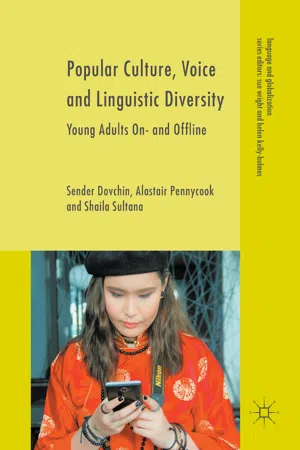
This book analyses the language practices of young adults in Mongolia and Bangladesh in online and offline environments. Focusing on the diverse linguistic and cultural resources these young people draw on in their interactions, the authors draw attention to the creative and innovative nature of their transglossic practices. Situated on the Asian periphery, these young adults roam widely in their use of popular culture, media voices and linguistic resources. This innovative and topical book will appeal to students and scholars of sociolinguistics, applied linguistics, cultural studies and linguistic anthropology.
eBook - ePub
Popular Culture, Voice and Linguistic Diversity
Young Adults On- and Offline
- English
- ePUB (mobile friendly)
- Available on iOS & Android
eBook - ePub
Popular Culture, Voice and Linguistic Diversity
Young Adults On- and Offline
About this book
Information
© The Author(s) 2018
Sender Dovchin, Alastair Pennycook and Shaila SultanaPopular Culture, Voice and Linguistic DiversityLanguage and Globalizationhttps://doi.org/10.1007/978-3-319-61955-2_11. Language, Culture and the Periphery
Sender Dovchin1 , Alastair Pennycook2 and Shaila Sultana3
(1)
Centre for Language Research, University of Aizu, Tsuruga, Japan
(2)
Faculty of Arts and Social Sciences, University of Technology Sydney, Ultimo, NSW, Australia
(3)
Department of English Language, University of Dhaka, Dhaka, Bangladesh
Keywords
Young adultsPopular cultureGlobalizationSociolinguisticsOnline and offline environmentThis book deals with the language of young adults in both online and offline environments . The very fact that we can talk of ‘offline’ environments points to the salience of life online: for many young people today, being online—on Facebook , Twitter, What’s App, texting, chatting, Skyping—is part of everyday life. You do not set aside a time of day to ‘go online’—you simply are online much of the time. It no longer makes sense to view this as some alternative and lesser (virtual) reality: being online is as real as anything else. These online and offline worlds are also interlinked, with offline worlds becoming part of the online and online affecting face to face interactions. So this is the first context of this book: the intertwined worlds of online and offline conversations, postings, comments and chats.
Why young adults ? By and large, this is where the action is, and these are also the people who interest us as educators. These are the people who have grown up with the new technologies , who learned to ‘swipe’ a page at an early age, whose fingers move comfortably across mobile keyboards, messaging, adding emoticons, chatting, watching and multitasking. They are also at an age of flexibility, happy to try stuff out, exploring identities, messing around with language and engaged with popular culture. They are sitting in our university and other classes, watching us (now and then), checking their mobile devices (more often) and living in multiple linguistic , cultural and spatial worlds. These are also the consumers of popular culture , people for whom music , TV dramas, films form not just a backdrop to their daily lives, not just a pastime when they are not doing something else, but a fabric around which parts of their lives are built.
The book is about three particular aspects of this young adult action. First, we are interested in the way they use, mix and mash up language. In line with contemporary trends in sociolinguistics , we no longer view this through a lens of bilingualism or code-mixing, but rather take this use of multiple linguistic resources as the norm. Young people are exposed to and take up a range of linguistic and broader semiotic resources in their daily communications. These young adults are also the drivers of innovation, the setters of new trends, the ones bending the rules, making up the terms and changing the way language works. As they communicate in and across various social groups, these new trends may move rapidly around the globe, getting picked up and passed on from online forum to Twitter account, from YouTube clip to café discussion, while at the same time they may also define subcultural language uses, showing who is in and who is out, who knows how to mess with language and image in this way and who does not.
Second, we are interested in the sources from which they draw these multiple resources. While language classes, travel and other more traditional modes may provide some of the input into their linguistic repertoires , it is a popular culture that plays a major role here. These young adults tend to be highly engaged with music , dance, film , gaming and multiple forms of popular culture, which provide not only content to be discussed or parodied but also voices and linguistic resources . They take up and play with the voices of popular culture, and in so doing gain access to a range of languages, ideas and ways of articulating the world. The linguistic creativity , parody and play, therefore, involve voices, sounds , images and phrases drawn from a variety of cultural forms, from well-known songs to film scenes, from information about sport stars to details about technology.
Third, we are interested in how these relations get played out in the Asian periphery . Much has been made of the diversity brought about by migration to European cities, but much less attention has been paid to the diversity that now occurs in contexts marked by online rather than physical mobility. The Asian focus allows us to turn the attention away from Europe and North America, which are so often the focus of such studies and instead to look at the vibrant and emerging Asian scene, which again, we might suggest is where the action is, as Asian and non-Asian forms of popular culture circulate through the digital pathways. The peripheral focus adds a further dimension to this, allowing us to look in depth at two contexts that have to date received little attention in the literature: Bangladesh and Mongolia . At the same time, this peripheral focus draws attention to questions of access and distribution: Who gets to play around with language and culture in what contexts?
Eye Shopping: güzel çanta
Before exploring these themes of language mixing, popular culture, digital literacies and the periphery in greater detail in the following sections, a couple of examples may serve to show the kind of thing that is going on. Here in Excerpt 1.1, for example, is a Facebook (FB) posting by Altai, a 20-year-old female third-year chemical engineering student at the National University of Mongolia. The examples below have been retrieved from Altai’s daily FB wall status updates, where she actively posts about her daily activities, including the places she has been to or the photographs she has taken, or the movies she has seen (Dovchin 2015) . A general guide to transcription conventions is provided at the end of the chapter, while specific guides to language identification conventions are provided before each excerpt. All data examples were translated from Mongolian and Bangla into English by the authors, and all the names used for the research participants are pseudonyms to protect their real identities.
Excerpt 1.1
Language guide: regular font = Mongolian; italics = English; bold = Turkish; underlined bold = Korean; underlined italics = French
Facebook status | Translation |
|---|---|
1. Altai: Undraa! çok güzel çıkmışsınız tatlım…zondoo unsey hairtai shuu… annesine benziyor…love n miss | Altai: Undraa! you look so pretty sweetie… lots of kisses love you…looking like your mother love n miss |
2. Altai: Ai syopping @ Louis Vitton… güzel çanta… | Altai: Window shopping @ Louis Vuitton…lovely bags… |
In the first line, Altai uploads a photograph of her friend (Undraa) with a caption combining Turkish and Mongolian in Roman script and a popular transnational online phrase ‘love n miss’ to show affection. This is a typical example of her Facebook repertoire, where the extensive incorporation of Turkish is often integrated either with Mongolian or English resources. As will become clear throughout this book, the identification of a linguistic and cultural origin of such resources is rarely without problems: To say here that ‘love n miss’(a common globally available phrase) is in English, or that ‘Ai syopping’ (a phrase from Korean English) is Korean, or that ‘Louis Vitton’ (a popular brand name) is French is not so much to tie such terms to a language of origin, but rather to point to the already-mixed cultural and linguistic resources these young people draw on (Dovchin 2015).
The rather unexpected use of Turkish here can be explained by her high school experience, which has resulted in the development of linguistic skills in Turkish and English. Altai is originally from Khentii Province in the East of Mongolia , bordering Russia. Her family moved to the capital, Ulaanbaatar (UB), where she attended a Turkish high school. Initially, Turkish high schools were established in Mongolia from the mid-1990s, when large numbers of Turkish people started coming to the country. Today, there are five Turkish schools still operating in Mongolia. Turkish schools are well known for their Turkish and English-medium teaching, targeting natural science specialized studies, and are regarded as some of the best high schools in Mongolia, with extremely strict entrance examinations. Students who gain entrance are often provided with a comfortable dormitory and free-of-charge study materials. Many graduates of these schools get impressively high scores in state examinations. More recently, these schools have also become the target of controversy due to their alleged association with the exiled Muslim cleric Fethullah Gülen, who is now blamed for masterminding the military coup in Turkey. In fact, it is alleged that Gülen-associated Turkish schools are currently operating in 173 countries. Since the failed military coup attempt, Turkey has escalated its all-out campaign to put pressure on dozens of countries around the world to shut down Gülen-linked Turkish schools.
In line 2, Altai updates her Facebook status, echoing the anglicize...
Table of contents
- Cover
- Frontmatter
- 1. Language, Culture and the Periphery
- 2. Transglossia: From Translanguaging to Transglossia
- 3. Transglossia and Music: Music, Sound and Authenticity
- 4. Transglossia and Films: Sense of Affiliation
- 5. Transglossia and Sports: Men Talk and Masculinity
- 6. Cyber Transglossia: Unequal Resources
- 7. Transglossia and Cultural Jamming: Parodies and Group Solidarity
- 8. Popular Culture, Transglossic Practices and Pedagogy
- Backmatter
Trusted by 375,005 students
Access to over 1.5 million titles for a fair monthly price.
Study more efficiently using our study tools.
Frequently asked questions
Yes, you can cancel anytime from the Subscription tab in your account settings on the Perlego website. Your subscription will stay active until the end of your current billing period. Learn how to cancel your subscription
No, books cannot be downloaded as external files, such as PDFs, for use outside of Perlego. However, you can download books within the Perlego app for offline reading on mobile or tablet. Learn how to download books offline
Perlego offers two plans: Essential and Complete
- Essential is ideal for learners and professionals who enjoy exploring a wide range of subjects. Access the Essential Library with 800,000+ trusted titles and best-sellers across business, personal growth, and the humanities. Includes unlimited reading time and Standard Read Aloud voice.
- Complete: Perfect for advanced learners and researchers needing full, unrestricted access. Unlock 1.5M+ books across hundreds of subjects, including academic and specialized titles. The Complete Plan also includes advanced features like Premium Read Aloud and Research Assistant.
We are an online textbook subscription service, where you can get access to an entire online library for less than the price of a single book per month. With over 1.5 million books across 990+ topics, we’ve got you covered! Learn about our mission
Look out for the read-aloud symbol on your next book to see if you can listen to it. The read-aloud tool reads text aloud for you, highlighting the text as it is being read. You can pause it, speed it up and slow it down. Learn more about Read Aloud
Yes! You can use the Perlego app on both iOS and Android devices to read anytime, anywhere — even offline. Perfect for commutes or when you’re on the go.
Please note we cannot support devices running on iOS 13 and Android 7 or earlier. Learn more about using the app
Please note we cannot support devices running on iOS 13 and Android 7 or earlier. Learn more about using the app
Yes, you can access Popular Culture, Voice and Linguistic Diversity by Sender Dovchin,Alastair Pennycook,Shaila Sultana in PDF and/or ePUB format, as well as other popular books in Languages & Linguistics & Linguistics. We have over 1.5 million books available in our catalogue for you to explore.