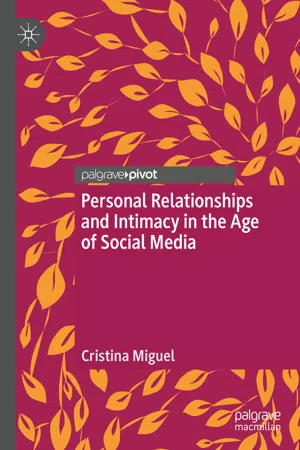
This book examines how intimate relationships are built, negotiated and maintained through social media. The study takes a cross-platform approach, analysing three social media platforms of different genres – Badoo, Couchsurfing and Facebook – and exploring two interactive forces that shape the way people communicate through social media: the platforms' architecture and policies, and actual practises of use. Combining analysis of the political economy of social media with users' perspectives of their own practises – as well as exploring the tensions between the two – the book provides a detailed picture of intimacy as a complex structure of continuity and change.
- English
- ePUB (mobile friendly)
- Available on iOS & Android
eBook - ePub
Personal Relationships and Intimacy in the Age of Social Media
About this book
Information
© The Author(s) 2018
Cristina MiguelPersonal Relationships and Intimacy in the Age of Social Mediahttps://doi.org/10.1007/978-3-030-02062-0_11. Introduction
Cristina Miguel1
(1)
Business School, Leeds Beckett University, Leeds, UK
Cristina Miguel
Abstract
This chapter explores the values and history of network culture, the commercial turn of the Internet, the field of Internet studies, and how social media platforms mediate communication in order to contextualize the study of intimacy in the age of social media. It introduces the concept of intimacy in digital contexts by discussing the tensions between privacy and publicity on social media interaction, as well as the interplay between the politics of platforms and the intimacy practices that take place through them. Finally, it presents an outline of the content of the rest of the chapters.
Keywords
Internet historyInternet studiesIntimacyNetwork cultureSocial media1.1 Networked Culture
The way we establish, maintain, modify, or destroy social relations, according to Castells (2004), has changed to a new social paradigm in the late twentieth century: the network society. Castells (ibid.) points to a communication paradigm shift as a result of the advent of the Internet, the economic crisis, and different social movements such as feminism and ecologism. Likewise, Rossiter (2006) observes that “the network” has been one of the most used metaphors in picturing this new social structure, based on connections of practices and information through the Net. In order to approach the study of network culture, I start by analysing how the Internet was first configured and how it was transformed through the years by the influences of different countercultures, economic forces, and practices. In this section, I also discuss how the use of the Internet became mainstream with the emergence of social media services.
The telegraph has been considered the precursor of the Internet. Nevertheless, rather than to facilitate personal communication, the Internet was originally developed for military purposes. The Internet was created by the US Defense Department in the 1960s, as several scholars (e.g., Castells 2001; Curran 2012) have addressed. The Defense Advance Research Projects Agency (DARPA) created a network of computers that could still transmit information to each other despite being attacked. DARPA evolved under the Advanced Research Projects Agency Network (ARPANET), a research network that also included the think tank corporation RAND, the Massachusetts Institute of Technology (MIT), and the National Physics Laboratory (NPL) from the UK. Later the University of California, Los Angeles (UCLA), and Stanford University joined the project. Those academics who created the technical mechanisms to allow electronic communication also developed the protocols for interpersonal communications. Following this argument, Castells (2001) analyses the values of the network culture using a historical perspective and argues that at least four distinct cultures have shaped the Internet: (1) techno-elites (academics, innovators, and early adopters), (2) hacker culture (open-source movement), (3) virtual communitarians (roots in the San Francisco Bay area’s countercultures), and (4) entrepreneurs (Silicon Valley).
Castells (ibid.) explains that the network culture is based on the academic tradition of sharing knowledge, reputation derived from academic excellence, peer review, and openness in all findings obtained through research. Historically, the Internet was developed in academia, by the work of both teachers and students, whose values, habits, and knowledge spread in the hacker culture. Lévy (2001) describes in his book Cyberculture, which takes a philosophical approach of his own experiences as an Internet user, the characteristics of cyberspace and the social relations that emanate from this new environment. For Lévy (ibid.), hacker culture refers to the set of values and beliefs that emerged from the networks of computer programmers interacting online to collaborate on projects of creative programming. Yet Castells (2001) argues that the specific values and social organization of hacker culture are best understood if one considers the development of the open-source movement, where the operating system Linux is one of its main examples. The hacker culture shares characteristics of the techno-meritocratic culture with the academic world, but has a countercultural character that makes it different. Freedom is the supreme value of hacker culture. Freedom combined with collaboration through the practice of gift culture, which means that a hacker publishes their contribution to the development of software in the network with the expectation of reciprocity and recognition. In summary, hacker culture is a culture of technological creativity based on freedom, cooperation, reciprocity, and informality. Based on the values of hacker culture, as Barbrook (1998) observes, users collaborate altruistically within a system where there is no monetary exchange, what he labels the hi-tech gift economy.
In the same vein, Castells (2001) stresses that network culture is not only reduced to the values of technological innovation, but it also includes social patterns. So while hacker culture provides the technological foundations of the Internet, community culture, manifested in social forms, provides the processes and uses. Early users of computer networks created virtual communities and these communities were sources of values, patterns of behaviour, and social organization. Virtual communities, continues Castells (ibid.), have their roots in the counterculture movements of the 1960s, especially the hippie communes. In the 1970s, the San Francisco Bay area was the site of many virtual communities that experimented with computer-mediated communication (CMC), where projects such as the Community Memory project (1973) and Homebrew Computer Club (1975) developed. The Community Memory project was the first bulletin board system. Those involved in Usenet news networks and the bulletin board system developed and disseminated forms and network applications: messaging, mailing lists, chat channels, multiuser games, and conferences. Communities of interests were created around these new communication channels. These virtual communities were characterized by free horizontal communication and the ability for anyone to express their opinions. Rheingold (1993) introduced the term virtual community into the public lexicon with his book The Virtual Community: Homesteading on the Electronic Frontier, where he gathered his experiences participating in the virtual community “The WELL”. As virtual communities were expanding in size and scope, the original connection with counterculture weakened.
Later, Wellman and Gulia (1997), in their article “Net Surfers Don’t Ride Alone: Virtual Communities as Communities”, criticized the use of the term “virtual community” and pointed to the use of the concept “social networks” in order to picture the relationship created among Internet users through bulletin boards and forums. In opposition to traditional forms of community (the neighbourhood, the family, the school), Rainie and Wellman (2012, p. 3) suggest that the Internet facilitates the creation of different social networks around the individual. Rainie and Wellman (ibid.) have developed the concept of networked individualism, where the individual is a connectivity node who administers diverse social networks. Although Californian counterculture values influenced the configuration of the network culture, according to Castells (2001), the hacker culture plays an essential role in building it for two reasons: the hacker culture is a breeding ground for technology through cooperation and free communication innovations, and it bridges the knowledge generated in the techno-meritocratic culture with entrepreneurship start-ups that spread Internet use in wider society. Start-ups were mainly concentrated around Silicon Valley (California) and created what was labelled the dot.com bubble, which burst in the early 2000s. Castells (2001) argues that there was certain distrust with the commercialization of the Internet at that time. On the other hand, Curran (2012) observes that these dot.com start-ups had very unrealistic business plans. Nevertheless, Fuchs (2014) points to the low number of Internet users at the end of the 1990s as the main cause of the failure of most of these projects. Fuchs (ibid.) explains how Web 2.0 emerged after the dot.com crisis in order to create new Internet business models and ways of monetizing traffic, where the main source of value comes from the users who co-create content.
With the emergence of the World Wide Web in the 1990s, Internet-related research began to emerge to explore the new social relations facilitated by this medium. Some of these studies were located under the umbrella of the so-called field of CMC, defined by Ess (2012, p. 276) as “studies rooted both in social science and disciplines such as sociology, and anthropology, and in humanistic disciplines, such as linguistics, literature, and m...
Table of contents
- Cover
- Front Matter
- 1. Introduction
- 2. Intimacy Frameworks in the Context of Social Media
- 3. Intimacies of Digital Identity
- 4. Social Media Platforms as Intimacy Mediators
- 5. The Political Economy of Networked Intimacy
- 6. Meeting People Online
- 7. Conclusions: Networked Intimacy
Trusted by 375,005 students
Access to over 1.5 million titles for a fair monthly price.
Study more efficiently using our study tools.
Frequently asked questions
Yes, you can cancel anytime from the Subscription tab in your account settings on the Perlego website. Your subscription will stay active until the end of your current billing period. Learn how to cancel your subscription
No, books cannot be downloaded as external files, such as PDFs, for use outside of Perlego. However, you can download books within the Perlego app for offline reading on mobile or tablet. Learn how to download books offline
Perlego offers two plans: Essential and Complete
- Essential is ideal for learners and professionals who enjoy exploring a wide range of subjects. Access the Essential Library with 800,000+ trusted titles and best-sellers across business, personal growth, and the humanities. Includes unlimited reading time and Standard Read Aloud voice.
- Complete: Perfect for advanced learners and researchers needing full, unrestricted access. Unlock 1.5M+ books across hundreds of subjects, including academic and specialized titles. The Complete Plan also includes advanced features like Premium Read Aloud and Research Assistant.
We are an online textbook subscription service, where you can get access to an entire online library for less than the price of a single book per month. With over 1.5 million books across 990+ topics, we’ve got you covered! Learn about our mission
Look out for the read-aloud symbol on your next book to see if you can listen to it. The read-aloud tool reads text aloud for you, highlighting the text as it is being read. You can pause it, speed it up and slow it down. Learn more about Read Aloud
Yes! You can use the Perlego app on both iOS and Android devices to read anytime, anywhere — even offline. Perfect for commutes or when you’re on the go.
Please note we cannot support devices running on iOS 13 and Android 7 or earlier. Learn more about using the app
Please note we cannot support devices running on iOS 13 and Android 7 or earlier. Learn more about using the app
Yes, you can access Personal Relationships and Intimacy in the Age of Social Media by Cristina Miguel in PDF and/or ePUB format, as well as other popular books in Social Sciences & Media Studies. We have over 1.5 million books available in our catalogue for you to explore.