eBook - ePub
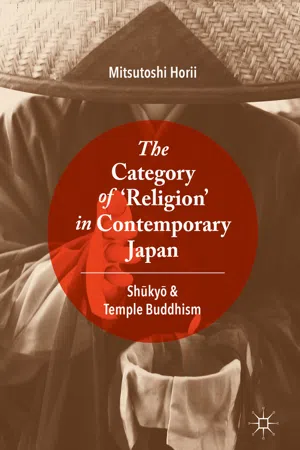
The Category of ‘Religion’ in Contemporary Japan
Shūkyō and Temple Buddhism
- English
- ePUB (mobile friendly)
- Available on iOS & Android
eBook - ePub
About this book
Information
© The Author(s) 2018
Mitsutoshi HoriiThe Category of ‘Religion’ in Contemporary Japanhttps://doi.org/10.1007/978-3-319-73570-2_8Negotiating with ‘Shūkyō’ in the Context of the ‘Religious Corporation’
Mitsutoshi Horii1
(1)
Shumei University, Chiba, Japan
Buddhist temples are generally certified as ‘religious corporations’ (shūkyō hōjin) , and their organisational activities are presumed to be ‘religious’ in their nature and purpose. There is a widely shared assumption that Buddhist priests have a duty to specialise in ‘religious activities’ (shūkyō katsudō) as ‘religious professionals’ (shūkyōka). The meaning of the term ‘religious’ in the discourse of ‘religious activities’ is highly ambiguous. Nevertheless, there seems to be a normative presumption that ‘religious activities’ must be coupled with ‘public benefit’ (kōeki).
As discussed in chapter “Critical Reflections on the Category ‘Religion’ in Japan”, the term shūkyō is encompassed by the category of kōeki . For example, ‘religious corporations’ (shūkyō hōjin) is a subtype of so-called ‘public benefit corporations’ (kōeki hōjin), which include ‘private school corporations,’ ‘social welfare corporations,’ ‘medical corporations,’ and ‘religious corporations.’ This classification presumes that shūkyō is kōeki. In this light, ‘religious activities’ (shūkyō katsudō) are supposed to be kōeki in their nature . This chapter examines the assumption of shūkyō as kōeki in the context of a variety of activities engaged in by Buddhist priests and temples.
Religious Activities (shūkyō katsudō) as Public Benefit (kōeki)
The equation of shūkyō katsudō as kōeki has been presumed by commentators of Temple Buddhism in general as if it is a natural order of things or a state of being. There are a couple of publications which symbolise this. The first one is Shakai kōken suru shūkyō [Religion Which Contributes to Society], which is a collection of essays edited by Keishin Inaba and Yoshihide Sakurai (2009). At the time of the publication, Inaba was an associate professor at Kobe University, and Sakurai a professor at Hokkaido University. These two editors and other academics who contribute to this book discuss various examples of ‘social contributions’ (shakai kōken) by ‘religious organisations.’ What is implicit throughout the book is the normative assumption that ‘religion’ should contribute to society. This echoes the idea of religion as kōeki.
In the context of Temple Buddhism , the Institute of Engaged Buddhism (Rinshō Bukkyō Kenkyūjo) has facilitated the discussion on kōeki. It hosted a symposium in 2008. The presentations and discussions which took place at the symposium were later published in the book Naze jiin wa kōkyōsei o towarerunoka [Why are Buddhist temples asked about their public benefits?] (Rinshō Bukkyō Kenkyūjo 2009). Here again, it is assumed that Buddhist temples should be involved in kōeki activities. Each contributor to this volume expresses a different understanding of kōeki. One claims priests’ everyday prayer has an element of ‘public benefit’ on its own, while some regard priests’ involvement in mortuary rites can be public benefit, when it functions to support people going through grief. However, overall the notion of kōeki is interpreted as ‘socially engaged activities.’ This echoes the phrase ‘engaged Buddhism ’ which is referred to in the name of the Institute .
Some others assert ‘public benefit’ of ‘religious activities’ carried out by a religious corporation in the sense that ‘religion’ is by nature beneficial for the public. A professor in commercial science at Keio University , Takanobu Nakajima (2005) argues in his Otera no Keizaigaku [The Economics of Buddhist temples] that ‘religion’ nurtures and vitalises ‘pious heart’ (shinkōshin) which, he believes, belongs to the realm of human instinct. He continues that ‘religion’ stabilises emotional fluctuations and heightens the morality. Nakajima assumes that these functions of ‘religion’ give positive impacts to society in general. Given this, he claims that ‘religion’ as public benefit. This is the most common understanding of shūkyō as kōeki, which is also shared by other commentators of Temple Buddhism and Buddhist priests themselves as well as government agencies as such the former Ministry of Education, which was historically involved in the writing of Religious Corporation Law .
This understanding of religion’s public benefit constructs another layer of assumptions that Temple Buddhism as a ‘religion’ should have public benefit, and a Buddhist temple as a religious corporation should be involved in public benefit activities. Then, this kind of thinking turns into the argument which associates the current non-taxable status of religious corporations’ revenue from ‘religious activities’ with religious corporations’ classification as ‘public benefit’ corporations . It is widely believed that ‘religious corporations’ were granted ‘tax exemption’ (rather than ‘non-taxation’) on the incomes from ‘religious activities,’ because of ‘public benefit’ nature of their ‘religious activities.’ This naturalises and authorises the way of thinking that a Buddhist temple as a religious corporation , and a Buddhist priest as a religious professional , must direct their activities to public benefit, and otherwise their ostensibly privileged status within the current tax system cannot be justified.
There has been academic discourse, however, against this kind of understanding, which relates the non-taxable status to the category of ‘public benefit.’ For example, in his lecture at the Japan Buddhist Federation, Osamu Tanaka (2004) explained in a convincing way that the current non-taxation on public benefit corporations (including religious corporations) are nothing to do with ‘public benefit.’ Having traced the history of the corporation taxation in Japan, he claims that it is intimately associated with profit makings and shareholder dividend of commercial corporations. According to Tanaka, corporate tax is instituted against the profit which can be shared by individuals. In contrast, public benefit corporations (including religious corporations) are not taxed in the same way because their profit cannot be shared by individuals. Any profit made by a public benefit corporation must be invested for its charitable aim. Thus, Tanaka does not see any logic in the argument that demands religious corporations to be publicly beneficial in order to justify their non-taxable status. He argues that the non-taxability of religious corporations are related to their non-profit nature of corporations, where any surplus has to be invested towards their organisational aims as religious corporations .
Although Tanaka’s argument makes sense in its own light, it seems to be powerless against the dominant force which relates non-taxation on the income from religious activities to the idea of public benefit. Yoshio Takeuchi (2017) in his review article shows that the categorisation of ‘religion’ as public benefit has been the norm in Japanese legal discourse since the late nineteenth century. The term kōeki first appeared in Japanese legal discourse in 1890. It meant ‘charity,’ in the sense of helping the poor. By the mid-1890s, the term was utilised to mean ‘public welfare.’ The category of ‘religion’ was first integrated to the idea of kōeki in 1899, in the context of religion’s role in indoctrinating the people of Japan to support the value orientation of the state. As explained in chapter “Critical Reflections on the Category ‘Religion’ in Japan” ‘religion’ in this context meant three ‘religions’ of Buddhism , Christianity, sectarian Shinto . By the late 1920’s, kōeki of religion became measured by its contribution towards the ideological goal which had been enshrined by the state. And this was the basis on which ‘religious organisations’ at that time were regulated by the state under the Religious Organisation Law .
After the Second World War , when the Religious Organisation Law was abolished under the Allied Occupations , those who had been recognised as ‘religious organisations’ under the pre-war legal framework demanded a new law to ensure their corporate and tax status. When the new legal framework was negotiated between the Ministry of Education of the Japanese government, on the one hand, and the Civil Information and Educational Section (CIE) led by the Supreme Commander of the Allied Powers (SCAP) , on the other hand, it became apparent that the two sides had different understandings of ‘religious organisations.’ The Ministry of Education was expecting ‘religious organisations’ to possess characteristics which promote ‘public benefit,’ while CIE was only interested in conferring legal capacity on religious organisation, without making any judgement on their ‘public benefit’ characteristics (Koga 1990). The Ministry of Education’s view was rejected by CIE , and as the end product of this negotiation, the Religious Corporation Law reflects CIE’s view on ‘religious organisation’ (Koga 1990). Its Article 1 claims: “The purpose of this Act is to confer legal capacity on religious organisations.”
Although the assumption about religion as kōeki was not included in the Religious Corporation Law , this assumption has been still implicit in the legal discourse during the postwar era. It is still alive as the classification of ‘religious corporations’ as a type of ‘public benefit corporations.’ In more recent decades, as Takeuchi (2017) demonstrated, the normative assumption about religious corporations to contri...
Table of contents
- Cover
- Front Matter
- Introduction
- A ‘Critical Religion’ Approach to Japanese ‘Religion(s)’
- Critical Reflections on the Category ‘Religion’ in Japan
- ‘Religion’ in the Popular Discourse
- Temple Buddhism and the Japanese Social Classification: A Brief Historical Overview
- The Construction of Shūkyōka
- Life Stories and Identities of Nichiren-shū Priests
- Negotiating with ‘Shūkyō’ in the Context of the ‘Religious Corporation’
- Conclusion
- Back Matter
Trusted by 375,005 students
Access to over 1.5 million titles for a fair monthly price.
Study more efficiently using our study tools.
Frequently asked questions
Yes, you can cancel anytime from the Subscription tab in your account settings on the Perlego website. Your subscription will stay active until the end of your current billing period. Learn how to cancel your subscription
No, books cannot be downloaded as external files, such as PDFs, for use outside of Perlego. However, you can download books within the Perlego app for offline reading on mobile or tablet. Learn how to download books offline
Perlego offers two plans: Essential and Complete
- Essential is ideal for learners and professionals who enjoy exploring a wide range of subjects. Access the Essential Library with 800,000+ trusted titles and best-sellers across business, personal growth, and the humanities. Includes unlimited reading time and Standard Read Aloud voice.
- Complete: Perfect for advanced learners and researchers needing full, unrestricted access. Unlock 1.5M+ books across hundreds of subjects, including academic and specialized titles. The Complete Plan also includes advanced features like Premium Read Aloud and Research Assistant.
We are an online textbook subscription service, where you can get access to an entire online library for less than the price of a single book per month. With over 1.5 million books across 990+ topics, we’ve got you covered! Learn about our mission
Look out for the read-aloud symbol on your next book to see if you can listen to it. The read-aloud tool reads text aloud for you, highlighting the text as it is being read. You can pause it, speed it up and slow it down. Learn more about Read Aloud
Yes! You can use the Perlego app on both iOS and Android devices to read anytime, anywhere — even offline. Perfect for commutes or when you’re on the go.
Please note we cannot support devices running on iOS 13 and Android 7 or earlier. Learn more about using the app
Please note we cannot support devices running on iOS 13 and Android 7 or earlier. Learn more about using the app
Yes, you can access The Category of ‘Religion’ in Contemporary Japan by Mitsutoshi Horii in PDF and/or ePUB format, as well as other popular books in Social Sciences & Buddhism. We have over 1.5 million books available in our catalogue for you to explore.