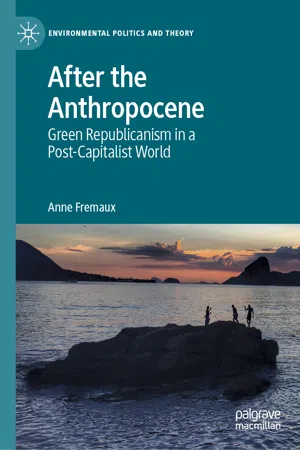
The environmental crisis is the most prominent challenge humanity has ever had to battle with, and humanity is currently failing. The Anthropocene—or so called 'age of humans'—is indeed a period when the survival of humanity has never been so much at risk. This book locates itself in the field of critical green political theory. Fremaux's analysis of the current environmental crisis calls for us to embrace radical shifts in our modes of being; or, in other words, socially progressive innovations that will be described within the unique framework of "Green Republicanism." In offering a constructive and emancipatory delineation of what could be considered an ecological civilization that is respectful of its natural environment and social differences, this book describes how to shift from an 'arrogant speciesism' and materialistic lifestyle to a post-anthropocentric ecological humanism focusing on the 'good life' within ecological limits. This new political regime calls for a radical reinvention of our societies, a decentering of the humans within our metaphysical worldview, and a withdrawal of the capitalist technosphere at the benefit of the biosphere. It will require a new economic paradigm that replaces the unsustainable capitalist logic of growth by sustainable degrowth and steady economics. Rooted in ethical thinking and political philosophy, this book seeks to offer a concrete roadmap of how sustainable societies can be fostered.
- English
- ePUB (mobile friendly)
- Available on iOS & Android
eBook - ePub
About this book
Information
© The Author(s) 2019
Anne FremauxAfter the AnthropoceneEnvironmental Politics and Theoryhttps://doi.org/10.1007/978-3-030-11120-5_11. Introduction
Anne Fremaux1
(1)
School of Politics, International Studies and Philosophy, Queen’s University, Belfast, UK
The Anthropocene or Living in Times of Pluri-Disasters
If the main starting point of this book is the severe environmental crisis we are facing and the natural planet-wide collapse toward which we are heading, today’s ecological reality is powerfully connected to other issues such as growing socioeconomic inequalities, the erosion of democratic institutions, the organized apathy of citizens, the loss of power of nation-states in favor of corporations, the progressive disappearance of the notion of common good , and the economic colonization of the social, cultural, and political life by economic objectives. The global ecological crisis reveals these interlinked disasters caused by the core components of capitalism that include: an excessive exploitation of nature, the rise of industrialism, the self-destructive over-confidence in human-technical power, the arrogant anthropocentric mind-set, and denial of ecological limits , as well as the narrow rationalism and materialism that develop within a reductionist predominant form of science.
Neoliberalism as a ‘global system’ threatens societies as a whole and more especially the core values of social communities and democracy , such as justice , ‘common decency,’ civic virtue , or citizenship . In neoliberal patterns, economic efficiency, market values, employability, consumer freedom , and instrumental rationality are favored over democratic participation, civic values, personal autonomy , active citizenship , intellectual development (‘enlightenment’ 1 ), and moral rationality (reasonability 2 ). Institutions dedicated to the common good are systematically turned into competitive structures to satisfy the interests of markets and greedy elites . Pluralism is disappearing under the assault of a one-dimensional consumer pattern which treats humans and non-humans as commodities under the hegemony of private interests. Civil society , an essential element of the agonistic and critical democracy defended in this book, is losing out to ‘spectator democracy .’ Indeed, citizens are more and more passive and self-centered in part because existing political and democratic structures leave them with few opportunities to participate and make collective decisions. As a consequence, the link between democratic politics and citizens is being critically weakened. Neoliberal individuals end up being overtaken by lassitude and resignation, indifference, and loss of interest for the shared common world. What defines neoliberal society is, indeed, a widespread disaffection for democracy and social bonds entailed by the loss of political agency and self-determination. In such a system, propaganda is necessary to manufacture consent 3 and to shape the fundamental values to ensure that individuals see themselves as consumers, workers, or owners of capital , rather than citizens, spiritual or relational individuals, friends, or members of social and ecological communities. In order to be fully operational, such a system must also rely on high doses of cynicism and the value of relativism cultivated by deconstructive postmodern views .
Neoliberal competitive market-state systems have colonized all aspects of life, but mainly, they have subjugated nature and used it as an ‘unlimited’ spring of profit and resources intended to feed the logic of growth. The globalized neoliberal framework behaves as if nature were only a neutral background for profit-seeking and economic development. In order to push back the ecological limits that are more and more visible, neoliberals argue that those limits can be transcended through decoupling and technological innovations (Chapter 5). Indeed, constructivist neoliberal governments act as if the biosphere were a mere component of the socioeconomic sphere. As an anti-ecological ideology, neoliberalism denies the existence of natural limits and promotes unlimited material wants vs. limited resources, a cult of endless consumption (consumerism), and techno-fixes (techno-optimism ) as the solution to social and ecological problems. The appropriation and commodification of nature undertaken by this form of economic ideology and the freedom it enshrines—understood mainly as the legitimate exercise of extractive power—entail that the environment is viewed only as an instrumental source of raw material and sinks of fossil fuels rather than as an ethically valuable physical, biological, and chemical context of life. Inevitably, this type of economy has supported an insatiable extraction that is today overwhelming ecosystemic capacities. Neoclassical economics is certainly the instrumental form of rationality ‘that most actively opposes the ethical valuation of the environment’ (Smith , 2001: 26).
The neoliberal capitalist agenda, associated with an arrogant anthropocentrism and the technological optimism of many political leaders, experts, techno-scientists, academics, and citizens, has transformed nature and people into raw materials (‘natural’ and ‘human resources’). It has replaced democratic and republican institutions—defined by their concern for the common good —by structures aiming at facilitating the activities and profits of corporations and markets. It has deprived Western political structures of substantial democratic energy by turning citizens of wealthy liberal nations into demoralized and nihilist homo oeconomicus (‘neoliberal citizens’), that is, passive consumers as opposed to active citizens. More than that, neoliberalism , through mass media, entertainment, information, and educational systems, has incrementally converted all the spheres, activities, and dimensions of life into economic ones (‘economization’ or ‘marketization’ of life). Private and public institutions are used as ways to transmit the values of capitalism . 4 As an unethical and unsustainable model of commercialization, ultraliberal capitalism supports crass commodification , intensifies inequalities and transforms everything in its way—from non-human nature to human beings—into replaceable, dispensable and disposable products. As a global threat, neoliberalism leads to ‘environmental stresses (water shortages, deforestation, soil erosion or climate change), food and energy insecurity, peak oil, rising poverty and inequalities within and between societies, increasing passivity of citizens within democracies and the inexorable rise of corporate power within and over the democratic state ’ (Barry , 2008: 3).
The price we, humans, are socially, politically and ecologically paying and will continue to pay in the future for the triumph of the neoliberal ideology is disproportionate with anything humankind has experienced so far (see Fig. 1.2). However, human relatively recent history already shows that the popular passivity and political apathy (mentioned above) fostered by cynical and disempowering systems of ideas have the potential to favour the rise of dictatorial regimes in which a father figure or ‘strong man’ could take upon the conduct of public affairs. At a time when chauvinistic, racist, anti-elitist, and macho-ist p...
Table of contents
- Cover
- Front Matter
- 1. Introduction
- 2. A Critical Examination of the Naturalistic Narrative of the Anthropocene
- 3. The ‘Return of Nature’ in the Capitalocene: Against the Ecomodernist Version of the ‘Good Anthropocene’
- 4. For a Post-Anthropocentric Socio-Nature Relationship in the Anthropocene
- 5. A New Green Political Economy for the Anthropocene
- 6. A Post-Liberal Green Republican Democracy for the Anthropocene
- 7. Conclusion: The Need for a Counter-Anthropocene Narrative
- Back Matter
Trusted by 375,005 students
Access to over 1.5 million titles for a fair monthly price.
Study more efficiently using our study tools.
Frequently asked questions
Yes, you can cancel anytime from the Subscription tab in your account settings on the Perlego website. Your subscription will stay active until the end of your current billing period. Learn how to cancel your subscription
No, books cannot be downloaded as external files, such as PDFs, for use outside of Perlego. However, you can download books within the Perlego app for offline reading on mobile or tablet. Learn how to download books offline
Perlego offers two plans: Essential and Complete
- Essential is ideal for learners and professionals who enjoy exploring a wide range of subjects. Access the Essential Library with 800,000+ trusted titles and best-sellers across business, personal growth, and the humanities. Includes unlimited reading time and Standard Read Aloud voice.
- Complete: Perfect for advanced learners and researchers needing full, unrestricted access. Unlock 1.5M+ books across hundreds of subjects, including academic and specialized titles. The Complete Plan also includes advanced features like Premium Read Aloud and Research Assistant.
We are an online textbook subscription service, where you can get access to an entire online library for less than the price of a single book per month. With over 1.5 million books across 990+ topics, we’ve got you covered! Learn about our mission
Look out for the read-aloud symbol on your next book to see if you can listen to it. The read-aloud tool reads text aloud for you, highlighting the text as it is being read. You can pause it, speed it up and slow it down. Learn more about Read Aloud
Yes! You can use the Perlego app on both iOS and Android devices to read anytime, anywhere — even offline. Perfect for commutes or when you’re on the go.
Please note we cannot support devices running on iOS 13 and Android 7 or earlier. Learn more about using the app
Please note we cannot support devices running on iOS 13 and Android 7 or earlier. Learn more about using the app
Yes, you can access After the Anthropocene by Anne Fremaux in PDF and/or ePUB format, as well as other popular books in Politics & International Relations & Political Philosophy. We have over 1.5 million books available in our catalogue for you to explore.