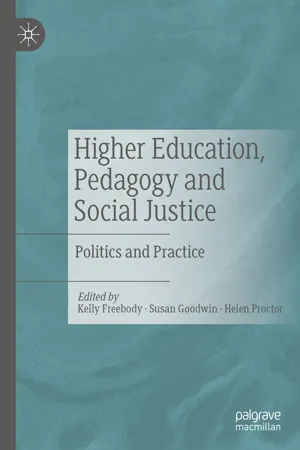
This book explores how the concepts of social justice, diversity, equity and inclusion can be understood within the context of higher education. While terms such as these are often in common use in universities, they are not always used with clarity and precision. The editors and contributors offer a serious and detailed examination of pressing contemporary concerns around 'social justice' across politics, practice and pedagogy in order to encourage hard thinking and practical agenda setting for social-justice oriented research, teaching and community engagement. Drawing upon new theoretical work, research projects and innovative university teaching, this book offers both useful theoretical insights and practical possibilities for action. This collective and collaborative volume will be of interest and value to all those interested in promoting social justice, in particular how it can be promoted within the university setting.
eBook - ePub
Higher Education, Pedagogy and Social Justice
Politics and Practice
- English
- ePUB (mobile friendly)
- Available on iOS & Android
eBook - ePub
Higher Education, Pedagogy and Social Justice
Politics and Practice
About this book
Information
Topic
EducationSubtopic
Education Theory & Practice© The Author(s) 2019
K. Freebody et al. (eds.)Higher Education, Pedagogy and Social Justicehttps://doi.org/10.1007/978-3-030-26484-0_11. Introduction: Social Justice Talk and Social Justice Practices in the Contemporary University
Susan Goodwin1 and Helen Proctor1
(1)
Faculty of Arts and Social Sciences, The University of Sydney, Sydney, NSW, Australia
Terms such as ‘social justice’ and its familiars—‘diversity’, ‘equity’, ‘inclusion’, ‘participation’ (indeed widening participation), ‘social good’—are in common use in universities in Australia and elsewhere. Wilson-Strydom (2015: 143) states “social justice is currently a ‘mantra’ in higher education” and evidence to support this can be found in a quick search of mission statements and marketing claims from universities in different corners of the globe. Yet it has not always been the case that social justice was a valued objective of universities, nor even considered relevant to the work they do.
The recent rise of social justice talk in universities and its prevalence in the contemporary is related to shifts in the conditions of universities, and society more broadly, that have made ‘social justice’ something to speak about. For university administrators, social justice talk seems to flow from the identity problems that arise from competing pressures, and perhaps desires, to somehow integrate the economic and social purposes of higher education into its operations and strategic agendas (Kenny 2009; McArthur 2011). For university teachers and researchers, social justice talk seems to be connected to a need to express and renew political orientations and commitments in the context of the ‘squeezing out’ (Winter and O’Donohue 2012) or outright refusal of their values and goals. As Singh (2011: 491) explains:
In both the developed and developing world, social justice is part of the policy vocabulary of decision-makers and planners who are currently engaged in the strategic positioning of higher education within the skills and knowledge requirements of the knowledge society and the knowledge economy. However, social justice is also part of the analytical and normative vocabulary of those who seek fairer and more democratically enabling societies….. This has given the notion of social justice an ambiguous normative and strategic role and presence within knowledge society discourses.
These kinds of tensions provide the impetus for this book. While social justice discourses in higher education settings are increasingly common, they can often obscure rather than clarify motivations, hopes and intentions. Sometimes they describe well-developed plans of action, at other times they represent little more than progressive chic. The book engages in a serious examination of what university workers—researchers and teachers—mean by ‘social justice’. It presents a range of angles on social justice claims and social justice activities, as the authors draw on current projects and practices in order to explore the opportunities and challenges of social justice agendas.
“Social thought happens in particular places” (Connell 2007: ix) and so we begin by acknowledging where we are speaking from. All of the contributors to this book have written from their position as scholars and researchers in an Australian university or as part of an Australian university research team. Some have come from elsewhere, representative of the global academic diaspora, some are Indigenous Australians, others have lived and worked on this Land1 as part of either long-standing or more recent migrant populations. All are engaged in teaching or research in the fields of education, social work or social policy: applied social science disciplines that are “at once academic and professional” (Nash 2003: 23) and, as such, work between the competing demands of the state, their scholarly communities, and the students, institutions, systems and communities they serve. Speaking about social justice and higher education from this particular place involves certain preoccupations, some of which will very easily resonate with readers across sites and disciplines, some of which invite consideration of different preoccupations in different settings.
There are various ways to capture the specificities of where we write about social justice and higher education from and in this opening chapter we choose to depict that place in terms of a settler colonial space, and the authors as grappling with both established and emerging conceptions of social justice “in neoliberal times” (Brodie 2007; Deeming 2014). Describing this place and these times makes sense of some of the particular concerns of the contributors.
From a Settler Colonial Space
Australia developed its distinctive identity and sovereignty through a form of colonialism that sought the replacement of Indigenous populations with an invasive settler society. As Rowe and Tuck (2017: 4) argue, settler colonialism is the “specific form of colonialism in which people come to a land inhabited by (Indigenous) people and declare that land to be their own”. To describe the place from which we write as a settler colonial state is to make visible what was involved in the formation of the nation: the violent removal of people from their homelands and the reconfiguring of Indigenous land into settler property. In contemporary Australia, most universities and university workers now formally acknowledge this aspect of place and pay respect to the original owners of the Land on which universities are built, research is undertaken, and teaching and learning occur.2 Yet, as critical race theorist Patrick Wolfe (2006) argued, settler colonialism is not just an historical event in the past or the story of a nation state’s origins. Instead, invasion persists.
From this perspective, universities in Australia are understood as settler colonial institutions that were not only built by and for settlers, but which continue to entrench the ideological hegemony of both colonialism and coloniality. As Raewyn Connell explains (in this volume), universities in Australia were established by British imperial governments in the 1850s, primarily to “help form an imperial governing class with a shared mentality” (p. 24) and were not intended for the Indigenous population, or even much of the white settler population who were “in large part uneducated, often illiterate, ex-convicts and their children” (p. 23). Australian universities, and education systems more generally, have played an important role in creating and maintaining an array of race, class and gender dominations through colonial knowledge systems which have normalized imperial knowledges and delegitimated other ways of knowing. It is in this context that ontological, epistemological and practical questions about social justice, research practices, university teaching and university/community engagements are being raised.
In Neoliberal Times
The conditions associated with neoliberalization also provide the context for contemporary social justice discourses and activities in universities in Australia and elsewhere. Neoliberal rationalities which have installed and extended market values throughout contemporary institutions have reinvigorated social justice claims, for example, for more collectivized, less individualized responsibility for quality of life; for expanding the realm of the social; for re-instating universal and/or public provision of social goods such as education and higher education. Neoliberal forms of governing and ways of thinking have been met by demands for fairer distributions of income and wealth at global and national levels and for new ways of addressing entrenched exclusions. But the coincidence of neoliberalism and social justice talk has also focused attention on the kinds of questions—the ambiguities and tensions—that prompted this book: How can normative and political social justice ideals be reconciled in the neoliberal context?
Universities themselves have also been transformed in neoliberal times. The global and local positioning of universities (and the students, disciplines and academics within them) in competition with one another, the corporatization of academia, the rise of managerialism and the embedding of audit cultures that measure and assess performance are some of the new conditions that shape contemporary university work. In the United States, Emmett Jones and Shefner (2014) argue that the impact of neoliberalism has been clear and unambiguous, describing the effects of neoliberalism on public universities in the United States in the following way:
As an ideology, neoliberalism prioritizes individual accomplishment and how such accomplishments are valued monetarily above all else. This position contrasts dramatically with the role of public universities as fundamentally collective efforts to build knowledge. As a basis of policy, neoliberalism searches for ways to reduce society’s obligations to all citizens. Universities, again in contrast, are fundamentally about the social use of knowledge and have historically provided one avenue to individual social mobility and collective social, economic, and political progress (Jones and Shefner 2014: 3).
In Australia, public universities have been similarly impacted. Terms such as t...
Table of contents
- Cover
- Front Matter
- 1. Introduction: Social Justice Talk and Social Justice Practices in the Contemporary University
- Section I. Politics and Perspectives
- Section II. Pedagogies and Practices
- Back Matter
Trusted by 375,005 students
Access to over 1.5 million titles for a fair monthly price.
Study more efficiently using our study tools.
Frequently asked questions
Yes, you can cancel anytime from the Subscription tab in your account settings on the Perlego website. Your subscription will stay active until the end of your current billing period. Learn how to cancel your subscription
No, books cannot be downloaded as external files, such as PDFs, for use outside of Perlego. However, you can download books within the Perlego app for offline reading on mobile or tablet. Learn how to download books offline
Perlego offers two plans: Essential and Complete
- Essential is ideal for learners and professionals who enjoy exploring a wide range of subjects. Access the Essential Library with 800,000+ trusted titles and best-sellers across business, personal growth, and the humanities. Includes unlimited reading time and Standard Read Aloud voice.
- Complete: Perfect for advanced learners and researchers needing full, unrestricted access. Unlock 1.5M+ books across hundreds of subjects, including academic and specialized titles. The Complete Plan also includes advanced features like Premium Read Aloud and Research Assistant.
We are an online textbook subscription service, where you can get access to an entire online library for less than the price of a single book per month. With over 1.5 million books across 990+ topics, we’ve got you covered! Learn about our mission
Look out for the read-aloud symbol on your next book to see if you can listen to it. The read-aloud tool reads text aloud for you, highlighting the text as it is being read. You can pause it, speed it up and slow it down. Learn more about Read Aloud
Yes! You can use the Perlego app on both iOS and Android devices to read anytime, anywhere — even offline. Perfect for commutes or when you’re on the go.
Please note we cannot support devices running on iOS 13 and Android 7 or earlier. Learn more about using the app
Please note we cannot support devices running on iOS 13 and Android 7 or earlier. Learn more about using the app
Yes, you can access Higher Education, Pedagogy and Social Justice by Kelly Freebody, Susan Goodwin, Helen Proctor, Kelly Freebody,Susan Goodwin,Helen Proctor in PDF and/or ePUB format, as well as other popular books in Education & Education Theory & Practice. We have over 1.5 million books available in our catalogue for you to explore.