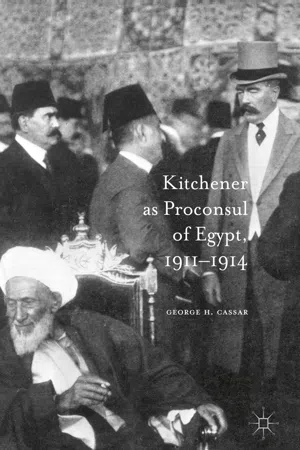
This book covers the tenure of Kitchener as Proconsul in Egypt in the years preceding the First World War. Based mostly on unpublished sources – including government records and private papers – it not only fills a gap in the life and career of Kitchener, the most famous soldier in Britain since Wellington, but it also deals with an important but practically unknown period in Egyptian history. George Cassar shows Kitchener to be an ardent imperialist, but one who had a sense of responsibility to the country he governed. Exchanging his field marshal's uniform for the dress of a statesman, he arrived in Egypt when British prestige was at a low point on account of his predecessor's policies. He restored political stability, created conditions that bolstered the economy, and introduced a wave of reforms. Kitchener as Proconsul of Egypt, 1911-1914 reveals how Kitchener's interest extended beyond Egypt, and how throughout these years he worked quietly to prepare theground in an attempt to create an Arab Empire under Britain's suzerainty.
- English
- ePUB (mobile friendly)
- Available on iOS & Android
eBook - ePub
Kitchener as Proconsul of Egypt, 1911-1914
About this book
Information
© The Author(s) 2016
George.H. CassarKitchener as Proconsul of Egypt, 1911-191410.1007/978-3-319-39363-6_11. From Birth to the End of Military Service
George H. Cassar1
(1)
Eastern Michigan University, Ypsilanti, Michigan, USA
Horatio Herbert Kitchener came from a respectable English family of moderate means. His father, Henry Horatio Kitchener, chose the army as his career and saw service in the Indian Army, eventually reaching the rank of lieutenant-colonel. At the age of 39, Henry, then a captain, married 19-year-old Frances Anne, nicknamed, “Fanny,” daughter of a Suffolk vicar, in July 1845. As he was on leave, Henry, accompanied by his bride, returned at once to India. The climate of India did not suit Fanny, whose health deteriorated, leading Henry to bring her and their first born back home in 1847 and going on half-pay. Unable to find military employment in England after months of fruitless inquiry, the Colonel sold his commission and decided to start a new life in Ireland. At the time Ireland was still reeling from the failure of the potato crop—the staple food of most of the people—which had brought death, starvation, misery and ruin to hundreds of thousands. As a result the estates of bankrupt landlords were going cheaply. At a cost of £3000 the Colonel secured a 2000 acre estate called Ballygoghlan, near Listowel, County Kerry, in the south of Ireland. It was here that his third child and second son, Horatio Herbert, was born on 24 June, 1850. 1 His first name was borrowed from his father, though the family always called him Herbert.
The Colonel’s estate was run down and the house itself was in such a state of disrepair that it required alterations before the family could move in. The Colonel skillfully managed his property, adding productive land by constructing an efficient drainage system, introducing up-to-date agricultural techniques, setting up a brick factory and breeding horses. In 1857 the Colonel was in good enough financial shape to purchase a second estate in Kerry, located a mile from the village of Kilflyn, half way between Listowel and Tralee. Built during the reign of Charles I, Crotta House, with its large garden, finely-timbered grounds and view of the broom-covered Kerry Hills, was grander than Ballygoghlan. The Kitchener family settled in Crotta House but in the summer spent time at Ballygoghlan which the children preferred.
The Colonel ran his household with order and discipline as though it were a small military unit. His five children were assigned various tasks on the estate and were taught to be proud of their English heritage, adhere to a strict code of honor, fear God and revere the Queen and Country. The children rarely quarreled and led sheltered lives with few toys and no outside playmates. Young Herbert was said to be sensitive and shy, tended to be aloof and keep to himself and, apart from his obvious deep love for his mother, rarely betrayed his emotions.
The Colonel was an eccentric and one of his strange notions was the belief that schools had no merit. He employed tutors to educate his children. It was not an ideal solution, at least in this case. When a cousin, Francis Elliot Kitchener, then a Fellow of Trinity College, Cambridge, tested young Herbert’s knowledge, he reported that he had never known a boy more devoid of general knowledge.
The family received a shock in 1863 when it was discovered that Fanny’s lungs had been affected by incipient tuberculosis. The Colonel was devoted to his wife and to have remained in the damp climate of southern Ireland would have caused her health to deteriorate further. In 1864 he sold his properties at a handsome profit and moved his family to Switzerland where it was hoped that the pure mountain air might restore her health. Alas, the change in climate failed to improve her condition. Before the end of the year, Fanny, to the great sorrow of her family, died of tuberculosis at Montreaux. 2
The Colonel decided to remain in Montreaux and sent Herbert and his two younger brothers to an English boarding school at the Château du Grand Clos in the village of Rennaz near Villeneuve. It was a traumatic period for the Kitchener boys. In Ireland they had lived in comfortable circumstances and were encouraged to think of themselves as superior to the poor and benighted local population. At school they found themselves out of step with their classmates who were more articulate, confident, worldly and knowledgeable than they were. On a more personal note they were ridiculed for their Irish accent, ignorance, and the old-fashioned clothes they wore. Coming on the heels of their beloved mother’s death, the humiliating experience deepened their despondency and induced them to keep to themselves as much as possible.
Herbert realized how far behind he was compared to his more able peers and he responded by pouring all of his energies into remedying his educational deficiencies. During the two and a half years that he spent at the Château, he became fluent in French, acquired a rudimentary knowledge of German, showed an aptitude for mathematics, and studied English history and the natural sciences. Kitchener had his heart set on attending the Royal Military Academy at Woolwich and becoming an engineer—contrary to his father’s wishes that he should opt for the cavalry. In 1867 he left the Swiss school and returned to England to prepare for his entrance examination. He was coached first by his cousin Francis in Cambridge, then by Reverend George Frost, a well-known army crammer in London. Kitchener placed 28 out of 60 successful candidates and in February 1868 entered the Royal Military Academy at Woolwich. 3
The Academy, nicknamed “The Shop,” prepared cadets for commissions in the Royal Artillery and Royal Engineers. Kitchener’s period at the Academy was unremarkable and he does not appear to have made much of an impression. As he had not attended English public school, he was slow to conform to the customs and practices of his fellow cadets. The only close friendship he formed was with Claude Conder whom he had first met at Reverend Frost’s house. A learned and gifted student, Conder was interested in the languages and customs of the Levant—the area consisting today of Syria, Lebanon and Israel. He introduced Hebrew to Kitchener and the two spent their spare time learning the language, an activity that drew them into the High Church ritualistic movement. Herbert’s period of religious fervor did not last long, although he continued to observe Anglo-Catholic practices within the Church of England. His early development was slow and he worked extremely hard to keep up with his peers and missed an entire term because his health broke down. After two years at the Academy he successfully passed out in December 1870 and joined his father who had remarried and was living in Dinan, in Brittany, France.
The usual festivities and merriment at Christmas that year were conspicuously absent as France was approaching the end of a disastrous war with Prussia. Herbert and an English friend, Harry Dawson, saw an opportunity to gain first-hand experience of war. With the encouragement of the old Colonel, Herbert and Dawson made their way to Laval to join General Chanzy’s forces which were attempting to relieve the siege of Paris. Before they arrived, Chanzy’s army of ill-trained and poorly equipped reservists and conscripts was badly defeated in a three-day battle at Le Mans. After they reached Chanzy’s battered army, which was in the process of reforming, they were attached to an ambulance unit and saw plenty of harrowing sights but no action. Chanzy received fresh raw recruits and was preparing another offensive when news arrived on 28 January, 1871, that Paris had capitulated, effectively ending the war.
Kitchener persuaded a French officer to take him up in a balloon so that he could observe the distant German lines. He did not wear enough warm clothing and, in the cold upper air, caught a chill which developed into pneumonia and pleurisy. Dawson alerted the Colonel who found his son in critical condition in a cold and unsanitary billet and brought him back to Dinan. When Kitchener recovered from his illness, he returned to England. 4
Kitchener’s escapade in France had not gone unnoticed and he was summoned to the War Office to appear before the Commander-in-Chief of the British Army, Field-Marshal HRH the Duke of Cambridge, to answer for his action. Kitchener’s commission had been issued on 4 January, 1871, while he was in France. As a serving officer he had violated his country’s strict policy of neutrality when he joined Chanzy’s army. The Duke poured a cataract of abuse on Kitchener, telling him that he was a deserter, a disgrace to the British army, that his behavior was unpardonable and that he deserved to lose his commission. Shaken and fearing that his career was over before it had begun, Kitchener breathed a sigh of relief when the Duke ended by saying, “Well, anyhow, boy, go away, and don’t do it again.” 5
Several years passed before Kitchener had an opportunity to escape from the uncongenial and routine service at home. The Palestine Exploration Fund had been founded in 1865 with the object of surveying Palestine, drawing an accurate map and identifying the sites referred to in the Bible. The War Office, anxious to acquire knowledge of the military geography of Palestine that could be of value in war, willingly lent engineers and equipment to the Fund. Since 1872, Kitchener’s friend, Claude Conder, had been directing the survey of west Palestine as a lieutenant on behalf of the Fund. In the summer of 1874 Conder urged Kitchener to apply to replace his civilian assistant who had died of fever. On the strong recommendation of Conder, Kitchener received the appointment and, with the blessing of the War Office, embarked on his long journey. He arrived at Conder’s camp in the plain of Philistia on 19 November, 1874. 6
Kitchener was as happy as a lark in Palestine and threw himself with great enthusiasm into whatever task he undertook. He surveyed, took photographs, copied inscriptions and conducted research on biblical sites. He seemed to be emerging from his shell, showing himself to be more extroverted and sociable. He was described by a French archaeologist who saw him periodically as vigorous, frank and outspoken, cheerful and friendly in contrast to Conder’s serious disposition, and possessing an inordinate capacity for work. Kitchener’s high- energy level was contagious and the survey’s rate of progress rose sharply, from roughly 76 to 280 square miles a month. Somehow Kitchener found time to study Arabic (which he mastered in fairly short order) and Turkish.
As if the work was not demanding enough, the members of the party had to battle such ailments as fever and dysentery. While in Jerusalem at the start of the New Year 1875, Kitchener came down with a fever that was so severe Conder feared that he might be invalided home. Fortunately, an English doctor found the right remedy and by Easter, Kitchener was back again in the field. The party was working on the coast near Gaza and its member often bathed in the Mediterranean. On 5 April Conder was caught in an undertow and it is assumed he would have drowned had Kitchener, who was a strong swimmer, not rescued him. Three months later, Kitchener played a vital part in saving Conder’s life a second time. In the village of Safed in Galilee on 10 July a group of fanatical Muslims, resenting the presence of infidels on their sacred land, approached the party hurling stones, wielding clubs and shouting anti-Christian blasphemous epithets. Conder tried to stand his ground but an Arab pushed his way to the front and struck him over the head with a club. A second blow on the head would have finished off Conder but he butted his assailant so that the club fell on his neck. Still the assault caused serious wounds from which he never fully recovered. As it was apparent that Conder was in deep trouble, Kitchener, his left thigh severely bruised by a large stone, managed to reach him and parried the next blow with his hunting crop. Badly injured Conder gave orders to retire to a nearby hill, while Kitchener used his newly acquired knowledge of Arabic to hold off the mob. When his comrades were safe on the hill, Kitchener broke away and made good his escape. Suffering from the after-effects of his wounds, Conder was no longer fit to work in the field, as a result of which the Fund appointed Kitchener to replace him in command of the survey. 7
For Kitchener the months that he was in charge of the survey increased his knowledge and had the effect of developing his leadership qualities, managerial skills, shaping his work habits and laying the foundation for his future career. He was frequently called upon to negotiate with local officials, suspicious imams (religious leaders) and sheikhs, developing his natural tact and gaining insight as to how to engage in diplomacy with Arabs. Apart from managing his party, it was incumbent on him to find ways to overcome obstacles, deal with a host of administrative tasks like reports to the Fund and logistical situations and operate within strict economic guidelines. Kitchener understood the need to keep the men’s spirit up for the work was dangerous and grueling. The countryside was hilly and lugging around heavy and awkward surveying instruments in the fierce heat was exhausting. To make matters worse, members of the party, including Kitchener himself, faced debilitating bouts of fever from time to time.
Kitchener remained steadfast and focused after war between Russia and the Ottoman Empire broke out in April 1877. At the outset of the conflict, the Ottoman government withdrew all of its soldiers from the countryside, which meant there would be no policing authority in the event the survey party ran into hostile tribesmen. The Fund authorities were inclined to think that Kitchener and his team should return home as their safety could not be assured. Kitchener saw no cause for alarm, confident that he could handle any potential danger. Nevertheless he saw the need to complete the survey in the shortest time possible lest England be drawn into the conflict on the Turkish side, in which case he probably would be recalled for special service. Thus he set an arduous pace. By driving his men to work a minimum of 12 hours a day, seven days a week, he completed the survey of Galilee in July 1877 and also of western Palestine two months later. Kitchener was justifiably proud of what he and his team had accomplished. Under trying conditions they had triangulated and surveyed about 3000 square miles of Palestinian territory, investigated and recorded all known archaeological sites, taken thousands of photographs of points of interest, corrected errors of previous map makers and compiled reports of the names, religion and water supply of every village. The Fund praised Kitchener’s leadership skills, in particular for his thoroughness, energy, timely completion of his task and keeping within budgetary limits. 8
After Kitchener sent his staff home on 22 November, he travelled to Constantinople as well as to other parts of the Ottoman Empire. He was back in London at the start of January 1878 and throughout the spring and summer worked with Conder on a map of Palestine. The glowing reports of Kitchener’s work in Palestine had drawn the attention of the government and on the day he submitted his finished product to the Fund he was assigned to survey and triangulate the island of Cyprus, acquired earlier in the year from Turkey.
Kitchener liked Cyprus and its inhabitants but it was not long before he found himself at odds with the newly appointed High Commissioner, Lieutenant-General Sir Garnet Wolseley. Kitchener wanted to produc...
Table of contents
- Cover
- Frontmatter
- 1. From Birth to the End of Military Service
- 2. Back to Egypt
- 3. Personality, Thoughts and Methods of a Benevolent Autocrat
- 4. The Challenge of Neutrality
- 5. Striving to Advance Egypt
- 6. Public Safety
- 7. The Capitulations and the Organic Law
- 8. The Royal Rebel
- 9. Prelude to World War I
- Backmatter
Trusted by 375,005 students
Access to over 1.5 million titles for a fair monthly price.
Study more efficiently using our study tools.
Frequently asked questions
Yes, you can cancel anytime from the Subscription tab in your account settings on the Perlego website. Your subscription will stay active until the end of your current billing period. Learn how to cancel your subscription
No, books cannot be downloaded as external files, such as PDFs, for use outside of Perlego. However, you can download books within the Perlego app for offline reading on mobile or tablet. Learn how to download books offline
Perlego offers two plans: Essential and Complete
- Essential is ideal for learners and professionals who enjoy exploring a wide range of subjects. Access the Essential Library with 800,000+ trusted titles and best-sellers across business, personal growth, and the humanities. Includes unlimited reading time and Standard Read Aloud voice.
- Complete: Perfect for advanced learners and researchers needing full, unrestricted access. Unlock 1.5M+ books across hundreds of subjects, including academic and specialized titles. The Complete Plan also includes advanced features like Premium Read Aloud and Research Assistant.
We are an online textbook subscription service, where you can get access to an entire online library for less than the price of a single book per month. With over 1.5 million books across 990+ topics, we’ve got you covered! Learn about our mission
Look out for the read-aloud symbol on your next book to see if you can listen to it. The read-aloud tool reads text aloud for you, highlighting the text as it is being read. You can pause it, speed it up and slow it down. Learn more about Read Aloud
Yes! You can use the Perlego app on both iOS and Android devices to read anytime, anywhere — even offline. Perfect for commutes or when you’re on the go.
Please note we cannot support devices running on iOS 13 and Android 7 or earlier. Learn more about using the app
Please note we cannot support devices running on iOS 13 and Android 7 or earlier. Learn more about using the app
Yes, you can access Kitchener as Proconsul of Egypt, 1911-1914 by George.H. Cassar,George. H. Cassar in PDF and/or ePUB format, as well as other popular books in History & African History. We have over 1.5 million books available in our catalogue for you to explore.