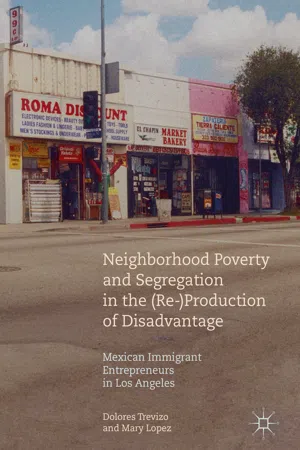
The scholarship on immigrant entrepreneurship is rich with analyses of different groups of immigrants who “make it” in their host society through the hard work involved in owning and managing small businesses.1 Many start out as bootstrap entrepreneurs who, with the support of co-ethnics and the use of family labor, achieve a small degree of social mobility by becoming small business proprietors. This book focuses on Mexican immigrant entrepreneurs, a group of people who have been underrepresented in the ranks of small shopkeepers in the US despite their long and sustained history of migration since at least the early twentieth century. Their historic underrepresentation among Los Angeles’s small business owners is particularly counterintuitive because the area has been a destination point for various cohorts of migrants from Mexico since the city’s founding as a Spanish pueblo in 1781.2 So, while their presence as a prominent and long-standing racialized ethnic minority—one that continuously integrates newly arrived immigrants—spans many decades, only at the turn of the twenty-first century has the number of Mexican immigrants engaged in storefront proprietorship begun to increase. This book not only documents some of the reasons for this change, but we focus on explaining why some of these small storefronts are more successful than are others.
The research presented in this book speaks broadly to stratification theory the aim of which is to explain social inequalities—whether in levels of wealth, earnings, social prestige, or in vulnerability to poverty, to give just a few examples. If stratification theory addresses the general question, who gets what and why? this book focuses on some patterns in incremental, or short-distance, upward mobility, as well as in social immobility. We do so by focusing on Mexican immigrants who moved from waged employment to small business proprietorship. Even if the experiences of our survey respondents are not the norm among their co-ethnics, they are noteworthy considering that the vast majority of the immigrants in our sample had been undocumented for years, if not decades, before legalizing their status. After laboring in low-skill jobs in the US, they first legalized their immigration status and started small storefront businesses with the goal of earning more money.3 Their plan was reasonable not only because of the low entry costs of small business ownership, but because theirs was a proven strategy that had worked for other disadvantaged immigrants (e.g., Italian immigrants) at different times. Our research shows that for Mexican immigrants, however, the entrepreneurial pathway of upward mobility is mostly blocked. Nevertheless, the proprietors we studied still, to varying degrees, enjoyed a small boost from entrepreneurship, and this book explains the conditions under which some of their small shops achieved a modicum of success. Even though the small shops in our study are unlikely to become large firms, the aggregation of viable storefronts along commercial corridors in ethnic neighborhoods contributes to community stability (Butler and Kozmetsky 2004: viii). In addition, small business ownership is not only a marker of personal success and self-determination; in some cases, it offers employment opportunities to others.
Our research focuses on the neighborhood conditions under which such small shops are more likely to create employment opportunities. We specifically examine how neighborhood poverty, relative to other stratification variables, including racial segregation and gender, affects the business performance of small shopkeepers, and thus their capacity to employ others. We demonstrate that less poor and more multiethnic neighborhoods offer Mexican immigrant shopkeepers better opportunities for their businesses than do the highly impoverished and racially segregated Mexican neighborhoods of Los Angeles. While our findings clearly contribute to the scholarship of concentrated disadvantage that emphasizes the long-term consequences of neighborhood deprivation (Wilson 1987; Massey and Brodmann 2014), our analysis also studies both the effects of microclass differences as well as those of legal capital (defined below). Our central thesis is that even poor Mexican immigrants whose class backgrounds in Mexico imparted an entrepreneurial disposition can achieve a modicum of business success in the right (US) neighborhood context, and the more quickly they build legal capital, the better their outcomes. Therefore, while we show that the local place characteristics of neighborhoods both reflect and reproduce class and racial inequalities, we also demonstrate that there exists a diversity of experiences among Mexican immigrants living within the spatial boundaries of these communities and that this diversity matters to their economic mobility or immobility.
Our research is relevant to contemporary political debates because Mexican immigrants, along with their US-born children and grandchildren, are among the largest, poorest, and most negatively racialized ethnic groups in the US. Whereas African Americans comprise about 13% of the total US population as of 2010, Latinos/as of Mexican ancestry alone are nearly 11% of that US total. Recent data from the Pew Research Center indicate that there are 34.6 million Hispanics of Mexican origin in the US, although the number may be greater if the undocumented are undercounted in the Census. What is clear is that as of 2015, there were at least 11.5 million Mexican immigrants, a figure not only greater than that of Cubans and Puerto Ricans combined, but one on par with the figure of 11.6 million immigrants from both South and East Asia.4 So, if neighborhoods—“the linchpin” of stratification—are largely defined by the social demographic profiles of the resident groups living within their boundaries (Massey and Brodmann 2014: 62), all such groups have class specific and even gendered histories that also matter to stratification. To explain how intra-ethnic and place characteristics matter for stratification, we will review the literature on individuals, neighborhoods, and entrepreneurship.
Individuals, Neighborhoods, and Ethnic Entrepreneurship in Stratification Theory
The study of small-scale entrepreneurship has a long tradition in sociology. Among the classic thinkers, both Max Weber (1930: 39) and Georg Simmel (1971 [1908]) observed that entrepreneurship is an adaptation—and therefore a survival strategy—to a minority’s (religious or ethnic) blocked mobility. While some contemporary scholars argue that blocked mobility also leads to entrepreneurship among unemployed White workers in the post-industrial, post-union, flexible “gig” economy,5 petty proprietorship has historically been one of the few survival strategies available to ethnic and racialized groups. Scholars thus continue to show that many racialized ethnic groups survive systematic discrimination and oppression by creating entrepreneurial opportunities for themselves that take the form of small business ownership (Bonacich and Modell 1980; Waldinger et al. 1990; Butler 1991; Butler et al. 2009).
If Weber, Simmel, and others explain why entrepreneurship is a common survival strategy for people whose mobility is blocked by widespread discrimination, Pierre Bourdieu’s theoretical framework offers details as to how certain cultural competencies might help them negotiate their social worlds, including through entrepreneurship. In the spirit of Max Weber,6 Bourdieu emphasizes that while economic class and social status are mutually constitutive, cultural processes play a role in the social construction of both. Bourdieu, however, goes further by conceptualizing various species of capital and even subspecies of what he calls cultural capital (defined below). So, if Weber theorized that social and ethnic groups are socially endowed with different degrees of honor and prestige, Bourdieu specifies various mechanisms by which symbolic status differentiators may convert to economic capital. In this way, Bourdieu’s analysis of social mobility stresses that people negotiate labor markets, or complex fields,7 as social-cultural hierarchies that require specific forms of cultural knowledge about the game itself. We rely on his framework to understand how specific combinations of economic, social, and cultural capital influence people’s class standing as well as their social trajectory over time. Following Bourdieu, we conceptualize social classes by their different levels (volume) and composition (or types) of capital, including social and cultural capital (see below).
To explain further, Bourdieu conceptualized various species of capital beyond financial capital that contribute to the production and reproduction of class differences over time. For example, he defined social capital as the durable networks of people, friends, and family who can mobilize economic resources, power, job, and other opportunities. To take the case of business, friends and families can offer cash gifts, low-interest loans, information, investment opportunities, or connections to customers or suppliers (see also Anderson and Miller 2003). Bourdieu also observed that distinct subtypes of cultural capital, or cultural competencies, are transferred inter-generationally, each with a specific market exchange value. Some forms of cultural capital are formally credentialed (e.g., college degrees), others are informally acquired, some are tacitly understood, and others are ...