eBook - ePub
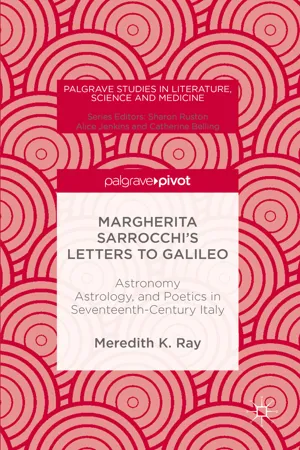
Margherita Sarrocchi's Letters to Galileo
Astronomy, Astrology, and Poetics in Seventeenth-Century Italy
- English
- ePUB (mobile friendly)
- Available on iOS & Android
eBook - ePub
Margherita Sarrocchi's Letters to Galileo
Astronomy, Astrology, and Poetics in Seventeenth-Century Italy
About this book
Information
© The Author(s) 2016
M. K. RayMargherita Sarrocchi's Letters to GalileoPalgrave Studies in Literature, Science and Medicinehttps://doi.org/10.1057/978-1-137-59603-1_11. Introduction
Meredith K. Ray1
(1)
University of Delaware, Newark, Delaware, USA
Abstract
Ray’s introduction presents the letters exchanged between Margherita Sarrocchi (1560–1617), a Naples-born poet based in Rome, and Galileo (1564–1642). Their correspondence, which has gone virtually unstudied before now, opens a fascinating window onto the collaboration and cooperation between literary and scientific circles in this important transitional moment in the history of science. The letters are characterized by three major themes: Sarrocchi’s request that Galileo help her to revise her ambitious epic poem, the Scanderbeide; Sarrocchi’s efforts to defend Galileo’s celestial discoveries to the scientific community in Italy; and, finally, the shared interest of these two figures in judicial astrology and the casting of natal charts.
Keywords
GalileoMargherita SarrocchiEarly modern ItalyScientific RevolutionCorrespondenceLettersAstronomyAstrologyEpic poetrySeventeenth-century RomeFlorence’s National Library houses thousands of rare documents pertaining to Galileo Galilei in the Fondo Galileiano: manuscript copies of his notes and works, watercolor sketches of his cosmological observations, and records concerning his 1633 trial by the Roman Inquisition. The collection also includes a trove of letters exchanged between Galileo and members of his circle, a complex epistolary web that traces the coordinates of the Republic of Letters throughout seventeenth-century Italy and Europe. Among this wealth of information is a hand-bound book marked Manoscritti Galileiani 23, a substantial file dedicated solely to Galileo’s female correspondents. The letters contained here offer valuable perspective on Galileo’s personal and intellectual relationships with women at diverse moments in his life, from his early years in Padua to the difficult period following his trial. Represented within these pages are ambassadors’ wives, abbesses, and even the painter Artemisia Gentileschi (1593–1656); along with Galileo’s mother and, notably, his daughter, Virginia (Suor Maria Celeste; 1600–1634), who maintained an enduring epistolary connection to her father from within her convent outside Florence and has remained the most well-known of his female correspondents. 1
Less familiar among these women, but second only to Maria Celeste in the number of her extant letters to Galileo, is the Naples-born writer Margherita Sarrocchi (1560–1617). 2 Renowned for her erudition in mathematics and natural philosophy and for her heroic poem, the Scanderbeide—one of few works in the epic genre to be published by a woman in early modern Italy—Sarrocchi was deeply integrated into the fabric of seventeenth-century intellectual society. 3 Her status as a learned woman who had been under the protection of a powerful cardinal made her a valuable ally in her adopted city of Rome: with ties to Roman scientific academies as well as to the Church hierarchy, Sarrocchi was not only a poet but a cultural intermediary. A well-connected intellectual, Sarrocchi gathered, confirmed, and disseminated new information about literary and scientific opinions and controversies. 4 Against this backdrop—one that situates Sarrocchi as both author and knowledge broker—we may most profitably investigate her richly evocative correspondence with Galileo, which spans the period from July 1611 to June 1612, pivotal months for both of them.
In Sarrocchi’s letters to Galileo, astronomy, astrology, and poetics share center stage, opening a window onto the fluid nature of networks of knowledge and the role of gender in early modern scientific and literary transactions. The letters, in which Sarrocchi offers her support of Galileo’s celestial discoveries in return for his aid in revising and promoting her literary work, illuminate the bonds of collaboration and reciprocal obligation that animated this epistolary relationship, while also offering new perspective on Galileo’s own literary and astrological interests. Their epistolary interaction unfolds following Galileo’s triumphant visit to Rome in 1611 to promote the discoveries detailed in his Sidereus nuncius; these were the same months in which Sarrocchi was revising her Scanderbeide for a second, complete edition. Not only do the letters represent an epistolary conversation in which literary and scientific questions are tightly intertwined, but they also highlight the delicate dynamics of cultural authority-building in Seicento Italy. At issue here is not high-stakes patronage (so clearly illuminated by Galileo’s interactions with the Medici, for example) but rather the more difficult-to-discern work of establishing networks of support at other levels, an enterprise that required engagement with various intellectual communities and with supporters of both sexes. 5 While Galileo needed the courtly approbation of Florence and the curial approval of Rome for his celestial discoveries, he also needed writers like Sarrocchi to help authorize and cement his reputation among a wider audience. Sarrocchi, on the other hand, sought the recognition and protection of the up-and-coming astronomer for her ambitious poem.
The Sarrocchi-Galileo letters thus provide additional context to the debate and controversy that followed Galileo’s cosmological discoveries of 1610 while also encapsulating, in miniature, the vibrant and heterogeneous nature of communities of knowledge in the era of the Scientific Revolution. In the early years of the seventeenth century, Sarrocchi’s Rome was a lively, often contentious, cultural center in which free-thinkers coexisted with men of the Church and social mobility was more fluid than in many other Italian cities. 6 Intellectual exchange was varied and incorporated traditional views with new perspectives: in academies, salons, and epistolary exchanges, debates over the latest scientific discoveries unfolded alongside continued discussion of alchemy, astrology, and natural magic. The Accademia dei Lincei—considered the earliest scientific academy—included among its members both Giambattista della Porta—author of the influential Magia naturalis (1558; expanded edition 1589), which had sections on metallurgy and alchemy—and later Galileo himself, herald of the new science. 7 The outlines of what is traditionally referred to as “the Scientific Revolution” were by no means sharply delineated: rather, a “constant mediation” was enacted between old, Aristotelian forms of knowledge and the new empiricism, giving rise to an intricate and multilayered intellectual dialogue. 8 Academic debate over scientific topics also intermingled with disputes about models for literary language and style. Chief among these was the quarrel over Ludovico Ariosto versus Torquato Tasso as a model for heroic poetry, a question in which both Sarrocchi—a follower of Tasso’s style—and Galileo—who extolled the psychological realism of Ariosto—had a strong stake. 9 Societies such as the Accademia degli Umoristi, which counted some of the most prominent figures in Rome (including the future Pope Urban VIII, Maffeo Barberini) among their numbers, brought together nobles and members of the Curia, natural philosophers, and a wide array of poets. 10 Communities of knowledge were thus diverse not only in their interests but also in their membership; in many cases, this included the participation of women. In Rome and throughout Italy, learned women participated in academic life at various levels, engaging, as men did, in the major intellectual debates of the day. 11
Sarrocchi herself was a regular member of at least three formal academies. She took part in the arguments over baroque poetics that swirled throughout literary society, her preference for a more refined style, in the model of Tasso, leading her to leave one academy, the Umoristi, to help form another, the Ordinati. 12 Sarrocchi explored themes of astrology and natural philosophy in her literary works and formed intellectual relationships with writers, scientists, and mathematicians, which she cultivated through well-attended gatherings held in her home, described by one observer as “…the refuge and academy of the best minds in Rome.” 13 Indeed, this unofficial “academy” attracted figures ranging from the poets Tasso and Giambattista Marino to Federico Cesi, founder of the Accademia dei Lincei—or, as another observer noted, “the most noble and virtuous spirits ever to live in or pass through Rome.” 14 Aldus Manutius the Younger (1547–1597), who attended Sarrocchi’s salon during a visit to Rome, vowed to return just to hear her speak again: “I would be beyond consolation, had I not the comfort offered by the hope—no, the complete determination—to return soon in order to see and hear her at greater length.” 15 Also among the honored guests at Sarrocchi’s salon was Galileo, a newly elected Lincean visiting Rome on the heels of his Sidereus nuncius (1610) to bolster support for his discoveries. Galileo would later recall warmly the time he had spent at Sarrocchi’s residence in the company of the mathematician Luca Valerio (1553–1618), Sarrocchi’s former tutor and longtime friend, and “other gentlemen of letters.” 16 Sarrocchi underscored these same collegial bonds when she sent greetings to Galileo in Florence from herself, “Signor Luca,” and “all these gentlemen who met you in my home.” 17
After Galileo’s departure from Rome, Sarrocchi began a correspondence with him that lasted approximately one year. Sarrocchi’s letters to Galileo reveal that, at least for a time, the two shared a mutual respect and admiration that encompassed matters of both science and literature. Sarrocchi was eager for the imprimatur of Galileo, who was just beginning his ascent to celebrity but had not yet encountered the full consequences of the collision of science and faith. Approaching him as a writer no less than as a scientist, she sought his advice about revisions to her Scanderbeide, a challenging prospect whose successful execution was paramount among her concerns. With the Scanderbeide, Sarrocchi was venturing into literary territory few women writers had sought to claim, and her formidable plans included the addition of 12 new cantos and careful reworking of language and plot. Despite Galileo’s well-known preference for Ariosto over Tasso, the literary philosophies of Sarrocchi and Galileo converged in their mutual privileging of Tuscan as the proper language for literature, and particularly for epic poetry, making Galileo an ideal guide for Sarrocchi. Galileo, for his part, turned to Sarrocchi and her friend Valerio to seek backing for his celestial discoveries, sending the pair copies of his works, including the Discourse on Floating Bodies (1612) and Letters on Sunspots (1613), and soliciting their opinion. Letters from others involved in Galileo’s affairs, either addressed to or specifically regarding Sarrocchi, further attest to the substantive intellectual exchange between these two figures: Sarrocchi’s view on Galileo’s discovery of Jupiter’s satellites, the so-called Medicean stars, among other things, is sought from corres...
Table of contents
- Cover
- Front Matter
- 1. Introduction
- 2. Astronomy, Astrology, and Poetics in Seventeenth-Century Italy
- 3. Translation of the Correspondence of Margherita Sarrocchi and Galileo (With Three Related Letters)
- Back Matter
Trusted by 375,005 students
Access to over 1.5 million titles for a fair monthly price.
Study more efficiently using our study tools.
Frequently asked questions
Yes, you can cancel anytime from the Subscription tab in your account settings on the Perlego website. Your subscription will stay active until the end of your current billing period. Learn how to cancel your subscription
No, books cannot be downloaded as external files, such as PDFs, for use outside of Perlego. However, you can download books within the Perlego app for offline reading on mobile or tablet. Learn how to download books offline
Perlego offers two plans: Essential and Complete
- Essential is ideal for learners and professionals who enjoy exploring a wide range of subjects. Access the Essential Library with 800,000+ trusted titles and best-sellers across business, personal growth, and the humanities. Includes unlimited reading time and Standard Read Aloud voice.
- Complete: Perfect for advanced learners and researchers needing full, unrestricted access. Unlock 1.5M+ books across hundreds of subjects, including academic and specialized titles. The Complete Plan also includes advanced features like Premium Read Aloud and Research Assistant.
We are an online textbook subscription service, where you can get access to an entire online library for less than the price of a single book per month. With over 1.5 million books across 990+ topics, we’ve got you covered! Learn about our mission
Look out for the read-aloud symbol on your next book to see if you can listen to it. The read-aloud tool reads text aloud for you, highlighting the text as it is being read. You can pause it, speed it up and slow it down. Learn more about Read Aloud
Yes! You can use the Perlego app on both iOS and Android devices to read anytime, anywhere — even offline. Perfect for commutes or when you’re on the go.
Please note we cannot support devices running on iOS 13 and Android 7 or earlier. Learn more about using the app
Please note we cannot support devices running on iOS 13 and Android 7 or earlier. Learn more about using the app
Yes, you can access Margherita Sarrocchi's Letters to Galileo by Meredith K. Ray in PDF and/or ePUB format, as well as other popular books in Literature & European Literary Criticism. We have over 1.5 million books available in our catalogue for you to explore.