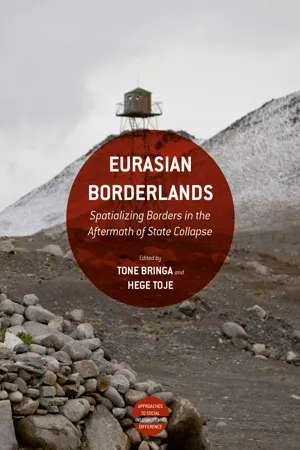
This book examines changing and emerging state and state-like borders in the post-Soviet space in the decades following state collapse. This book argues border-making is not only about states' physical marking of territory and claims to sovereignty but also about people's spatial practices over time. In order to illustrate how borders come about and are maintained, this book looks at border communities at internal, open administrative borders and borders in the making, as well as physically demarcated international state borders. This book also pays attention to both the spatial and temporal aspects of borders and the interplay between boundaries and borders over time and thus identifies some of the processes at play as space is territorialized in Eurasia in the aftermath of state collapse.
eBook - ePub
Eurasian Borderlands
Spatializing Borders in the Aftermath of State Collapse
- English
- ePUB (mobile friendly)
- Available on iOS & Android
eBook - ePub
Eurasian Borderlands
Spatializing Borders in the Aftermath of State Collapse
About this book
Information
© The Author(s) 2016
Tone Bringa and Hege Toje (eds.)Eurasian BorderlandsApproaches to Social Inequality and Difference10.1057/978-1-137-58309-3_11. Introduction: Eurasian Borderlands
Tone Bringa1 and Hege Toje1
(1)
Department of Social Anthropology, University of Bergen, Bergen, Norway
Keywords
BordersEurasiaTerritorialization of spaceBorder populationsIntroduction: Eurasian Borderlands
Recent events in Europe—the war in Eastern Ukraine, Russia’s annexation of Crimea, and the building of border fences to keep out migrants—have given border studies a new urgency. In this book, we examine border processes characterized by both openings and closures in the aftermath of a defining moment on the eve of the 21st century; the break-up of the Soviet Union. The collapse of the communist federated states of the Soviet Union and Yugoslavia made way for new state borders and nation-states, often through violent means, and as the result of ethnic cleansing on ethnically diverse territory. Concomitantly, over the last two decades the European Union (EU) developed a more unified policy toward a common external border. 1 Yet, while the latter development has produced a series of studies, it is striking that there is no single volume which deals with the changing borderlands in the aftermath of the collapse of the Soviet Union and Yugoslavia. 2 This book seeks to fill this gap by looking at border dynamics in the former Soviet Union area.
After the collapse of the Soviet Union, its outer borders, which most Soviet citizens had been barred from crossing since 1923 (See Pelkmans 2006; Chandler 1998), became generally more permeable. This change facilitated mobility from the former Soviet Union to areas such as Europe, China, the USA, Turkey and the Middle East, and vice versa. New opportunities for travel enabled new connections and dependencies. New relationships were developed in trade, education, cultural exchange and religion—oftentimes connecting people with the people and institutions previously unreachable under the strict border regime of the Soviet Union (see Kalb 2002).
At the same time, new borders emerged as new states were created along previously internal, administrative boundary lines. Crossing the border in areas that had formerly been unified became difficult with new visa regimes and citizenship categories that defined a new set of insides and outsides. Indeed, in the former Soviet space, the collapse is commonly referred to as razpad, “falling-apart,” conveying a sense of fragmentation that captures both the state collapse and the territorial transformations that took place after 1991. Railroad networks were divided into several autonomous units to match new political boundaries, reflecting a desire for national control of the infrastructure of circulation and communication. Infrastructure grids such as roads, gas pipelines, electricity networks and water supplies are not only channels that connect borderlands with a center (Donnan 2010, 254), but ways to integrate territory. Such grids are thus transposed as part of the political work of territorially and socially delineating new or aspiring nation-states. This restructuring complicates people’s everyday lives and often leads to conflict, as has been documented for the Ferghana Valley by Madeleine Reeves (2014). Following the dissolution of the Soviet Union, border regimes covered everything from tense militarized borders to borders where mobility was unhindered by physical barriers. The borders are usually the demarcation lines of internationally recognized sovereign states, but they may also mark aspiring but unrecognized states. The collapse of the Soviet Union and of its neighboring communist states ultimately implied a re-drawing of political, economic and social boundaries. It affected the entire former Soviet space, re-arranging relations between center and periphery, spurring the new forms of identity politics, producing new religious and economic landscapes, new modes of interaction and new systems of meaning, and altering the flow of ideas, goods and people. These processes are at work in the world that has emerged today, and are the subjects of the studies in this volume.
Borderlands
The expression “spatializing borders,” found in the subtitle of this book, may appear as an oxymoron. But the expression resonates with terms such as “spatializing states,” which Ferguson and Gupta introduce to capture “how states come to be understood as entities with particular spatial characteristics,” (2002, 981) and with Setha M. Low’s term “spatializing culture,” by which he means “to locate both physically and conceptually [culture] in social space” (1996, 861). By using the term spatializing borders, we want to stress that borders not only delineate territory, but also delineate and even separate social space and spaces of interaction. In general terms, this book is concerned with changing state borders and their impact on people’s mobility and their relationships with each other and the state. The book explores processes of social mapping and the dynamics of bordering in borderlands in areas where international state borders or borders in the making may separate communities and form new patterns of interaction and mobility, where cultural identities are formed ambiguously, and often in tension with the state’s official categorizations, and where people are vulnerable to the changing aspirations of political leaders and to animosity between neighboring states, and live in “borderlands under stress” (Blake 2000, 1; see also Donnan and Wilson 2010, 3; Berdahl 1999; Brown 2004). The communities in such lands are often considered marginal—they are far from the center of state power, but they still embody the state’s claim to sovereignty over territory. Borderlands may be areas of heightened control, but they may also be sites of resistance and of social and cultural exchange and creativity. They are locations where the interplay between borders and boundary-making is often dynamic processes.
We will argue that, to understand the dramatically changing border landscape in the last decades, there is much to be gained from shifting our gaze away from the center and redirecting it toward processes at the borderlands, keeping in mind that such “borderlands could be intrastate as well as interstate” (Readman et al. 2014, 12).
“Borderlands” is a term that allows us to investigate how people’s lives are formed by territorial borders, and how these borders are, in turn, formed by people’s social and cultural practices. We see borderlands “as a special type of place,” one that “generates a particular kind of social relations in which the border and its transformations become an instrument (as well as a reflection) of different forms of power and conflicts as these emerge and mutate” (Donnan 2010, 254). We can understand the processes Donnan identifies by studying the emergence or transformation of borderlands in the aftermath of state collapse, because this leads to re-alignment between centers and peripheries, involving a re-definition of territories and the formation of multiple boundaries and borders-in-the-making.
Borders and Boundaries
In recent years, anthropologists have become increasingly interested in border studies through the lens of people’s everyday lives and their sense of collective identity. The creation of boundaries, and ethnic boundaries in particular, is a precursor to this, 3 and some scholars writing about borders use boundaries and borders interchangeably. However, distinguishing between the two words based on their semantic nuances allows us to explore the interplay between symbolic/category boundary-making and border-making. Processes of boundary-making, we suggest, sometimes precede and sometimes result from border-making.
A border is a specific type of boundary that forms a physical and symbolic demarcation of politically controlled territory. Boundaries, however, are drawn around categories and symbolic entities. Categorization is a fundamental part of human thought, and it is one reason that anthropology has long been concerned with boundaries as a concept. The most influential study of boundaries is Fredrik Barth’s 1969 edited volume Ethnic Groups and Boundaries, which rejected the prevalent position of the day that saw cultures as “delineated unchanging wholes.” It offered, instead, a new perspective by focusing on the boundaries of ethnic groups and arguing that boundaries persist despite a flow of personnel across them. This processual perspective was a radically new insight at the time, and later theorists owe much to this book, since the perspective on ethnicity and ethnic groups offered in the book questioned the taken-for-granted nature of group boundaries. The concern of the scholars contributing to Ethnic Groups and Boundaries was with the durability and stability of boundaries, but it is above all the alteration of boundaries and borders which affects people’s lives, often dramatically and violently.
But Barth’s volume took the existence of the boundary itself for granted, and thus ignored the role of politics and history in the creation of these boundaries. Borders, we suggest, are ways of naturalizing imagined ethnic, cultural and political boundaries. Weedon reminds us “the appeal to the ‘natural’ is one of the most powerful aspects of commonsense thinking, but it is a way of understanding social relations which denies its history” (1987, 3 quoted in Peterson 2013, 57), and Peterson adds, “to characterize something as ‘natural’ both denies its history and erases its politics” (Peterson 2013, 57). In this volume, we acknowledge the role of history and politics, while highlighting the processes of naturalizing difference through borders and boundary-making.
The contributors to this volume are notable for the attention they have given to the history and politics of the borderlands they study. This is crucial in trying to understand contemporary border and boundary dynamics. Particularly perhaps, since states in this region are still influenced by the Soviet legacy of both ethnically labeling and categorizing their citizens, and defining and controlling the boundaries between them.
Before 1989, studies of borders and border regions often questioned top-down models of the nation-state and views of cultures as units naturally bounded within nation-states (see Pelkmans 2006), and this helped us to challenge the way difference was naturalized through boundaries and state borders, but with the fall of the Berlin Wall, border studies became more concerned with the effects of removing state borders on communities that had been divided since 1945 (see Borneman 1993; Berdahl 1999). Since the 1990s, the scholarly literature on borders has developed into a multidsciplinary subfield of border studies: political scientists, human geographers, historians, sociologists and anthropologists have all contributed their perspectives to the study of borders.4
The 1990s literature, according to Berry et al. (1998), was “influenced by globalization and globalization theories […] and moved away from the ideas of ‘boundedness’” and was more concerned with “the fluidity of phenomena […] such as culture, identity, sovereignty, national territory, citizenship” (1998, 7). But the dramatic and often violent re-drawing of borders in Eurasia after the collapse of the Soviet Union and Yugoslavia challenged predictions of disappearance of boundaries and a “space of flows” (Castell 1989, quoted in Kemp 1998, 75).
Starting from the Barthian understanding of the socially constructed ethnic boundary as stable over time, independent of the movement of people across it, we now arrive at a point where boundaries (as boundary-making) must be linked to “dimensions of time and space” (Berry et al. 1998, 7). Kemp, drawing on Soja, argues that social theory has (so far) “privileged time over space” and suggests that this explains why “social theory has paid scant attention to […] territorial boundaries” (1998, 74); she applies the term “spatial socialization” (ibid., 76; see also Paasi 1996, 8) to combine space and time. Sarah Green (2012, 585) suggests the term “tidemarks” with similar intentions. We see “spatial socialization,” looking at the interplay between spatial delineations and identity, as involving two sets of processes, one being time and space, and the other, boundaries and borders. We examine in this volume how the border itself is constituted, considering, on one hand, spatial and temporal perspectives on social practices, and political and historical perspectives on state-making on the other.
Eurasia
The title of this book is Eurasian Borderlands; the concept of “Eurasia” has acquired various meanings and is used both in a geographical sense and as part of political discourse. Scholars who deal with cultural and economic history have found it productive to consider the term “Eurasia” as a landmass—one in which the exchange of knowledge, goods and people can be observed. Specifically, “Eurasia” has been used to launch a critique of a Eurocentric understanding of cultural and economic history. In The Eurasian Miracle, Goody discusses the shared history and the cultural and economic exchange between Europe and Asia, countering what he sees as Eurocentric narratives about modernization and capitalism. He argues that the history of modernization and capitalism is not the history of Europe, but of Eurasia (Goody 2010; see also Hann 2016).
A second use of the term has become common within Western academia: Eurasia has come to denote the Soviet Union’s fifteen successor states, which cover parts of both Europe and Asia. Several prominent research institutions and university departments, whose scholarship and research deal with Eastern Europe, Russia, the Caucasus and Central Asia, have adopted Eurasia in their names. Eurasia is, however, a flexible term and is therefore often expanded to include neighboring states that may have economic, cultural or political relations with the post-Soviet space; this is particularly true for Afghanistan and parts of western China.
A third use of Eurasia is specific to Russia ...
Table of contents
- Cover
- Frontmatter
- 1. Introduction: Eurasian Borderlands
- 2. Post-Soviet or Eurasian Lands? Rethinking Analytic Categories in the Ukraine–EU and Russia–China Borderlands
- 3. “Dead End”: A Spatial History of a Border Town in Post-Soviet Kyrgyzstan
- 4. With a Border Fence in the Backyard: Materialization of the Border in the Landscape and the Social Lives’ of Border People
- 5. Across the Enguri Border: Lives Connected and Separated by the Borderland Between Georgia and Abkhazia
- 6. Remembering and Living on the Borderlands in the South Caucasus
- 7. Time and Contingency in the Anthropology of Borders: On Border as Event in Rural Central Asia
- 8. Producing Territories: Spatial Practices and Border Effects Between Krasnodar Krai and the Republic of Adygea
- 9. From Boundaries to Borders: Spatial Practices and State-making; the Case of Bosnia-Herzegovina
- Backmatter
Trusted by 375,005 students
Access to over 1.5 million titles for a fair monthly price.
Study more efficiently using our study tools.
Frequently asked questions
Yes, you can cancel anytime from the Subscription tab in your account settings on the Perlego website. Your subscription will stay active until the end of your current billing period. Learn how to cancel your subscription
No, books cannot be downloaded as external files, such as PDFs, for use outside of Perlego. However, you can download books within the Perlego app for offline reading on mobile or tablet. Learn how to download books offline
Perlego offers two plans: Essential and Complete
- Essential is ideal for learners and professionals who enjoy exploring a wide range of subjects. Access the Essential Library with 800,000+ trusted titles and best-sellers across business, personal growth, and the humanities. Includes unlimited reading time and Standard Read Aloud voice.
- Complete: Perfect for advanced learners and researchers needing full, unrestricted access. Unlock 1.5M+ books across hundreds of subjects, including academic and specialized titles. The Complete Plan also includes advanced features like Premium Read Aloud and Research Assistant.
We are an online textbook subscription service, where you can get access to an entire online library for less than the price of a single book per month. With over 1.5 million books across 990+ topics, we’ve got you covered! Learn about our mission
Look out for the read-aloud symbol on your next book to see if you can listen to it. The read-aloud tool reads text aloud for you, highlighting the text as it is being read. You can pause it, speed it up and slow it down. Learn more about Read Aloud
Yes! You can use the Perlego app on both iOS and Android devices to read anytime, anywhere — even offline. Perfect for commutes or when you’re on the go.
Please note we cannot support devices running on iOS 13 and Android 7 or earlier. Learn more about using the app
Please note we cannot support devices running on iOS 13 and Android 7 or earlier. Learn more about using the app
Yes, you can access Eurasian Borderlands by Tone Bringa, Hege Toje, Tone Bringa,Hege Toje in PDF and/or ePUB format, as well as other popular books in Law & Civil Rights in Law. We have over 1.5 million books available in our catalogue for you to explore.