- English
- ePUB (mobile friendly)
- Available on iOS & Android
eBook - ePub
About this book
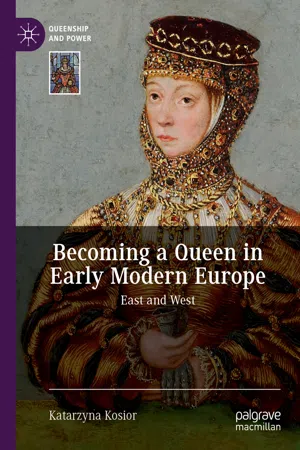
Queens of Poland are conspicuously absent from the study of European queenship—an absence which, together with early modern Poland's marginal place in the historiography, results in a picture of European royal culture that can only be lopsided and incomplete. Katarzyna Kosior cuts through persistent stereotypes of an East-West dichotomy and a culturally isolated early modern Poland to offer a groundbreaking comparative study of royal ceremony in Poland and France. The ceremonies of becoming a Jagiellonian or Valois queen, analysed in their larger European context, illuminate the connections that bound together monarchical Europe. These ceremonies are a gateway to a fuller understanding of European royal culture, demonstrating that it is impossible to make claims about European queenship without considering eastern Europe.
Information
© The Author(s) 2019
Katarzyna KosiorBecoming a Queen in Early Modern EuropeQueenship and Powerhttps://doi.org/10.1007/978-3-030-11848-8_11. Introduction: East and West
Katarzyna Kosior1
(1)
Northumbria University, Newcastle upon Tyne, UK
Katarzyna Kosior
Archduchess Catherine of Austria and Sigismund August , King of Poland and Grand Duke of Lithuania, married by proxy on the cusp of summer 1553. It should have been a happy occasion. Catherine, daughter of Ferdinand, King of the Romans, would become queen of the largest monarchy in Europe. But the atmosphere at the wedding deteriorated soon after the hand of the princess was bound with a bishop’s stole to the hand of Mikołaj ‘the Black’ Radziwiłł, Voivode of Vilnius and Sigismund August’s proxy. Some modern historians are still too careful to include an account of the episode in their studies, calling it ‘distasteful’.1 It was also removed from the nineteenth-century edition of the chronicle by Łukasz Górnicki, who was in the entourage of Jan Przerębski, the other ambassador sent to conclude the marriage negotiations.2 Górnicki reports:
This moment of tension has much to teach us about queenship, royal ceremonies, and royal families. The Polish and Habsburg sides both understood the purpose and general procedure of marriage by proxy, but differences in political cultures were alluded to. The Poles, having just arrived from an elective, parliamentary monarchy where rhetorical skill was highly valued as part of the culture of active political participation, expected royal ceremony to be accompanied by ‘grand speeches’. Consummation by proxy was not usually part of Polish ceremonies, and Ferdinand referred to it as the custom of ‘our House’. These differences could be navigated by ambassadors, who acted as intermediaries and were normally well versed in the protocol of royal courts. However, Mikołaj ‘the Black’ Radziwiłł was not an experienced ambassador and had only entered the world of high-level politics following his cousin Barbara’s scandalous, but short-lived, marriage to Sigismund August in 1547—she died in 1551. This helps explain why he was so oblivious to the custom that Ferdinand had to give him instructions. Górnicki reports that the voivode lay down ‘as he was dressed’, while the usual custom was for the ambassador to undress down to his shirt. Even if Radziwiłł’s behaviour was unusual, Catherine’s resistance cannot be explained by maidenly embarrassment. She was already 20 years old and a widow, having been married to Francesco III Gonzaga, Duke of Mantua, for four months in 1549–1550. Catherine must have been familiar with the custom and understood that this was part of the job. Instead of the maidenly blushes that would befit a princess bride, the episode reveals the complex personal anxieties Catherine must have felt about the marriage. She had to be put into bed by force and immediately leapt out almost fainting in the process, because she was marrying the same man her sister Elizabeth had married ten years previously, the man who notoriously neglected the older Archduchess on account of his then mistress, Barbara Radziwiłł. Having to get into bed with the cousin of the woman who stole her older sister’s (and now Catherine’s own) husband added insult to injury. This episode throws into sharp relief that these ceremonies, which so often come down to us as sets of depersonalised platitudes, were, in fact, deeply personal. Górnicki’s report also helps us think about family dynamics in the context of dynasticism and rehearses ideas about the gendered expectations of royal women. Ferdinand would not be humiliated by his daughter and she is made to comply by force. In the report, dynastic rhetoric of ‘our house’ quickly becomes the family business of disciplining Catherine—the father calls his son, not his courtiers, to help him.After the banquet there was dancing. King Ferdinand was dancing himself, and rather a lot. After dancing they went to the bedroom. There, the King told the Voivode of Vilnius to lie down, saying: ‘The usual custom has to be observed in our House.’ And when the Voivode of Vilnius lay down as he was dressed, the King ordered his daughter to lie down beside him, but she was too embarrassed to do it. So her father caught her by the shoulders and said to his son: ‘Maximilian, help me.’ Maximilian caught her legs, and they put her next to the Voivode. Immediately afterwards the Queen leapt out of bed, not without help, and the Voivode as well. There were other ceremonies too, but not accompanied by grand speeches as in our country.3
Catherine embodies the connections between European royal courts in the sixteenth century that this study encompasses. As the daughter of Anne of Bohemia and Hungary, she was niece, sister, and aunt to queens of France and Poland-Lithuania. She was also the granddaughter of Anne de Foix, who was the cousin to the queens of France Anne of Brittany and Claude of France. But even though Catherine’s cousins, sisters, aunts, and nieces figure prominently in French and English-language scholarship, she and her fellow queens of Poland are absent from narratives about sixteenth-century queenship, even those that claim to have a pan-European focus.4 The obscurity of Polish queens helps perpetuate the notion that Europe was historically divided into ‘West’ and ‘East’, implying that a fundamental political and cultural divide animated life on the continent. As Norman Davies observes, ‘by taking transient contemporary divisions, such as the Iron Curtain, as a standing definition of “West” or “East”, one is bound to distort any description of Europe in earlier periods. Poland is neatly excised from the Renaissance, Hungary from the Reformation’.5 Davies wrote this in the immediate aftermath of the fall of communism, but the tendency to diminish the extent of contact between Poland and the West while emphasising the ‘otherness’ or marginality of Polish culture persists in the historiography. For example, the tendency to downplay the significance of the Polish nobility in European affairs is even evident in Fanny Cosandey’s otherwise outstanding study of French queenship. In her introduction, she lists the 12 French queens of her study. Only Marie Leszczyńska, the wife of Louis XV and queen of France for 42 years, is given a descriptor. She is called ‘a modest Polish princess’ in direct contrast to Marie Antoinette, who is identified as ‘born archduchess of Austria’.6 This apparently innocuous contrast speaks volumes. Marie Leszczyńska was the only surviving daughter of King Stanisław I Leszczyński of Poland and Grand Duke of Lithuania (1704–1709, 1733–1736), later Duke of Lorraine, and Katarzyna Opalińska, like her husband of a very distinguished Polish family.
Since Davies wrote in 1992, Robert Frost and Natalia Nowakowska have pioneered early modern Polish history as an English-language field of study. Nowakowska is right to argue that ‘where our models are built from examples garnered from only half the continent, we risk operating with only a half (or even a half-accurate) picture of Renaissance European society’.7 In other words, historians have tried to define the ‘European’ by looking only at half of Europe, as eastern and central Europe remains the primary context for representing the Polish monarchy.8 Polish historiography is no less guilty of this tendency. It tends to treat queenship in even more reclusive terms, for although it includes assiduously researched biographies of some queens, particularly Bona Sforza, few attempts have been made to relate Polish queens to each other, never mind other European consorts.9
This study seeks to address these imbalances. It uses ‘East’ and ‘West’ in a strictly geographical sense, eschewing any sense that these terms necessarily signify fundamental cultural difference, and pierces stereotypes of sixteenth-century Poland’s cultural and political isolation by offering the first substantial comparison of Polish royal ceremony and culture with that of France, an apparently quintessentially western realm. French queens have been studied as a group by historians such as Fanny Cosandey, Kathleen Wellman, and Simone Bertière, but their connection to the Polish queens has never been fully understood or appreciated.10 More generally, even in the robustly developing area of royal studies, sustained comparisons are rare, an exception being Jeroen Duindam’s study of the Valois-Bourbon and Habsburg royal courts.11 By framing Polish and French queenship comparatively and relating Polish queenship and monarchy to the ongoing debates in recent scholarship, this study will reinforce our growing understanding of how queens helped spin the thread that connected early modern Europe, linking together various European realms with blood-ties and alliances; it will also demonstrate that Poland was very much a part of that rich tapestry, exposing the extent to which the wives of the Valois and Jagiellonian kings related to each other.
The ceremonies of becoming a queen, understood as the wedding with the accompanying festivals, coronation, childbirth, and motherhood, marked the transition of a bride into a queen consort but have never been studied as a sequence in a larger European context. The analysis of these ceremonies illuminates French and Polish queenship by revealing the ideological, conceptual, political, diplomatic, and family frameworks within which queens functioned. Establishing the patterns that marked the movement of royal brides between East and West, laying bare the connections that bound together monarchical Europe, enables us to question whether the differences in European royal ceremony and queenship were motivated by specific ‘Eastern’ and ‘Western’ ideas. This study uses both queens and royal ceremonies as a way of understanding the political and cultural dynamics that animated life on the continent in the sixteenth century.
Although the historiography of the Polish monarchy has not been affected by the ‘ceremonial turn’ to the same extent as the English and French-language scholarship, works on Polish royal ceremony have been produced by Michał Rożek, Urszula Borkowska, Aleksander Gieysztor, Krystyna Turska, and Karolina Targosz.12 But the tremendously prolific English-language scholarship on ceremonies is limited too. The tendency to focus on the western part of the continent has produced a lopsided account of European ceremony, and therefore royal culture, because not only does the literature neglect a large expanse of European territory but it also fails to take account of ceremonies in a different political setting than that provided by hereditary and absolute monarchies.13 Among the works claiming to have...
Table of contents
- Cover
- Front Matter
- 1. Introduction: East and West
- 2. Royal Weddings: Protocol, Identity, and Emotion
- 3. Coronation: Consort to Royal Power
- 4. Political Culture and the Rhetoric of Queenship
- 5. Conception, Childbirth, and Motherhood: Performing a Royal Family
- 6. Conclusion
- Back Matter
Trusted by 375,005 students
Access to over 1.5 million titles for a fair monthly price.
Study more efficiently using our study tools.
Frequently asked questions
Yes, you can cancel anytime from the Subscription tab in your account settings on the Perlego website. Your subscription will stay active until the end of your current billing period. Learn how to cancel your subscription
No, books cannot be downloaded as external files, such as PDFs, for use outside of Perlego. However, you can download books within the Perlego app for offline reading on mobile or tablet. Learn how to download books offline
Perlego offers two plans: Essential and Complete
- Essential is ideal for learners and professionals who enjoy exploring a wide range of subjects. Access the Essential Library with 800,000+ trusted titles and best-sellers across business, personal growth, and the humanities. Includes unlimited reading time and Standard Read Aloud voice.
- Complete: Perfect for advanced learners and researchers needing full, unrestricted access. Unlock 1.5M+ books across hundreds of subjects, including academic and specialized titles. The Complete Plan also includes advanced features like Premium Read Aloud and Research Assistant.
We are an online textbook subscription service, where you can get access to an entire online library for less than the price of a single book per month. With over 1.5 million books across 990+ topics, we’ve got you covered! Learn about our mission
Look out for the read-aloud symbol on your next book to see if you can listen to it. The read-aloud tool reads text aloud for you, highlighting the text as it is being read. You can pause it, speed it up and slow it down. Learn more about Read Aloud
Yes! You can use the Perlego app on both iOS and Android devices to read anytime, anywhere — even offline. Perfect for commutes or when you’re on the go.
Please note we cannot support devices running on iOS 13 and Android 7 or earlier. Learn more about using the app
Please note we cannot support devices running on iOS 13 and Android 7 or earlier. Learn more about using the app
Yes, you can access Becoming a Queen in Early Modern Europe by Katarzyna Kosior in PDF and/or ePUB format, as well as other popular books in History & Eastern European History. We have over 1.5 million books available in our catalogue for you to explore.