This book offers a post-representational approach to a range of fiction and non-fiction films that deal with labour migration from Turkey to Germany. Engaging with materialist philosophies of process, it offers analyses of films by Thomas Arslan, Christian Petzold, Aysun Bademsoy, Seyhan Derin, Harun Farocki, Yüksel Yavuz and Feo Aladag. Shifting the focus from the longstanding concerns of integration, identity and cultural conflict, Gozde Naiboglu shows that these films offer new expressions of lived experience under late capitalism through themes of work, social reproduction, unemployment and insecure work, exhaustion and precarity, thereby calling for a rethinking of the established ideas of class, community and identity.
eBook - ePub
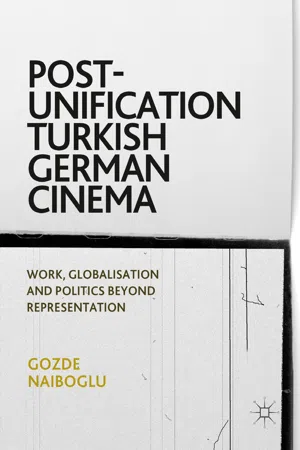
Post-Unification Turkish German Cinema
Work, Globalisation and Politics Beyond Representation
- English
- ePUB (mobile friendly)
- Available on iOS & Android
eBook - ePub
Post-Unification Turkish German Cinema
Work, Globalisation and Politics Beyond Representation
About this book
Information
Subtopic
Film & Video© The Author(s) 2018
Gozde NaibogluPost-Unification Turkish German Cinemahttps://doi.org/10.1007/978-3-319-64431-8_11. Introduction
Gozde Naiboglu1
(1)
University of Leicester, Leicester, Leicestershire, UK
This book examines what came to be known as Turkish German Cinema from the period following the German Unification in 1990, with a focus on ethics , affectivity and labour . Today, Turkish German Cinema broadly refers to a diverse set of films that deal with the transformations that the labour migration from Turkey to Germany brought about in the last 50 years. Mass migration from Turkey to Germany was initiated with the labour migration agreement, which was signed between the two countries in 1961. Within the past few decades, this migration has radically changed the cultural, social and political spheres in Germany, which in turn has generated a growing body of work classified under the subdiscipline of intercultural German studies. The study of film in this category has resulted in a diverse body of work, focused on certain aesthetic, formal, narrative traits and tropes.
In their introduction to the first edited collection in the English language to focus solely on Turkish German Cinema, Sabine Hake and Barbara Mennel argue that there has been a shift in focus in the films produced after the fall of the Berlin Wall in 1989. They write,
Turkish German cinema is often associated with a particular sensitivity toward national belonging and ethnic embodiment and an acute awareness of the politics of identity and place. However, this body of work has more recently been associated with attempts to complicate and destabilize discourses – of social realism and fluid attachments in a globalized world. The films made since the 1990s tell stories about the problems of dislocation and integration; yet they also open up new ways of thinking beyond fixed categories of identity and the binary logic of native and foreign, home and abroad, and tradition and modernity. (Hake and Mennel 2013: 1)
As Hake and Mennel argue, a new generation of Turkish German filmmakers, such as Seyhan Derin , Aysun Bademsoy , Thomas Arslan , Fatih Akın , Yüksel Yavuz and Hussi Kutlucan , have invented new ways to tackle issues such as dislocation and integration , which in turn have caused film scholars to ‘realign their compass of historical and theoretical analysis’ (Koepnick and Schindler 2007: 8). Within the scholarship on Turkish German film, this has often been identified and analysed on the level of narrative and representation, through hermeneutic approaches that focus on national, ethnic and gender difference and identities.
In his discussion of Thomas Arslan’ s cinema, Marco Abel criticises this tendency to focus on identity and meaning for being reductive, and argues that such representational analyses block productive investigations into the oeuvre of Turkish German filmmakers, which might open them up ‘to contexts that cannot readily be reduced to an identitarian, or representational framework’ (2012: 44). Abel suggests that an alternative approach could release the political potential of the films by enabling a consideration of how films can creatively ‘constitute Germany anew, as a new people…without presuming to know already who the Germans and its Others are’ (Abel 2013: 54). In line with this argument, the chapters in this book explore Turkish German film after Unification, with a focus on the ethics and aesthetics of change, informed by materialist approaches that challenge representational thinking. However, the purpose here is different; instead of reterritorialising differences within the German national context, the emphasis will instead be on situated yet transversal experiences of work, labour , social reproduction and precarity in relation to migration and displacement, as expressed in the audiovisual configurations of film.
The shift in Turkish German Cinema in the 1990s can be better understood within the wider context of the political and social transformations that globalisation has given rise to. Since the end of the Cold War, neoliberalism has rapidly become the dominant world system. Its destabilising forces such as technological advances, neoliberal economy, deterritorialisation of borders and increased mobility, combined with the effects of the worldwide financial crisis and September 11, 2001, have transformed the social sphere in radical ways. The effects of such destabilising transformations have produced new forms of affects, subjectivities and precarious living and working conditions that have inspired filmmakers to invent new aesthetic strategies to articulate this change and make sense of such unprecedented conditions.
As Steven Shaviro argues, these changes in technologies and economic relations have brought about ‘new ways of manufacturing and articulating lived experience…that are so new and unfamiliar that we scarcely have the vocabulary to describe them, and yet have become so common, and so ubiquitous, that we tend not even to notice them any longer’ (2010: 2). These new relations are not containable within the confines of binary categories and identities, and the experiences are not reducible to psychological states or emotions, and precisely for that reason they challenge representational frameworks. Shaviro argues that, every emotion carries ‘a certain surplus of affect that escapes confinement’, drawing on Brian Massumi ’s distinction of affect and emotion (2010: 4). According to this distinction, affect is ‘primary, non-conscious, asubjective or presubjective, asignifying, unqualified, and intensive’, while emotion is ‘derivative, conscious, qualified, and meaningful’; and existence and experience are always ‘bound up in affective and aesthetic flows that elude cognitive definition and capture’ (Shaviro 2010: 3–5). It is through these affective flows that subjectivity is ‘opened to and constituted through, broader social, political and economic processes’, and therefore such affective processes are precisely the zone where change and potential can be mapped creatively and not representationally (Shaviro 2010: 4).
Despite this unprecedented intensification of globalisation ’s deterritorialising forces, politics of borders and immigration have become more acute than ever in recent years. Germany’s relationship with immigration and its migrant population has never been less than problematic and complex, but with the global intensification of hostility against migration and migrants in the twenty-first century, the politics of immigration have taken a sharp turn. In October 2010, during her address to the young Christian Democratic Union members in Potsdam near Berlin, the German chancellor Angela Merkel declared that the country’s efforts to build a multicultural society had ‘utterly failed’ (Sinico and Kuebler 2010). Merkel’s emphasis was on the effects of immigration on Germany particularly in the last 20 to 30 years and the unwillingness or failure of the migrants to integrate into German society. Merkel was not only signalling a diversion to a new politics of migration , but by presenting multiculturalism as a direct result of integration, thus placing full responsibility on the migrants, she was also repeating the widespread, age-old integration debate, which can be summarised as the expectation from migrants to adopt, and adapt to, the host country’s culture and values. Integration as a social category at best creates the division of ‘good’ and ‘bad’ migrants, and at worst, its failure leads to the antagonism, insecuritisation, marginalisation and criminalisation of migrants. As a political discourse, integration has been adopted by both the centre left and the centre right; the state, media and the visual culture each celebrate the figureheads of integration and condemn its failures. The prevailing approach to Turkish German feature films tend to ascribe to this binary, favouring narratives and tropes that were postintegration, therefore modernised and hybridised.
One of the direct outcomes of the emphasis on integration in the scholarly debates has been the elimination of a central topic in Turkish German Cinema from such discussions: notably the issue of work and labour . These issues—work, unemployment, insecurity and illegal work, social reproduction , exhaustion and precarity—have been prevalent topics within Turkish German Cinema since its inception. From earlier documentaries that examine the precarious working conditions of Turkish labour migrants, such as Günter Wallraff’s Ganz Unten (Lowest of the Low, 1985), to more recent and subtler explorations of the changing nature of labour in Christian Petzold’s Jerichow (2009), issues of labour and its transformation from the early days of migration to post-Fordism and its twenty-first century forms have been central to films that explore the afterlife of Turkish labour migration to Germany. The following chapters present the proposition that Turkish German Cinema has provided a sustained critique of the changing forms of work and life in Germany, as the films have expressed the need to reformulate issues of ethics, subjectivity, labour and reproduction in the passage to global capitalism.
Existing criticism of contemporary Turkish German Cinema tends to focus on narrative tropes such as integration, entrapment and female victimisation through spatial terms. The films are often viewed through the framework of identitarian politics, which, as Abel argues, ‘locate a film’s politics and political efficacy in the degree to which a film does justice to the real lives of this or that identity’ (2013: 40). This book will however view the films in their own right, having the capacity to create affect and affective experiences through their audiovisual configurations.
Turkish German Cinema Since the 1990s
The critical interest in Turkish German Cinema within Anglo-American film scholarship was initiated mainly by Deniz Göktürk’s seminal article ‘Turkish Delight-German Fright’, in which she discusses a major shift that took place in Turkish German Cinema in the 1990s. She argues that post-Unification Turkish German Cinema evolved from being a ‘cinema of duty’ , towards becoming a cinema that illustrates what she terms the ‘pleasures of hybridity’ (2001: 131). For Göktürk, whereas the Turkish migrants of the earlier generation were depicted as voiceless, archaic and passive figures in films of the previous decades such as Helma Sanders-Brahms ’s Shirins Hochzeit (Shirin’s Wedding, 1976) and Tevfik Başer’s 40 qm Deutschland (40 Square Meters of Germany, 1986), themes of humour and playfulness in the films of the second-generation Turkish German filmmakers such as Fatih Akın , Thomas Arslan , Ayşe Polat and Buket Alakuş introduced a new dimension to this minor cinema of the social realist tradition. Göktürk critiques stereotyping via narratives of victimisation, alienation and confinement and welcomes this narrative turn as a celebration of multiculturalism , integration and hybridity .
Shedding new light on this cinema, which had until then been mostly neglected in German and film studies in the English language, this debate initiated by Göktürk has become the dominant framework, and it was further expanded and elaborated on by various scholarly articles, mainly focusing on gender relations and the construction of spaces on screen (Eren 2003; Göktürk 2000; Mennel 2002a; Naiboglu 2010). Most studies of Turkish German films focus on what Kobena Mercer has famously referred to as the ‘burden of representation’: a presumed duty to be representative of a minority culture as a whole, which haunts the discussion of migrant and diasporic cinemas, and which Göktürk affiliates ...
Table of contents
- Cover
- Front Matter
- 1. Introduction
- Part I. The Berlin School and Turkish German Cinema
- Part II. Documentary Film
- Part III. Social Realism
- Back Matter
Trusted by 375,005 students
Access to over 1.5 million titles for a fair monthly price.
Study more efficiently using our study tools.
Frequently asked questions
Yes, you can cancel anytime from the Subscription tab in your account settings on the Perlego website. Your subscription will stay active until the end of your current billing period. Learn how to cancel your subscription
No, books cannot be downloaded as external files, such as PDFs, for use outside of Perlego. However, you can download books within the Perlego app for offline reading on mobile or tablet. Learn how to download books offline
Perlego offers two plans: Essential and Complete
- Essential is ideal for learners and professionals who enjoy exploring a wide range of subjects. Access the Essential Library with 800,000+ trusted titles and best-sellers across business, personal growth, and the humanities. Includes unlimited reading time and Standard Read Aloud voice.
- Complete: Perfect for advanced learners and researchers needing full, unrestricted access. Unlock 1.5M+ books across hundreds of subjects, including academic and specialized titles. The Complete Plan also includes advanced features like Premium Read Aloud and Research Assistant.
We are an online textbook subscription service, where you can get access to an entire online library for less than the price of a single book per month. With over 1.5 million books across 990+ topics, we’ve got you covered! Learn about our mission
Look out for the read-aloud symbol on your next book to see if you can listen to it. The read-aloud tool reads text aloud for you, highlighting the text as it is being read. You can pause it, speed it up and slow it down. Learn more about Read Aloud
Yes! You can use the Perlego app on both iOS and Android devices to read anytime, anywhere — even offline. Perfect for commutes or when you’re on the go.
Please note we cannot support devices running on iOS 13 and Android 7 or earlier. Learn more about using the app
Please note we cannot support devices running on iOS 13 and Android 7 or earlier. Learn more about using the app
Yes, you can access Post-Unification Turkish German Cinema by Gozde Naiboglu in PDF and/or ePUB format, as well as other popular books in Medien & darstellende Kunst & Film & Video. We have over 1.5 million books available in our catalogue for you to explore.