This book examines the American industrial strategy, from the late 70s to the present day, in what is now known as the 'neoliberal era'. The author illustrates the ways in which the protection and promotion of American companies and industries took place in the context of the international 'free market'. He provides clear evidence of how the economic power of the United States – wielded to influence the formal and informal institutions of the neoliberal order – has been used as a tool for enhancing its competitive advantage against other world economies.
eBook - ePub
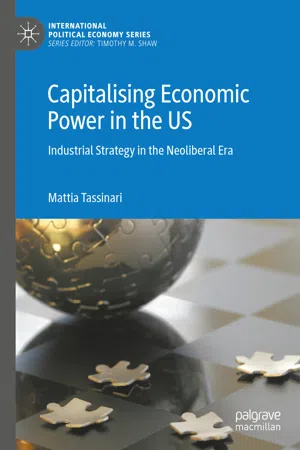
Capitalising Economic Power in the US
Industrial Strategy in the Neoliberal Era
- English
- ePUB (mobile friendly)
- Available on iOS & Android
eBook - ePub
About this book
Information
© The Author(s) 2019
Mattia TassinariCapitalising Economic Power in the USInternational Political Economy Serieshttps://doi.org/10.1007/978-3-319-76648-5_11. Introduction
Mattia Tassinari1
(1)
Department of Economics and Management, University of Ferrara, Ferrara, Italy
Keywords
Economic powerInstitutionsIndustrial developmentIndustrial strategyUnited StatesThe last 40 years have seen our everyday life increasingly influenced by the global economic dynamic. Interconnections among the world economies have resulted in new formal and informal institutions . National governments have progressively changed their role at both domestic and international level. The enlargement of the markets’ scope has called for specialization, efficiency in production and new ways to do business, fostering processes of international division of labour. Innovation and technological change have determined a rise in productivity and radical processes of structural adjustment in many countries. Globalization has meant new life styles for many people, by varying models of consumption and working, by modifying the development status of societies and by defining new modalities of relation within them.
The ongoing process of global transformation has not had the same impact around the world and within societies. Competition to survive and succeed in the international marketplace, as the founding element of the contemporary global economy, has stimulated private and political actors to put in place strategic actions in order to gain competitive advantage, to reduce threats coming from competitors and to maintain economic supremacy over rivals.1 With this setting, differences in initial endowments of resources and capabilities, in basic institutions and in modalities to participate in global production networks, have discriminated between “winners” and “losers” in the international economic game. Rising productivity, income growth and high standards of living for some groups have coexisted with unemployment, marginalization and stagnation for some others.2
In this context, economic power has been one of the fundamental forces to determine the outcome of the global economic game and its evolution over time. Economic power refers to the ability of the members (or subsystems) of the international economy to control and organize productive resources. It is the capacity of exerting an influence over the conformation and results of an organization by determining the allocation of its productive resources. Private and political actors endowed of higher economic power have prevailed in directing productive forces, according to the nature of the interest they intended to pursue.3 Interactions among the different economic power depositaries (i.e. public governments, financial institutions , enterprises, consumers, etc.) have determined the outcome of the international system, in terms of—for example—what types of goods and services have been produced, their amount and distribution, the grade of productive efficiency and technological innovation, capabilities and freedoms made available to the society, relations of production and consumption and future consequences of this general result. Accordingly, the actual conformation of the global economy reflects, to some extent, the distribution of economic power among its members, as the condition that enforces certain interests over others, influences the individual results reached by the agents and determines the direction of the system as a whole.4
In this context, economic power is based upon several individual factors, such as existing endowments of resources, capital and capabilities of specific actors (including, for instance, knowledge, information, skills and technical competences, capacity of analysis and of defining proper goals, attitude to innovate, persuasion abilities, etc.). Moreover, interrelations among members of the system and their different capabilities create collective constraints and incentives that affect the individual actions, by setting a particular institutional framework of reference. Institutions constitute the rules through which economic power can exert its influence over the results of the system. Competition for obtaining and maintaining economic power stimulates the strategic efforts of the actors to gain a “rent position”, by improving individual capabilities, given certain rules of the game, but also by controlling the dynamic of institutional change.5
Eventually, changes in the system outcome can be determined by a redistribution of economic power among the agents and by the result of the competition among vested interests. For instance, the dissatisfaction of some actors of the system for the results they achieved, a different perception of their position and role played within the system and new expectations on the outcome to be pursued, can generate internal conflicts and tensions that induce change in economic power distribution, in the fundamental institutions and in the final resources allocation of the organization.6 Understanding how the actors of the global economy have historically achieved, maintained and exercised their economic power is an essential element to explain the results and the changes of the contemporary international system.
This book is about the US economic power in the context of the global system. It analyses the American industrial strategy from the late 1970s to the present day, what is now known as the “neoliberal era ”, as the way in which the protection and promotion of the American economic system has taken place in the context of the international “free market ”. The work provides clear evidence of how the economic power of the United States—wielded to influence the formal and informal rules of the neoliberal order—has been used as a tool for enhancing its competitive advantage against other world economies. In this perspective, the US government’s role in promoting the national industrial system is a key standpoint which helps to explain the dynamic of the American economic power .7
This perspective, focused on public intervention in the productive system, could sound exceedingly out of place when referring to the United States, inasmuch a country where the “antipathy for government, and the corresponding belief in individualism, competition, and the marketplace, go back to the days of the founding” (Etzioni 1983: 47) . And perhaps this attitude has been particularly true during the neoliberal era , a period characterized by a radical increase in interactions among world economies, a substantial enlargement of the extension of the markets, and a supposed withdrawal of governments in favour of laissez-faire economic liberalism . Indeed, starting from the 1980s, many governments began to change their scope for action, abandoning, to some extent, the protectionist approach that had characterized the previous decades. This neoliberal wave became particularly popular around the world just when President Reagan in the United States (and Prime Minister Thatcher in the UK ) began a campaign of clear opposition to public intervention. In this context, the Americans’ affection for the free market , as a foundation of efficient and dynamic economies, led to painting government intervention into productive dynamics as an unwelcome intrusion, more inclined to respond to rent-seekers’ pressures rather than to improve economic and societal outcome. This spirit started to push the US commitment to the international promotion of free(er) trade with exceptional continuity over time.
Whilst this is the most commonly highlighted narrative in the relevant literature, there is a side of the story that most often remains in the shade. In spite of the American rhetoric of the last 40 years, the analysis on the practices of government intervention depicts the United States as moving away from the image of unconditional and g...
Table of contents
- Cover
- Front Matter
- 1. Introduction
- 2. Contextualizing the American Industrial Strategy in the Neoliberal Era
- 3. The Rise of the Neoliberal Rhetoric: Reaganomics and Its Contradictions
- 4. The End of the Cold War and the New Neoliberal Order
- 5. Industrial Strategy During the New Economy
- 6. Incubating the Crisis: Bush Junior Back to the Old Economy
- 7. The Great Recession and Recovery Under the Obama Administration
- 8. Trumponomics Facing a New Global Governance: Is the American Neoliberal Strategy Still Viable?
- 9. Conclusion: The Illusion of the Economic Power
- Back Matter
Trusted by 375,005 students
Access to over 1.5 million titles for a fair monthly price.
Study more efficiently using our study tools.
Frequently asked questions
Yes, you can cancel anytime from the Subscription tab in your account settings on the Perlego website. Your subscription will stay active until the end of your current billing period. Learn how to cancel your subscription
No, books cannot be downloaded as external files, such as PDFs, for use outside of Perlego. However, you can download books within the Perlego app for offline reading on mobile or tablet. Learn how to download books offline
Perlego offers two plans: Essential and Complete
- Essential is ideal for learners and professionals who enjoy exploring a wide range of subjects. Access the Essential Library with 800,000+ trusted titles and best-sellers across business, personal growth, and the humanities. Includes unlimited reading time and Standard Read Aloud voice.
- Complete: Perfect for advanced learners and researchers needing full, unrestricted access. Unlock 1.5M+ books across hundreds of subjects, including academic and specialized titles. The Complete Plan also includes advanced features like Premium Read Aloud and Research Assistant.
We are an online textbook subscription service, where you can get access to an entire online library for less than the price of a single book per month. With over 1.5 million books across 990+ topics, we’ve got you covered! Learn about our mission
Look out for the read-aloud symbol on your next book to see if you can listen to it. The read-aloud tool reads text aloud for you, highlighting the text as it is being read. You can pause it, speed it up and slow it down. Learn more about Read Aloud
Yes! You can use the Perlego app on both iOS and Android devices to read anytime, anywhere — even offline. Perfect for commutes or when you’re on the go.
Please note we cannot support devices running on iOS 13 and Android 7 or earlier. Learn more about using the app
Please note we cannot support devices running on iOS 13 and Android 7 or earlier. Learn more about using the app
Yes, you can access Capitalising Economic Power in the US by Mattia Tassinari in PDF and/or ePUB format, as well as other popular books in Politics & International Relations & Business General. We have over 1.5 million books available in our catalogue for you to explore.