This book examines the learning and development process of students' scientific thinking skills. Universities should prepare students to be able to make judgements in their working lives based on scientific evidence. However, an understanding of how these thinking skills can be developed is limited. This book introduces a new broad theory of scientific thinking for higher education; in doing so, redefining higher-order thinking abilities as scientific thinking skills. This includes critical thinking and understanding the basics of science, epistemic maturity, research and evidence-based reasoning skills and contextual understanding. The editors and contributors discuss how this concept can be redefined, as well as the challenges educators and students may face when attempting to teach and learn these skills. This edited collection will be of interest to students and scholars of student scientific skills and higher-order thinking abilities.
eBook - ePub
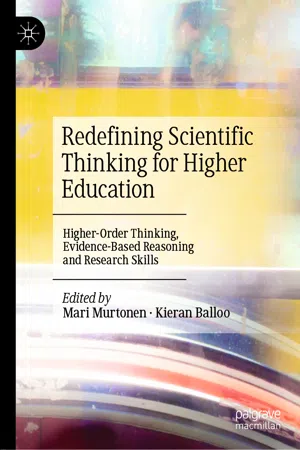
Redefining Scientific Thinking for Higher Education
Higher-Order Thinking, Evidence-Based Reasoning and Research Skills
- English
- ePUB (mobile friendly)
- Available on iOS & Android
eBook - ePub
Redefining Scientific Thinking for Higher Education
Higher-Order Thinking, Evidence-Based Reasoning and Research Skills
About this book
Information
Topic
EducationSubtopic
Educational Psychology© The Author(s) 2019
M. Murtonen, K. Balloo (eds.)Redefining Scientific Thinking for Higher Educationhttps://doi.org/10.1007/978-3-030-24215-2_11. Broadening the Theory of Scientific Thinking for Higher Education
Mari Murtonen1, 2 and Heidi Salmento3
(1)
Faculty of Education and Culture, Tampere University, Tampere, Finland
(2)
Department of Teacher Education, University of Turku, Turku, Finland
(3)
University of Turku, Turku, Finland
Introduction
University education across all disciplines aims to produce thinking skills in students that reflect the principles and practices of scientific research and rigour. University graduates are expected to use these higher order thinking skills in their future jobs to solve the complex problems of today’s world. By utilising these thinking skills, individuals are presumed to overcome the limitations of layman thinking, such as, gut feelings and non-scientific beliefs. They are supposed to use evidence-based reasoning by benefitting from the best research knowledge available related to the question at hand.
Although the thinking skills described above are extremely important, there is no common theory or even an agreed name for these thinking skills in higher education. In this chapter, a new theory named scientific thinking in higher education is proposed that combines the former theories related to this subject and empirical results concerning university teachers’ views of scientific thinking. This broad conceptualisation of scientific thinking builds on theories of the development of scientific thinking in natural sciences, the development of critical thinking in higher education, the theories of reasoning at different ages, and theories about the development of epistemological beliefs.
When looking at the history of scientific thinking, there have been many attempts to name, define and clarify what these skills are. According to Woolley et al. (2018), the above mentioned skills have been defined and named by many researchers and associations as scientific process skills, procedural skills, experimental and investigative science, habits of mind, scientific inquiry abilities, scientific reasoning skills, knowledge seeking behaviours with the coordination of theory and evidence, critical thinking skills, science process skills, basic skills, integrated skills, scientific literacy, and so on. Many of these have only concerned the natural sciences. The aim of this current work is to find something in common for all disciplines that are involved in university-level knowledge building. We base our suggestion on both previous research traditions on higher order thinking skills and empirical results depicting university teachers’ views of their students’ scientific thinking skills.
Kuhn, Amsel, and O’Loughlin (1988) state in the preface of their book, The development of scientific thinking skills, that “Skills in the coordination of theories and evidence are the most central and fundamental skills that define scientific thinking”. That is also the starting point for our broader theory of scientific thinking in higher education. Attention will be especially focused on the “skills” element, since in the case of adult learners in university, the skills that need to develop in the scientific endeavour across the disciplines are very challenging. The name scientific thinking was selected here for the new theory because it best describes the features that are important and common across the disciplines.
In proposing a new, broader theory of scientific thinking, the word science itself may create a problem due to its connection to natural sciences. Therefore, an analysis of the term science is presented and we show how it can be used in a broader sense to describe the thinking skills used across all academic domains. We also elaborate on how the new theory can aid instruction, since scientific thinking skills are extremely important to teach students during university education.
On the Meaning and Nature of “Scientific” Across Different Disciplines
The Meaning and Usage of the Word Science
In many instances, the word science is often used as a synonym for natural science. This is especially the case in the English language. In some languages the term science is not so closely attached to the natural sciences. For example, the German word Wissenschaft includes the ideas of knowledge and making, so it has a much broader meaning than the English word science. While science can be understood to include only natural sciences, social sciences and formal sciences, “Wissenschaft also includes the humanities, art, philosophy, and religion, and refers to learning and knowledge in general, whether obtained through scientific or non-scientific means” (Wiktionary, n.d.).
Scandinavian languages have adopted the idea of German Wissenshaft, for example, the Swedish vetenskap includes the word “vet” meaning “to know” and skap referring to a specific area or domain. Accordingly, the Finnish word tiede originates from the words “to know” and the whole word has the same logic as the Swedish idea of a domain, so it is used more broadly to refer to all disciplines in university.
Although the English word science is prima facie connected to natural sciences, it is used in a broader sense in many situations. Searching for the names of disciplines, faculties and departments of universities on the Internet, terms such as educational sciences, human sciences, medical sciences, economic sciences and historical sciences sit side by side with more natural science ones. Additionally, the word science is visible in many journal names in disciplines that are not considered to be natural sciences. For example, in the area of education, the International Journal of Educational Sciences states that it “publishes manuscripts that have direct relevance to the principles of learning and teaching, the significance of quality education, the role of technology in education, application of psychological concepts to education, student health and wellness, the importance of curriculum development and sociology of education”. Similarly, the journal Educational Sciences: Theory & Practice describes itself as “an international scientific journal for the publication of research and studies covering all aspects of education and education-related issues”. Thus, it is apparent that the word science is already used very broadly in many situations and connected to many academic disciplines.
Nature of Science in Different Disciplines
In addition to reflecting on the different usages of the word science, we should also question what science is and what it does in order to consider if it is suitable for a wider usage across disciplines. According to Hoover and Donovan (2011, p. vii), “science is about the reduction of uncertainty in a world of phenomena that are only partially knowable through observation”. This is a common goal of many, if not all, university disciplines. Research in various domains aims at understanding reality better, overlapping the human restrictions, both in observation and thinking. It is not only the so-called “hard sciences” which observe material reality, but also the “soft sciences”, such as social, economic and human sciences, that want to understand the world better. “Science is a process of thinking and asking questions”, Hoover and Donovan continue (2011, p. 3), portraying a very broad conception of science, applicable to all disciplines in universities.
In addition to the goals of science, there can be various other factors that have an impact on our conceptions of science. According to Ziman (2000), science generates knowledge, but how this knowledge generation is done, where it is done and by whom, is not as clear as it used to be. The new picture of science is more complicated and not so sharply defined as the outmoded stereotype, which has not been replaced but enlarged by concepts such as cultural elements, individual acts and collective processes. Ziman sums up that the notion of the scientific “method” is thus seen to extend outside the laboratory to a whole range of social practices.
A further question concerns whether there are some general features or principles in common for all disciplines. Disciplinary differences must, of course, be taken into account, but we also argue that it is important to try to find some common ground, especially for educational purposes in higher education. In 1959, Snow gave his now famous Rede Lecture at Cambridge (see Snow, 1964) about “the two cultures”, in which he suggested and warned that western society had been divided into two poles, scientific and non-scientific. The notion was studied further by Biglan (1973) and developed by Becher (1994), who proposed a model to divide the disciplines into hard pure (natural sciences), soft pure (humanities and social sciences), hard applied (science-based professions) and soft applied (social professions). Debates concerning the different types of science date back to the history of science and especially to the times when the “softer” topics were introduced to be included in science. When Darwin demonstrated that humans were not so distant from other animals in 1859 (see Darwin, 1979), entirely new methods of studying human beings arose (De Landsheere, 1988...
Table of contents
- Cover
- Front Matter
- Part I. Components of Scientific Thinking in Higher Education
- Part II. Challenges for the Development of Scientific Thinking in Higher Education
- Part III. Fostering the Development of Scientific Thinking in Higher Education
- Back Matter
Trusted by 375,005 students
Access to over 1.5 million titles for a fair monthly price.
Study more efficiently using our study tools.
Frequently asked questions
Yes, you can cancel anytime from the Subscription tab in your account settings on the Perlego website. Your subscription will stay active until the end of your current billing period. Learn how to cancel your subscription
No, books cannot be downloaded as external files, such as PDFs, for use outside of Perlego. However, you can download books within the Perlego app for offline reading on mobile or tablet. Learn how to download books offline
Perlego offers two plans: Essential and Complete
- Essential is ideal for learners and professionals who enjoy exploring a wide range of subjects. Access the Essential Library with 800,000+ trusted titles and best-sellers across business, personal growth, and the humanities. Includes unlimited reading time and Standard Read Aloud voice.
- Complete: Perfect for advanced learners and researchers needing full, unrestricted access. Unlock 1.5M+ books across hundreds of subjects, including academic and specialized titles. The Complete Plan also includes advanced features like Premium Read Aloud and Research Assistant.
We are an online textbook subscription service, where you can get access to an entire online library for less than the price of a single book per month. With over 1.5 million books across 990+ topics, we’ve got you covered! Learn about our mission
Look out for the read-aloud symbol on your next book to see if you can listen to it. The read-aloud tool reads text aloud for you, highlighting the text as it is being read. You can pause it, speed it up and slow it down. Learn more about Read Aloud
Yes! You can use the Perlego app on both iOS and Android devices to read anytime, anywhere — even offline. Perfect for commutes or when you’re on the go.
Please note we cannot support devices running on iOS 13 and Android 7 or earlier. Learn more about using the app
Please note we cannot support devices running on iOS 13 and Android 7 or earlier. Learn more about using the app
Yes, you can access Redefining Scientific Thinking for Higher Education by Mari Murtonen, Kieran Balloo, Mari Murtonen,Kieran Balloo in PDF and/or ePUB format, as well as other popular books in Education & Educational Psychology. We have over 1.5 million books available in our catalogue for you to explore.