eBook - ePub
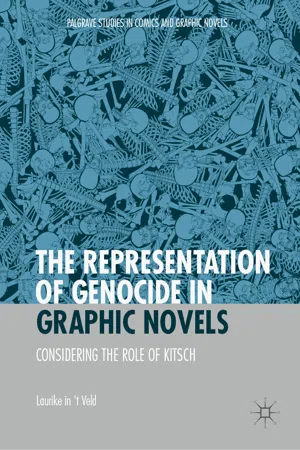
The Representation of Genocide in Graphic Novels
Considering the Role of Kitsch
- English
- ePUB (mobile friendly)
- Available on iOS & Android
eBook - ePub
About this book
Information
© The Author(s) 2019
Laurike in 't VeldThe Representation of Genocide in Graphic NovelsPalgrave Studies in Comics and Graphic Novelshttps://doi.org/10.1007/978-3-030-03626-3_11. Introduction: Graphic Novels, Genocide, Kitsch
Laurike in ’t Veld1
(1)
Center for Historical Culture, Erasmus University Rotterdam, Rotterdam, Zuid-Holland, The Netherlands
Laurike in ’t Veld
There is now a substantial group of graphic novels that tackle the highly sensitive and complex topic of genocide. Although it might be too early to speak of a fully developed subgenre, there are certainly commonalities between these works, even though they focus on different genocides. This book takes these graphic novels about genocide as its starting point, driven by the conviction that the analysis of this group of works will lead to important knowledge about the medium-specific ways in which cultural texts engage with historical instances of mass violence. Graphic novels that deal with genocide will inevitably respond to and intervene in the ongoing debates around (in)appropriate forms of genocide representation. In attempting to find productive ways of dealing with the difficult subject matter, these works balance explicit truth claims with more immersive strategies that aim to connect with a wider audience: a tension between “didacticism and sensationalism” (1989, 43) that Joseph Witek ascribes to historical comics in general.
This book mobilises the concept of kitsch to investigate these tensions around representations of genocide. As a cultural and visual concept, kitsch is generally associated with elements like excess , aestheticisation , and (emotional) manipulation and it is often seen as a questionable mode when dealing with precarious topics like mass violence, destruction, and death. Debates around (in)appropriate representations of genocide have centred on the Holocaust, but in the last few decades they have moved on to include other genocide texts as well. 1 Where initial debates in Holocaust studies were primarily focused on the “unrepresentability” of the Holocaust , there seems to have been a shift to a more detailed engagement with some of the visual and narrative strategies employed. Key elements in debates around the representation of the Holocaust are the extent to which the texts under scrutiny distort, aestheticise, trivialise, and dramatise the genocidal events. There remains the suggestion, sometimes explicitly communicated, sometimes implicitly inferred, that the Holocaust cannot be captured adequately in words or images that violate the moral guidelines of silence and restraint . Another concern is that these techniques will decontextualise the Holocaust and create a universal moral narrative that ignores historical specificities. Many scholars concerned with the representation of the Holocaust focus on texts that follow (post)modernist techniques like self-reflexivity, fragmented narratives, and anti-redemptory messages, explicitly or implicitly reinforcing the (academic) value and moral superiority of these representational strategies. 2
Throughout this book, I theorise kitsch as an aesthetic mode that is characterised by a simultaneous sense of being too much and too little. On the one hand, kitsch constitutes plenitude, excess, and transgression. It points to a use of a medium that is seen as excessive, often through a surplus of visuals, melodramatic narrative techniques, and the constant eliciting of inauthentic emotional responses (e.g. Greenberg 1961; Sontag 2001, originally published in 1974; Friedländer 1993; Kulka 1996). Kitsch is frequently considered to be morally transgressive, violating ethical standards in search for an affective response to the text. On the other hand, kitsch harbours a sense of being “too little”; it simplifies morally and politically complex situations and provides a reductive template through which we are invited to interpret the world (e.g. Sturken 2007; Rothe 2011). The effects of this interaction between excess and simplification is that kitsch offers a sentimental, spectacular, and universalised reading of historical reality. In this book, I place kitsch in dialogue with modernism , which I navigate as a cultural sensibility and mode of representation that is characterised by formal experimentation and a desire to explore human subjectivity in an often “confusing and difficult mental landscape” (Childs 2008, 6). Part of my working definition of modernism is that key modernist strategies mirror some of the central arguments in trauma studies about the disruptive and overwhelming effect of traumatic events on its witnesses (Felman and Laub 1992; Caruth 1995, 1996; Hartman 1994, 1996). Modernism as a cultural response to trauma and genocide thus offers a set of representational strategies that reject transparency and linearity and emphasise subjective witness experiences.
The term genocide was coined by Raphael Lemkin in 1943/1944 and adopted by the UN in 1948. The UN convention determines that “genocide means any of the following acts committed with intent to destroy, in whole or in part, a national, ethnical, racial or religious group”, after which the acts are listed, including causing serious bodily or mental harm and killing members of the group, as well as imposing measures to prevent births. 3 Since then, there has been a great deal of debate about this official definition, particularly because of its exclusion of political groups or social classes and the slippery notion of “intent” (Chalk and Jonassohn 1990; Feierstein 2011; Travis 2012). In addition, the recognition of cases of mass violence as genocide is by no means a straightforward process. For instance, the Armenian genocide is currently still not recognised by Turkey and Azerbaijan. Furthermore, the UN and the Clinton administration’s apprehension in labelling the massacres in Rwanda in 1994 as genocide, as well as the lack of decisive international intervention in both Rwanda and Bosnia, display the political sensitivities around instances of mass violence. Notwithstanding these complexities, I use the term “genocide” in this book following the UN definition, as the graphic novels under scrutiny deal with historical events that have entered public consciousness as primary examples of the systematic destruction of specific groups of people.
In response to the predominantly negative readings of kitsch as meaningless or inappropriate, The Representation of Genocide in Graphic Novels offers a fresh approach that considers how, in these graphic novels that deal with genocide, some of the kitsch strategies can produce meaning, while also facilitating interaction with the genocide narrative. At the same time, I do not completely replace the critical frameworks around genocide and kitsch with an unequivocally positive reading. Instead, I carefully analyse where representational strategies that use kitsch can be valued, and where they still produce problems. Throughout this book, I argue that kitsch can become a powerfully affective tool when it opens up a space for reflection. In these instances, the graphic novels offer compelling and direct forms of representation that intervene in the issues and debates around depictions of mass violence . I argue that kitsch becomes productive when it shows how visual metaphors stand in for victims (see Chapter 2) and I consider how explicit and excessive depictions of violence can produce meaning (see Chapter 4). However , the visual and moral excess of kitsch can also lead to ambiguities that do not necessarily allow for an effective interaction with the genocide narrative. For this reason , I take a more critical stance to kitsch in the representations of perpetrators (see Chapter 3), and in the visual and verbal representations of sexual violence (see Chapter 4). Furthermore, I analyse how graphic novels respond to debates around the limits of representing genocide by using anti-kitsch strategies that include the modernist acknowledgment of the impossibility of representation and the installing of explicit truth claims in the paratext (see Chapter 5).
Scope and Boundaries
Throughout this book, I use a comparative approach , analysing graph...
Table of contents
- Cover
- Front Matter
- 1. Introduction: Graphic Novels, Genocide, Kitsch
- 2. (In)human Visual Metaphors: The Animal and the Doll
- 3. From Gruesome to Grey: The Moralisation of Perpetrators
- 4. Visualising Mass Violence and Sexual Violence
- 5. Modernism and Historical Accuracy: Anti-Kitsch Strategies
- 6. Conclusion
- Back Matter
Trusted by 375,005 students
Access to over 1.5 million titles for a fair monthly price.
Study more efficiently using our study tools.
Frequently asked questions
Yes, you can cancel anytime from the Subscription tab in your account settings on the Perlego website. Your subscription will stay active until the end of your current billing period. Learn how to cancel your subscription
No, books cannot be downloaded as external files, such as PDFs, for use outside of Perlego. However, you can download books within the Perlego app for offline reading on mobile or tablet. Learn how to download books offline
Perlego offers two plans: Essential and Complete
- Essential is ideal for learners and professionals who enjoy exploring a wide range of subjects. Access the Essential Library with 800,000+ trusted titles and best-sellers across business, personal growth, and the humanities. Includes unlimited reading time and Standard Read Aloud voice.
- Complete: Perfect for advanced learners and researchers needing full, unrestricted access. Unlock 1.5M+ books across hundreds of subjects, including academic and specialized titles. The Complete Plan also includes advanced features like Premium Read Aloud and Research Assistant.
We are an online textbook subscription service, where you can get access to an entire online library for less than the price of a single book per month. With over 1.5 million books across 990+ topics, we’ve got you covered! Learn about our mission
Look out for the read-aloud symbol on your next book to see if you can listen to it. The read-aloud tool reads text aloud for you, highlighting the text as it is being read. You can pause it, speed it up and slow it down. Learn more about Read Aloud
Yes! You can use the Perlego app on both iOS and Android devices to read anytime, anywhere — even offline. Perfect for commutes or when you’re on the go.
Please note we cannot support devices running on iOS 13 and Android 7 or earlier. Learn more about using the app
Please note we cannot support devices running on iOS 13 and Android 7 or earlier. Learn more about using the app
Yes, you can access The Representation of Genocide in Graphic Novels by Laurike in 't Veld in PDF and/or ePUB format, as well as other popular books in Social Sciences & Historiography. We have over 1.5 million books available in our catalogue for you to explore.