István KónyaEconomic Growth in Small Open Economieshttps://doi.org/10.1007/978-3-319-69317-0_1
Begin Abstract
1. Introduction
István Kónya1
(1)
Centre for Economic and Regional Studies, Budapest, Hungary
End Abstract
The question of economic development plays a central role in modern societies. Before the Industrial Revolution, people’s worldview was fundamentally static, where increases in general welfare are non-systematic and temporary. If a country was able to achieve broad-based economic growth for a while, this was inevitably ended by wars, epidemics, or population growth that accompanied development (Malthus 2012). It seemed that the only road to individual success was to grab existing positions of power, either by moving into the old elite or by replacing it with a new one. This, however, is a zero-sum game: personal gains can be achieved not by a general increase in welfare but by the redistribution of existing goods.
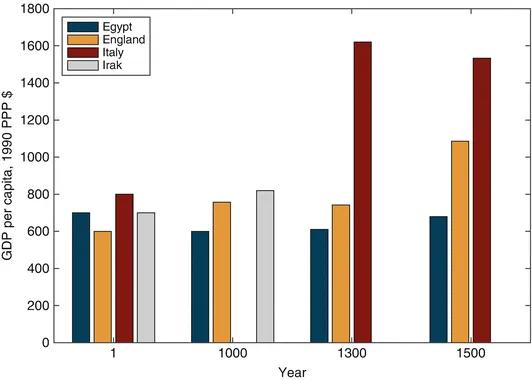
Although very imprecisely, we have estimates for verifying the above. The database of Angus Maddison and its current successor1 paints a rudimentary, but fundamentally accurate picture about the economic performance of the world before the Industrial Revolution. Since there are only a few countries with a suitably long time series, I use the output measures of states that existed in the current territories of Italy, England, Iraq, and Egypt for illustration.
Figure 1.1 clearly shows the fact that in pre-modern societies per capita incomes basically stagnated. The main reason for this is that throughout history technological advances led mostly to population increases. Malthusian theories looked like fundamental laws of nature. When there were differences across nations, the source of these seemed static: abundant local natural resources or appropriation of these resources from elsewhere, controlling important trade routes, or simply just plundering other countries through war. Moreover, these differences were fragile and temporary: it is enough to think of the fall of Roman civilization or the destruction of the Aztec and Inca empires.
Fig. 1.1
Economic development before 1500. The figure presents historical GDP per capita numbers for four countries/regions before 1500. Source: The Maddison Project, http://www.ggdc.net/maddison/maddison-project/home.htm, 2013 version
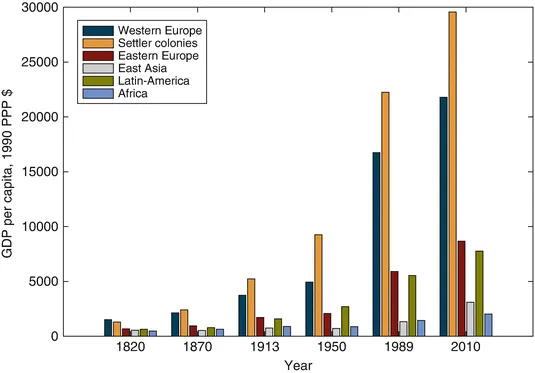
It is ironic that when Malthus published his important book, changes were already under way that offered the world an escape from the Malthusian trap. Also based on the Madison database, Fig. 1.2 is a dramatic illustration of the extent of economic development achieved in the past 200 years. Average per capita income has grown fourfold in Africa, sixfold in East and South Asia, 12-fold in Eastern Europe and Latin America, 14-fold in Western Europe, and almost 23-fold in the so-called settler colonies. A stagnating world was replaced by a dynamic global economy.
Fig. 1.2
Economic development after 1800. The figure presents historical GDP per capita numbers for large geopolitical regions in the modern era. Western Europe: Austria, Belgium, Denmark, Finland, France, Germany, Great Britain, Italy, Netherlands, Norway, Sweden, Switzerland. Settler colonies: Australia, New Zealand, Canada, the USA. Eastern Europe: Albania, Bulgaria, Czechoslovakia, Hungary, Poland, Romania, Yugoslavia. East Asia: China, India, Indonesia, Japan, Philippines, South Korea, Thailand, Taiwan, Bangladesh, Burma, Hong Kong, Malaysia, Nepal, Pakistan, Singapore, Sri Lanka. Latin America: Argentina, Brazil, Chile, Columbia, Mexico, Peru, Uruguay, Venezuela. Africa: changing composition. Source: The Maddison-Project, http://www.ggdc.net/maddison/maddison-project/home.htm, 2013 version
The figure also shows, however, that we can find large differences behind average growth rates. Although most countries of the world are significantly richer now than they were 200 years ago, inequalities across countries have also grown. While Western Europe was about three times as rich as Africa at the beginning of the period, by 2010 this ratio is close to 11. Differences between Western and Eastern Europe have remained basically unchanged.
Growth theory studies the oldest and most central questions of economics. What explains the explosion of global growth after long centuries of stagnation? Why have today’s advanced economies managed to reach sustained, balanced economic growth? What are the reasons behind the relative underdevelopment of the rest of the countries of the world? What are the conditions for a successful catch-up? It is clear that answering these questions is fundamental for the global economy and for individual countries.
It is impossible to answer all these questions in a single book, partly because economics itself offers only partial explanations.2 There may be many reasons behind economic success and failure, and these are discussed in the vast literature on development. It is difficult, however, to gauge the relative importance and general validity of the various factors. There are also significant methodological differences among the different approaches, which make comparing them harder. Macroeconomic time series are short and often patchy, so relying only on empirical findings is not enough.
In this book I study economic growth and development from a relatively narrow perspective. The analysis uses the toolkit of neoclassical growth theory, which started with the seminal contribution of Solow (1956). I view this approach as a very useful and flexible way to summarize and interpret stylized facts. The neoclassical model is modular. At various degrees of complexity and structure, it can serve as a simple tool to make sense of the data and also to calculate counterfactuals and give policy advise. In the book I proceed from basic exercises toward more and more sophisticated modeling and analysis.
I focus on a particular country group, the so-called Visegrad economies: the Czech Republic, Hungary, Poland, and Slovakia. As a comparison group, I also include four advanced European economies: Austria, France, Germany, and Great Britain. The Visegrad countries are a good laboratory for studying growth and convergence. Their transition to market economies started in the early 1990s, when they were significantly poorer than their Western counterparts. They had capital stocks that were partly obsolete, and production efficiency also lagged far behind. Given their proximity to (and expected membership of) the European Union, they were expected to converge relatively quickly both through productivity gains and capital accumulation. The premise of this book is that their experience in the past 20 years can be analyzed and understood with the help of the neoclassical model.
I begin the analysis with a mostly empirical exercise. With minimal assumptions, the neoclassical framework can be used to identify proximate causes of economic growth. This is the classical question of growth accounting: what are the contributions of productivity, capital investment, and labor input to growth in a given period. The same question can be asked not only for a single country over time but also across countries in a given year. Development accounting decomposes differences in economic development between two countries, to contributions of production factors on the one hand and to the contribution of total factor productivity on the other hand.
Growth and development accounting—while not completely free from theoretical assumptions—are primarily descriptive tools to summarize the data. As a next step, assuming somewhat more structure, I examine what the usage of production inputs reveals about the efficiency of factor markets. Efficiency conditions that follow from the neoclassical framework can quantify the extent of factor market distortions. Based on the calculated distortions, I can also predict the growth dividend that would follow from lowering these inefficiencies in particular countries.
In the remaining part of the book, I concentrate on particular versions of the fully specified, general equilibrium neoclassical growth model. After the descriptive or semi-structural approaches, I interpret observed time series through the lens of these particular model economies. First, I try to identify the main stochastic shocks behind the volatility of economic growth in the Visegrad countries. This is done by econometrically estimating a stochastic version of the neoclassical model. Using the model and the estimation results, one can identify the main external factors in a given period. The main question here is the extent to which growth volatility is explained by permanent shocks to productivity or changes in international financial conditions.
Finally, I present an even more detailed model, which has been constructed to understand the impact of the financial crisis of 2008–2009 on the Visegrad economies. I show that the worsening of external financial conditions was an important channel through which the crisis impacted these economies. I also show that initial conditions—primarily the extend of foreign debt—were important to understand the consequences of the financial shock in the four countries. The model can be used to analyze the effectiveness of the observed monetary policy responses to the shock, given initial conditions.
I firmly believe that in order to uncover causal relationships in economics, we need theoretical assumptions and quantitative models. It would perhaps be better to recover these relationships without any assumptions, using only the data. This, however, is not possible: in economics, and in macroeconomics in particular, data are too coarse. Without external assumptions—that cannot be independently verified—we cannot get clear answers. The scope for controlled experiments is also extremely limited, and the best we can hope for is to study the effects of well-identified random shocks. I treat the global financial crisis as such a shock, at least for the Visegrad economies.
Models are indispensable when we want to understand an economic phenomenon. It is important to keep in mind, however, that economic models are always very stylized and that the same model might not be appropriate to answer different questions.3 Therefore, although the book uses a single analytical framework, the model details are different depending on the particular question. The main advantage of this approach is that data are interpreted with the help of a unified, transparent, and consistent framework. There is enough flexibility, however, to highlight theoretical considerations that I feel relevant for a given problem, while pushing the less relevant elements into the background. It is not coincidental that after 60 years the neoclassical growth model is still popular for the analysis of economic development. While I am aware that some of the neoclassical assumptions are questionable, and the framework is not valid under all possible conditions, I find it very useful to analyze “well-behaved” emerging economies such as the Visegrad countries.
As always, choosing a particular modeling tool limits the applicability of the analysis. The neoclassical model is not designed to study many relevant and important aspects of development. Examples include the geographical and social determinants of economic growth, ethical aspects of development, questions of environmental sustainability, or the role and evolution of institutions in economic development. This book does not substitute for the exploration of these important topics, but complements them. My hope is that what follows is a useful addit...
Table of contents
Cover
Front Matter
1. Introduction
Part I. Part I
Part II. Part II
Part III. Part III
Back Matter
Trusted by 375,005 students
Access to over 1.5 million titles for a fair monthly price.
Study more efficiently using our study tools.
Frequently asked questions
Yes, you can cancel anytime from the Subscription tab in your account settings on the Perlego website. Your subscription will stay active until the end of your current billing period. Learn how to cancel your subscription
No, books cannot be downloaded as external files, such as PDFs, for use outside of Perlego. However, you can download books within the Perlego app for offline reading on mobile or tablet. Learn how to download books offline
Perlego offers two plans: Essential and Complete
Essential is ideal for learners and professionals who enjoy exploring a wide range of subjects. Access the Essential Library with 800,000+ trusted titles and best-sellers across business, personal growth, and the humanities. Includes unlimited reading time and Standard Read Aloud voice.
Complete: Perfect for advanced learners and researchers needing full, unrestricted access. Unlock 1.5M+ books across hundreds of subjects, including academic and specialized titles. The Complete Plan also includes advanced features like Premium Read Aloud and Research Assistant.
Both plans are available with monthly, semester, or annual billing cycles.
We are an online textbook subscription service, where you can get access to an entire online library for less than the price of a single book per month. With over 1.5 million books across 990+ topics, we’ve got you covered! Learn about our mission
Look out for the read-aloud symbol on your next book to see if you can listen to it. The read-aloud tool reads text aloud for you, highlighting the text as it is being read. You can pause it, speed it up and slow it down. Learn more about Read Aloud
Yes! You can use the Perlego app on both iOS and Android devices to read anytime, anywhere — even offline. Perfect for commutes or when you’re on the go. Please note we cannot support devices running on iOS 13 and Android 7 or earlier. Learn more about using the app
Yes, you can access Economic Growth in Small Open Economies by István Kónya in PDF and/or ePUB format, as well as other popular books in Economics & Development Economics. We have over 1.5 million books available in our catalogue for you to explore.