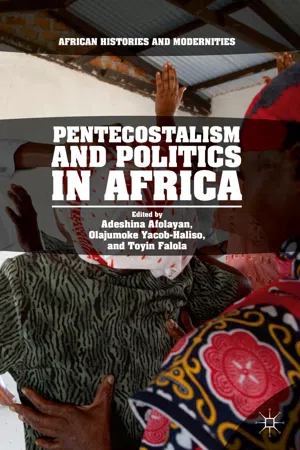
eBook - ePub
Pentecostalism and Politics in Africa
- English
- ePUB (mobile friendly)
- Available on iOS & Android
eBook - ePub
Pentecostalism and Politics in Africa
About this book
As the epicenter of Christianity has shifted towards Africa in recent decades, Pentecostalism has emerged as a particularly vibrant presence on the continent. This collection of essays offers a groundbreaking study of the complex links between politics and African Pentecostalism. Situated at the intersection between the political, the postcolonial, and global neoliberal capitalism, contributors examine the roots of the Pentecostal movement's extraordinary growth; how Pentecostalism intervenes in key social and political issues, such as citizenship, party politics, development challenges, and identity; and conversely, how politics in Africa modulate the Pentecostal movement. Pentecostalism and Politics in Africa offers a wide-ranging picture of a central dimension of postcolonial African life, opening up new directions for future research.
Information
© The Author(s) 2018
Adeshina Afolayan, Olajumoke Yacob-Haliso and Toyin Falola (eds.)Pentecostalism and Politics in AfricaAfrican Histories and Modernitieshttps://doi.org/10.1007/978-3-319-74911-2_11. Introduction: The Pentecostal and the Political in Africa
Adeshina Afolayan1 , Olajumoke Yacob-Haliso2 and Toyin Falola3
(1)
University of Ibadan, Ibadan, Nigeria
(2)
Babcock University, Ilishan-Remo, Nigeria
(3)
University of Texas, Austin, TX, USA
Adeshina Afolayan (Corresponding author)
Olajumoke Yacob-Haliso
The common concern of all the chapters in this volume is to critically explore the complex relationship between politics and Pentecostalism in Africa; or specifically, the relationship between the Pentecostal and the political. We ask, what are the current and pertinent features of African Pentecostalism and Pentecostalism in Africa? What are the antecedents for the establishment, proliferation and legitimization of the Pentecostal movement in Africa? How does Pentecostalism intervene in specific social and political issues, such as secularism, citizenship, endemic poverty, development challenges, ascension to power; and in primordial and political identity questions, including ethnicity and race issues, gender and womanist politics, ecumenism and interfaith relationship, party politics, political participation; and other facets of politics and society in Africa? Conversely, in what ways do the state and the peculiar nature of politics in Africa modulate the Pentecostal movement? Can Pentecostalism be regarded as an alternative vision or a compromised acquiescence to the political order of things in Africa? What theoretical frameworks and paradigms can we deploy for making sense of these questions, and what new hypotheses might we propose for explaining the intersections of Pentecostalism with politics in Africa? This book, Pentecostalism and Politics in Africa, addresses these questions, and more, from interdisciplinary perspectives in order to make a unique contribution to the literature specifically on Pentecostalism, and more broadly on religion and politics and comparative African politics.
Religion has become a defining phenomenon of modern life. This is contrary to the optimism and expectations of those modernization theorists who argued that religion and religious beliefs were primitive sentiments that would, to use the Marxist term, “wither away” as human societies modernize. Unfortunately, religion has failed to wither away. Pentecostalism, in this context, has come a very long way and is now a very strong, global religious force. All over the world Pentecostals are voicing their opinion on a variety of issues ranging from poverty and inequality to democratic representation. But the political essence of Pentecostalism is context-bound. Thus, its spiritual and political contours are shaped by geo-cultural factors that make Africa different from, for example, South America. While Pentecostalism has invaded the political sphere in most South American countries, in the wake of and under the strong influence of liberation theology, it remains to be seen in what specific senses we can begin to interpret the relationship between Pentecostalism and politics in Africa. In other words, in what sense does Pentecostalism qualify as a “political spirituality” à la Ruth Marshall, and how are its “political” and “spiritual” dimensions mediated by its situatedness and the postcolonial context in Africa?
There are already a few brilliant scholarly interrogations of Pentecostalism in Africa, Ogbu Kalu ,1 Ruth Marshall,2 and Nimi Wariboko,3 being the most prominent. While some are serious introductions to Pentecostal theology, many more constitute a critical examination of the political dimension of the Pentecostal movement in Africa. For instance, Freeman’s edited Pentecostalism and Development explores the critical connection between churches, NGOs , and the idea of social change in Africa. In Political Spiritualities , Marshall was concerned with the specific political form that Pentecostalism was taking within “the epistemological, normative, and ontological insecurity of life in urban postcolonial Nigeria”.4
There is as yet no comprehensive study that attempts to cumulate Pentecostalism’s political performances and the many different ways Pentecostal movements intersect and invade the political space in Africa. Pentecostalism in Africa, as most of these studies have demonstrated, is a unique practice that is molded by the specific postcolonial context, and yet, perhaps by further interrogation, we can find areas of symmetry and asymmetry, confluences and divergences. The idea of African politics in its multiple colorations and complexities provides a unique space within which to interrogate the interesting relationship between the religious and the political. The present volume makes a solid contribution in this regard, drawing on multiple disciplinary frameworks, the extant literature, case studies, and ethnographic research.
Politics, Pentecostalism, and the Post/Colonial in Africa
In the history of human evolution there has always been a complex relationship between religion and politics. The constitution of the political, or of the space within which it should manifest, has almost always been inflected by a religious character. One good example is to note the dynamics of the constitution of the public space and, for instance, the agora in the Greek city state or even in some African societies. Marcel Detienne narrates the research experience of French ethnologist Marc Abélès in mapping kinship relationships of the Ochollo society in Ethiopia. The Ochollo hold plenary assemblies on a daily basis that all Ochollo males who have reached puberty can attend and participate in. Interestingly, the discussions “take place inside a circle of stones hewed into the shape of a chair […]. The person who asks the presidents—who are the ‘sacrificers’ of the country—for permission to speak leaves his place and comes to face the assembly in the arc of the circle, in front of the seated presidents.”5
This structure of the Ethiopian agora mirrors the structure of the agora in certain Greek city states, where the site designated as the sanctuary of the gods also served a sociopolitical function as a space for assembly. This relationship became extremely complex and conflictual in the medieval period when the Catholic Church attempted to capture the whole of the religious and the political in a broad understanding of katholikos , a universality that unites all without exception. The specificity of the complex relationship between the religious and the political in the medieval period provides a particular context that sharpens our understanding of how the two categories can or cannot relate. Africa presents another unique and specific context within which the religious and the political can be understood; and this is a peculiar context because we are not just talking of the religious but of the Pentecostal religious. Africa is also a peculiar context since both the religious and the political are mediated by the colonial predicament.
When Christianity came to Africa, it came as part of the total package of the colonial enterprise. The missionaries, together with the European traders, laid the initial groundwork for the colonial situation in Africa. But the interpretation of that moment seems to divide students of colonialism in Africa. On the one hand, there are some who interpret the missionaries’ arrival as a signal for an unwitting positivity. Olufemi Taiwo, in How Colonialism Preempted Modernity in Africa (2010), unabashedly argues that one cannot, without contradiction, disaggregate the arrival of the colonial missionaries from the emergence of modernity. Commencing with what he calls “the peculiar circumstances of Anglophone West Africa” as a methodological warning about not generalizing the “career of colonialism” in Africa, Taiwo contends that, unlike the colonial administrators, “there is no evidence that missionaries similarly set up administrations for the governance of native peoples.”6,7 Thus:
If we take seriously the differences among the classes of Europeans, we must simultaneously reconceptualize the genealogy of modernity in Africa. I argue that the credit for introducing Africans to modernity must go to the missionaries. Of course, this contradicts the received wisdom that attributes the westernization of Africa and the continent’s induction into modernity to colonial administrators. In fact, I go so far as to contend that in their interactions with Africans, the missionaries were the revolutionaries and the administrators were the reactionaries. Once we acknowledge the revolutionary role of missionaries, new analytical possibilities suggest themselves. Modernity is a larger movement than colonialism, and it is the essence that the colonial authorities in different parts of the continent claimed to be implanting in the continent. Missionaries were the first to make the implantation of “civilization,” which for so long was indistinguishable from the forms of social living coterminous with modernity, one of the cardinal objectives of their activities in Africa.8
On the other hand, it would seem that the most important critique, following Mudimbe , derives from the need to see the missionizing enterprise as essentially a political performance. Mudimbe suggests that we read “Christian revelation as a political performance in Africa.”9 In fact, for him, the performances of the three actors in the colonial project—the colonial commissioner, the missionary, and the anthropologist—are all united in their attempts at “‘reenacting’ the Western experience as a sign of knowledge, of human experience, and of God’s revelation.”10 To re-enact revelation as political performance therefore means, in part, according to Mudimbe, a proposed integration “into Western culture as a means of participating in the messianic and paradigmatic extension of the message of the Deus Israel (God of Israel) to Gentiles, thus promoting sameness.”11 Within this context, therefore:
a missionary arrives in an African village. He or she meets the local chief, amicably negotiates a sojourn, and, in most cases, is accepted without problem. The event immediately degenerates into a pattern repeated throughout the continent. The missionary first establishes in the village a network of friends and sympathizers by recourse to generous initiatives and gifts. Second, he or she makes familiar his or her presence by associating it directly with the efficiency of a serving power. The mission, from its beginning, offers its meaning as a vocation of service and promotes schooling and caritative institutions such as dispensaries and hospitals. Third, the missionary inflates the spiritual and political sacredness of his or her own enterprise: the beard of the Catholic priest is identified with wisdom, the white cassock and celibate life of priests and nuns symbolize purity of heart, and missionary activity in general is conflated with God’s will and politics.12
One popular example relating to the inauguration of African philosophy is apposite here. The debate between those who take philosophy as a universal discourse and those who see it as essentially a cultural enterprise in Africa took a new turn with the publication of Bantu Philosophy in 1945 by a Belgian missionary, Father Placide Tempels . This book is significant because, in Abiola Irele’s words, it was the first within the European colonial disc...
Table of contents
- Cover
- Front Matter
- Part I. Introduction
- Part II. Pentecostalism and Society in Africa
- Part III. Pentecostalism and/as Politics in Africa
- Part IV. Conclusion
- Back Matter
Trusted by 375,005 students
Access to over 1.5 million titles for a fair monthly price.
Study more efficiently using our study tools.
Frequently asked questions
Yes, you can cancel anytime from the Subscription tab in your account settings on the Perlego website. Your subscription will stay active until the end of your current billing period. Learn how to cancel your subscription
No, books cannot be downloaded as external files, such as PDFs, for use outside of Perlego. However, you can download books within the Perlego app for offline reading on mobile or tablet. Learn how to download books offline
Perlego offers two plans: Essential and Complete
- Essential is ideal for learners and professionals who enjoy exploring a wide range of subjects. Access the Essential Library with 800,000+ trusted titles and best-sellers across business, personal growth, and the humanities. Includes unlimited reading time and Standard Read Aloud voice.
- Complete: Perfect for advanced learners and researchers needing full, unrestricted access. Unlock 1.5M+ books across hundreds of subjects, including academic and specialized titles. The Complete Plan also includes advanced features like Premium Read Aloud and Research Assistant.
We are an online textbook subscription service, where you can get access to an entire online library for less than the price of a single book per month. With over 1.5 million books across 990+ topics, we’ve got you covered! Learn about our mission
Look out for the read-aloud symbol on your next book to see if you can listen to it. The read-aloud tool reads text aloud for you, highlighting the text as it is being read. You can pause it, speed it up and slow it down. Learn more about Read Aloud
Yes! You can use the Perlego app on both iOS and Android devices to read anytime, anywhere — even offline. Perfect for commutes or when you’re on the go.
Please note we cannot support devices running on iOS 13 and Android 7 or earlier. Learn more about using the app
Please note we cannot support devices running on iOS 13 and Android 7 or earlier. Learn more about using the app
Yes, you can access Pentecostalism and Politics in Africa by Adeshina Afolayan, Olajumoke Yacob-Haliso, Toyin Falola, Adeshina Afolayan,Olajumoke Yacob-Haliso,Toyin Falola in PDF and/or ePUB format, as well as other popular books in History & African History. We have over 1.5 million books available in our catalogue for you to explore.