- English
- ePUB (mobile friendly)
- Available on iOS & Android
eBook - ePub
About this book
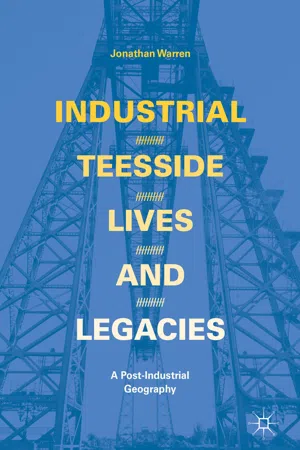
This book evaluates the consequences of economic, social, environmental and cultural change on people living and working within Teesside in the North-East of England. It assesses the lived experiences, working lives, health and cultural perspectives of residents and key stakeholders in the wake of serious de-industralisation in the region. The narrative is embedded within the long-term industrial history of Stockton: an area once dominated by steel, coal and chemical industries. This past still continues to shape its future and influences the ways in which that future is conceived and envisioned. The author explores a 'biography of place' analytical framework to offer a holistic view of the area, which considers the interaction between the social, economic, cultural, visual and environmental legacy of the community, which is firmly grounded in the past, present and future prospects of those who live and work there.
Information
© The Author(s) 2018
Jonathan WarrenIndustrial Teesside, Lives and Legacieshttps://doi.org/10.1007/978-3-319-64540-7_11. Introduction
Jonathan Warren1
(1)
Newcastle University, Newcastle upon Tyne, UK
When I wrote the proposal for this book in October 2015 the future of steelmaking on Teesside looked bleak. A slump in world steel prices meant that the steel made at the Redcar blast furnace was uncompetitive and unwanted. Steel that had been sold at £500 per ton a year before was now trading on the global markets at around £250 per ton. Redcar steel cost around £400 per ton to produce so the works looked likely to close, marking the end of steelmaking on Teesside.
However, the crisis was not just seen as a matter of economics. It was not seen as just the closure of a business, due to hard economic facts. Rather, it was seen in much bigger terms; this was an issue of identity and a threat to the region’s culture. The local press talked in terms of ‘170 years of history under threat’ (The Gazette 29/09/2015).
Tom Blenkinsop, MP for Middlesbrough South and East Cleveland at the time, said:
It’s the heart of our local economy, but more than that it’s our culture and tradition. It’s the very identity of where we come from, the pride we take in ourselves and our parents and grandparents before us. (Hansard 17/09/2015)
These reactions show that in an increasingly post-industrial world, where many of the industries that built modern Britain have faded from view or disappeared altogether, the industrial past still matters and has the power to evoke powerful emotions. What is happening on Teesside now has happened in many communities in Britain, Northern Europe and North America over the course of the last generation, it not only signifies an economic shift but is also part of a much wider and profound cultural transformation.
Things have moved on quickly. Hopes of saving the steelworks at Redcar quickly faded. Despite widespread public outcry, rallies and demonstrations there was no intervention from the UK government to save or support the Sahaviriya Steel Industries (SSI) operation. Instead the government held to the line that such closures are inevitable due to globalisation, and Business Minister Anna Soubry gave a predictable reaction:
The steel industry across the UK is facing very challenging economic conditions. The price of steel has almost halved over the past year, with overproduction in the world market. Government cannot alter these conditions. (The Guardian 28/09/2015)
So instead, a Task Force to deal with the fallout from the closure was set up, with central government contributing £80 million. £30 million of this was earmarked to deal with redundancy payments and the remaining £50 million was made available to help people return to work, by providing training, placements for apprentices, help to start new businesses, and supporting companies who had been part of the SSI supply chain. Additionally, a report by former Conservative Trade and Industry minister Lord Heseltine was commissioned.
However, as a former union convenor from the plant pointed out to me , the annual wages bill at SSI was around £120 million, for not much more the plant could have been mothballed (as it had been in 2010) and production resumed once the global steel demand began to rise (as it did in 2016).
The former site, whilst having excellent access to Teesport , is also highly contaminated, and with clean-up costs estimated to be in excess of £1 billion (Heseltine Report 2016), it is unlikely then that the former steelworks site will become an asset for Teesside’s economy in the near future.
There have also been a number of further significant developments in the past two years. In March 2016 the Indian-based steel conglomerate Tata industries announced that it wished to sell its UK-based steel operations, in particular the huge Port Talbot steelworks complex in South Wales, which employs over 6000 workers directly and has a major role in the Welsh economy. This time both the devolved Welsh government and central government were anxious to avoid closure, and got a lot more involved in trying to help Tata find a buyer. This provoked a backlash on Teesside ; why had Redcar not attracted the same concern or SSI been given the same amount of help as Port Talbot? Was this yet another case of Teesside and the North East being marginalised and forgotten?
Another significant development for the region and a question I had not considered when I wrote the initial outline for this book is:
What effect will the UK’s decision in the referendum of June 23rd 2016 to leave the European Union have upon the region?
This is as yet unknown but what was very clear is that Teessiders were amongst the most enthusiastic ‘Brexiteers’ in the UK. Teesside voted overwhelmingly to leave the EU. In Redcar and Cleveland 66.2% voted to leave the EU, in Middlesbrough 65.5%. Stockton voted to leave by a margin of 61.7% and Hartlepool had the highest ‘leave’ vote in the region with 69.6%. Darlington had the highest remain vote, but still 56.2% voted to leave. This potentially has serious implications for a region that is involved in a great deal of export activity and receives considerable funding from the EU to clear up polluted sites (like Redcar Steelworks) and had hoped to receive infrastructural funding for the new Tees crossing and link road endorsed by the Heseltine report (2016).
One potential explanation is that many in the region feel that they have been left behind over the past 30 years; one of my research participants told me:
we have got nothing now; the industry has all gone that’s why I voted to come out. (Focus group participant September 2016)
This may not be a rational response, as successive UK government policies have had a great deal more to do with de-industrialisation than the EU, nor is it true that “all the industry has gone”; Teesside still has a higher than average amount of manufacturing employment than the rest of the UK. It is, however, a response that needs to be investigated and understood. Why people believe it to be true is important.
In early July 2016 I interviewed Anna Turley, MP for Redcar . She told me that she felt the closure of SSI had made a big contribution to the Brexit vote.
people blamed the EU as the government kept saying that EU regulations meant that they couldn’t do anything to save the steelworks. (Anna Turley, MP for Redcar July 2016)
What is undoubtedly true is that Teesside’s future post-Brexit is not likely to be any more secure or clear than it is currently. It is also not clear what the political implications of this are for the area’s traditional Labour-dominated politics. At first glance, the voters of Teesside appear to have many of the features that the populist right has managed to mobilise in recent times. Areas with declining industrial work and diminishing job opportunities, older industrial areas that have suffered due to globalisation, have been fertile ground for the UK Independence Party (UKIP), and the Republicans under Trump in the USA. In France such areas have been attracted to the populist right, Marine Le Penn’s National Front, and also the radical left, Jean Luc Melenchon’s France Untamed. Whether normal service will be resumed in Teesside’s politics after Brexit remains to be seen.
Beyond Economics
So what has the economic impact of the closure of Redcar steelworks been? There were 2066 directly employed SSI workers who were made redundant as a result of the closure and 26 supply chain companies estimated job losses to total 849 employees. By September 2016, 1 year on from the closure, it was estimated that of the 2150 former SSI and supply chain workers who claimed benefits, 1990 (93%) had moved off benefits. Many are now in alternative employment , have started their own businesses, are in training or have taken retirement (SSI Task Force: One Year On Report 2016: 5).
Figures such as these suggest that the area has managed to ‘absorb’ the economic shock caused by the closure of the steelworks. However, there is concern about the quality and sustainability of the employment that workers have moved into, in particular some of the self-employment start-ups as someone associated with the task force told me:
I’m not sure how long some of this will last, there are only so many burger vans which you can have in one area.
The impact of the decline and closure of large industries can of course be monitored and expressed in economic terms and figures can be pointed to, but they only tell part of the story. Teesside is undoubtedly still an important industrial area, in particular in the field of petrochemical production.
Official figures from NOMIS (2015) show that the area has higher than average employment in manufacturing , 9.3% of the labour force as compared to the UK average of 8.3%, but surprisingly it is less than the 11% for the North East in general.
But figures do not tell the human story; yes, successful industries still exist, but they do not provide employment on anything like the scale that they once did. In October 2016 I went on a tour of the Wilton International chemical and processing site, which had been organised by SABIC chemicals. Anyone who was interested could go along as long as they signed up in advance. There were several writers, reporters and photographers, as well as former employees from the site. Our tour guide told us about the plants, which looked impressive in the night sky. He announced that around 1500 workers currently worked on the site, at which point a gentleman in the tour party remarked:
when I started work here at ICI there were 19,000 workers on this site.
What is clear is that whilst there is emotional attachment to industries such as steel and chemicals, what their passing or reinvention represents to many people is the loss of something—the loss of the security and certainty of work that existed for many and has disappeared within less than a lifetime.
This was also expressed by Keith , a former ICI worker whom I spoke to on several occasions in the course of the research. This quote from him illustrates a great deal:
I worked for ICI from when I left school until I was 52, my whole working life. I earnt a decent living, and really we were well looked after. You could buy a house and didn’t have to worry about booking holidays in advance, you knew you’d be able to pay for it. What have kids got today? My son still lives with us and he works in Sainsbury’s, lots of his mates are on zero hour contracts. There are only so many retail parks and cafes you can open; it seems the only people with any money to spend are people like us. The whole area is living on the pensions of people like me who worked for ICI or British Steel.
Why Teesside?
The idea for this book began during a research project attempting to assess the impact of ‘austerity’-driven, neoliberal policies, welfare reform and spending cuts upon the borough of Stockton-on-Tees . This area has high levels of inequality and the highest life expectancy inequality in England for both men and women.
In order to understand this, it is not only essential to understand the place as it is today, but the historic processes and forces that shaped it. In other words, it is necessary to understand the biography of the place. Stockton-on-Tees and the wider Teesside conurbation can be described as a post-industrial area. The term post-industrial , as Byrne (2005) has pointed out, does not necessarily mean that there is no longer any industry at all within an area; indeed within Teesside chemicals, steel, engineering and manufacturing are still important contributors to the area. But what is different is the size and the scale of such industries. Crucially they no longer exist on the same scale, have the same significance or require...
Table of contents
- Cover
- Frontmatter
- 1. Introduction
- 2. Understanding Biographies of Place: Industrial Teesside
- 3. Industrial Teesside’s Biography
- 4. Exploring Teesside’s Visual Legacies
- 5. Changing Industry, Transforming Lives: Social and Cultural Legacies
- 6. Two Teessides?—A Legacy of Inequalities
- 7. Conclusion: Place, People and the Post-Industrial
- Backmatter
Trusted by 375,005 students
Access to over 1.5 million titles for a fair monthly price.
Study more efficiently using our study tools.
Frequently asked questions
Yes, you can cancel anytime from the Subscription tab in your account settings on the Perlego website. Your subscription will stay active until the end of your current billing period. Learn how to cancel your subscription
No, books cannot be downloaded as external files, such as PDFs, for use outside of Perlego. However, you can download books within the Perlego app for offline reading on mobile or tablet. Learn how to download books offline
Perlego offers two plans: Essential and Complete
- Essential is ideal for learners and professionals who enjoy exploring a wide range of subjects. Access the Essential Library with 800,000+ trusted titles and best-sellers across business, personal growth, and the humanities. Includes unlimited reading time and Standard Read Aloud voice.
- Complete: Perfect for advanced learners and researchers needing full, unrestricted access. Unlock 1.5M+ books across hundreds of subjects, including academic and specialized titles. The Complete Plan also includes advanced features like Premium Read Aloud and Research Assistant.
We are an online textbook subscription service, where you can get access to an entire online library for less than the price of a single book per month. With over 1.5 million books across 990+ topics, we’ve got you covered! Learn about our mission
Look out for the read-aloud symbol on your next book to see if you can listen to it. The read-aloud tool reads text aloud for you, highlighting the text as it is being read. You can pause it, speed it up and slow it down. Learn more about Read Aloud
Yes! You can use the Perlego app on both iOS and Android devices to read anytime, anywhere — even offline. Perfect for commutes or when you’re on the go.
Please note we cannot support devices running on iOS 13 and Android 7 or earlier. Learn more about using the app
Please note we cannot support devices running on iOS 13 and Android 7 or earlier. Learn more about using the app
Yes, you can access Industrial Teesside, Lives and Legacies by Jonathan Warren in PDF and/or ePUB format, as well as other popular books in Social Sciences & Labour Economics. We have over 1.5 million books available in our catalogue for you to explore.