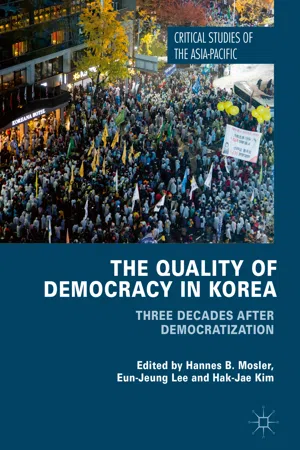
This edited volume assesses the quality of democracy in the Republic of Korea three decades after its formal democratization in 1987. It has been argued that Korea's two subsequent power turnovers prove that its democracy has been successfully consolidated, despite its tremendous progress; however, recent developments show signs of deterioration and retreat. Therefore, drawing on the recent quality of democracy literature this volume sets out to answer the question: Where does Korea's democratic quality stand today? The three chapters in first section of the book focus on aspects related to the presidency, political parties, and organized labor, also including the perspective of governance and human security as well as on the rule of law regarding the role and function of the prosecution. This is followed by a set of four chapters in section two that address the dimensions of democratic quality such as participation, freedom, equality, and responsiveness. The final, third section includes contributions on related inter-Korean policy issues. This book is an invaluable resource for political and social scientist working on democratic quality, and at the same for scholars in Asian or Korean Studies at faculty level as well as on graduate student level.
eBook - ePub
The Quality of Democracy in Korea
Three Decades after Democratization
- English
- ePUB (mobile friendly)
- Available on iOS & Android
eBook - ePub
The Quality of Democracy in Korea
Three Decades after Democratization
About this book
Information
© The Author(s) 2018
Hannes B. Mosler, Eun-Jeung Lee and Hak-Jae Kim (eds.)The Quality of Democracy in KoreaCritical Studies of the Asia-Pacifichttps://doi.org/10.1007/978-3-319-63919-2_11. Introduction: The Quality of Democracy in Korea
Hannes B. Mosler1 , Eun-Jeung Lee2 and Hak-Jae Kim3
(1)
Graduate School of East Asian Studies, Freie Universität Berlin, Berlin, Germany
(2)
Institute of Korean Studies, Freie Universität Berlin, Berlin, Germany
(3)
Institute for Peace and Unification Studies, Seoul National University, Seoul, Republic of Korea
As of this year, three decades have passed since South Korea (hereafter Korea) transitioned to a formal democracy in 1987. Following this historic conversion, the country has drawn consistent praise for its double achievement: the continued successful development of both its economy and democracy. Korea has experienced two peaceful, democratic changes in government to the opposite camp, and even recurrent economic crises seem to have been unable to stop its steady economic growth. Recently, however, both Korea’s economy and democracy have shown signs of regression, or at least of strong fluctuations, and media reports of these turbulences, as well as the academic treatment of the same, point to yet another chapter in Korea’s story. A number of works have examined Korea’s democratization up to the 1990s, to be followed by research on the country’s democratization after democratization through the early 2000s. In addition, Korea has often been included in comparative studies on Asian democracies as both an example of the Third Wave and a reference for comparable cases. However—owed perhaps to its considerable topicality—there remains as yet a void in terms of examining the issue of the quality of democracy in Korea. Political scientists have developed various frameworks, models, and indices for analyzing democracies, thereby providing a rich diversity of instruments, most of which have already been applied to the Korean case. However, while valuable in their own right, these approaches were often developed to conduct comparative analyses, ultimately serving the purpose of explaining variance. They, accordingly, have a tendency to neglect a deeper understanding of the particularity of any individual case (i.e., its particular quality). It is in the hope of adding to the existing literature that this book, which represents one of the first endeavors to examine the latest chapter in the development of Korean democracy, takes on the challenge of examining the quality of democracy in Korea three decades after democratization.
Three Decades of Democracy
Korea’s transition to a formal democracy in the year 1987 was marked by the June 29 Declaration of Roh Tae-woo, the designated successor of the incumbent president, Chun Doo-hwan, and the constitutional amendment on October 26 of that same year. Following its killings of several hundreds, if not thousands, of protesters in the south-eastern city of Kwangju in 1980, the authoritarian Chun Doo-hwan administration could not repeat its use of violence when mass demonstrations in the streets of Seoul and throughout the country demanded the ultimate end of authoritarian rule in the summer of 1987. The protesters called for the reintroduction of direct presidential elections , fair general elections , and regional self-governance. Following two consecutive conservative governments under Roh Tae-woo (1987–1993) and Kim Young-sam (1993–1998) respectively, the inauguration of President Kim Dae-jung (1998–2003) marked the first turnover from a conservative government to a liberal one. While Kim was succeeded by another liberal president, Roh Moo-hyun (2003–2008), government power was to once again return to a conservative administration, namely that of Lee Myung-bak (2008–2013); finally, in 2013, it was conservative Park Geun-hye that assumed power. It has been widely argued that the two turnovers of power in the years 1998 and 2008 are proof of Korean democracy having successfully consolidated. Recent developments, however, show signs of retreat and erosion, prompting concerns that Korea’s “contentious democracy” (Kim 2012) is “deteriorating” (cf. Mosler 2015) and becoming yet another instance of what has recently been diagnosed as a more general trend of “democratic deconsolidation ” (cf. Foa and Mounk 2016). Researchers have developed different standards for defining democratic consolidation . Besides Huntington’s minimalist postulation that a democracy can be considered reasonably consolidated after it has undergone two peaceful and orderly turnovers of power by democratic means (Huntington 1991, 266–267), there is Linz and Stepan’s approach (1996) that defines a consolidated democracy as a political system in which democratic elections and constitutional processes are “the only game in town” for resolving conflicts over power and policy (1996, 14). Schmitter (2010) has suggested parliamentarianism, decentralization (federalism), and checks and balances (horizontal accountability ) as preconditions for successful consolidation (2010, 24), all the while admitting that the application of any one single standard to each and every individual case will be problematic in itself. In the same vein, understanding Korean democracy and its consolidation or deconsolidation is only fully possible in the context of its specific circumstances.
Assessing Korean Democracy
One strand of the wide array of academic works on Korean democracy aims to explain the historical process of the country’s democratization as it has occurred since 1987, and to evaluate the positive and negative aspects of the consolidation of Korean democracy. Diamond and Kim (2000) examined the nature of party politics and the strength of civil society , the activities of labor organizations, and the process of electoral politics. On the question of the key challenges to consolidating and improving democracy in Korea, the authors pointed out several factors: a low degree of institutionalization of political society, a weak constitutionalism, an underdeveloped civil society , the delay in creating a welfare democracy, and the autonomy of global firms. In another approach used to evaluate the status of the consolidation of Korean democracy (Kim 2003), researchers touched upon the dimensions of civil society , women’s representation , the role of nationalism , regional politics, security, and the legacies of the developmental state . A recent study provided a more skeptical evaluation of the degree of consolidation of democracy by pointing out a crisis in participation and representation and worsening social conditions (Choi 2012). By defining Korean democracy as a “conservative democracy,” Choi (2012) systemically analyzed how the strong state continues to prevent the healthy growth of civil society and how the weak social base of the opposition party found itself unable to improve the country’s system of representation . Above all, Choi (2012) argues, it is the concentration of power in the president’s hands that constitutes an obstacle to further democratic consolidation.
Another strand of literature is based on a more comparative perspective that encompasses the entire East Asian region. In one example, Japan , Korea, and Taiwan are defined as relatively developed liberal democracies , while other Asian countries are classified as electoral democracies or electoral authoritarian states (Diamond and Plattner 2013). According to this understanding, Korea and Taiwan crossed further democratic thresholds when opposition parties succeeded in winning free and fair national elections , resulting in a historic turnover in power in 1998 in the Korean and in 2000 in the Taiwan ese case (Diamond and Plattner 2013). Providing comparative data on political rights , civil liberties, and the quality of governance , the authors also point out that the democracies could become stronger and more liberal by further enhancing the rule of law and civil liberties, and by improving mechanisms of accountability and transparency to control corruption and political favoritism. They conclude with the optimistic assumption that East Asian countries would follow global trends and exhibit a growing desire for democracy and accountability. Other assessments, however, have painted a more pessimistic picture, arguing that democracy in Asia is incomplete in that it is as yet immature (Dore et al. 2014). Their research is based on surveys revealing that positive evaluations of democracy do not necessarily produce a greater demand for democratic forms of accountability. A study on Korea and Taiwan that examines factors such as political parties, new media , economic changes, social welfare , and the issue of North Korean defectors and concludes that the maturation of these two democracies faces many challenges (Diamond and Shin 2014).
Research on Korean democracy relies on—and sometimes even develops—a number of methods or indices for assessing the state of a democracy or for comparing it with other democracies. These include databases and indices such as the Bertelsmann Transformation Index (BTI) , the Democracy Barometer (DBM) , the Economist Intelligence Unit’s Democracy Index (ED...
Table of contents
- Cover
- Frontmatter
- 1. Introduction: The Quality of Democracy in Korea
- 1. State, Governance, and the Rule of Law
- 2. Participation, Freedom, Equality, and Responsiveness
- 3. Inter-Korean Policy Issues
- Backmatter
Trusted by 375,005 students
Access to over 1.5 million titles for a fair monthly price.
Study more efficiently using our study tools.
Frequently asked questions
Yes, you can cancel anytime from the Subscription tab in your account settings on the Perlego website. Your subscription will stay active until the end of your current billing period. Learn how to cancel your subscription
No, books cannot be downloaded as external files, such as PDFs, for use outside of Perlego. However, you can download books within the Perlego app for offline reading on mobile or tablet. Learn how to download books offline
Perlego offers two plans: Essential and Complete
- Essential is ideal for learners and professionals who enjoy exploring a wide range of subjects. Access the Essential Library with 800,000+ trusted titles and best-sellers across business, personal growth, and the humanities. Includes unlimited reading time and Standard Read Aloud voice.
- Complete: Perfect for advanced learners and researchers needing full, unrestricted access. Unlock 1.5M+ books across hundreds of subjects, including academic and specialized titles. The Complete Plan also includes advanced features like Premium Read Aloud and Research Assistant.
We are an online textbook subscription service, where you can get access to an entire online library for less than the price of a single book per month. With over 1.5 million books across 990+ topics, we’ve got you covered! Learn about our mission
Look out for the read-aloud symbol on your next book to see if you can listen to it. The read-aloud tool reads text aloud for you, highlighting the text as it is being read. You can pause it, speed it up and slow it down. Learn more about Read Aloud
Yes! You can use the Perlego app on both iOS and Android devices to read anytime, anywhere — even offline. Perfect for commutes or when you’re on the go.
Please note we cannot support devices running on iOS 13 and Android 7 or earlier. Learn more about using the app
Please note we cannot support devices running on iOS 13 and Android 7 or earlier. Learn more about using the app
Yes, you can access The Quality of Democracy in Korea by Hannes B. Mosler, Eun-Jeung Lee, Hak-Jae Kim, Hannes B. Mosler,Eun-Jeung Lee,Hak-Jae Kim in PDF and/or ePUB format, as well as other popular books in Politik & Internationale Beziehungen & Asiatische Politik. We have over 1.5 million books available in our catalogue for you to explore.