On New Year’s Eve 2017, popular US YouTuber Logan Paul’s New Year message to his more than 15 million subscribers featured a crass encounter with an apparently dead man. The video shows Paul discovering the man’s body hanging from a tree in Japan’s Aokigahara park, otherwise known as the ‘Suicide Forest’ (Paul 2017). The vlogger later argued his post, which started by showing an apparently comedic attempt to camp with friends in the eerie location, was designed to create awareness of suicide. However Paul’s video was internationally condemned for exploiting his macabre discovery to gain views and subscribers.1 YouTube did not remove the post, even though it clearly violated its community standards but, after 48 hours of backlash, Paul deleted the offensive footage, posting several apologies (Paul 2018). Other YouTubers however created reaction and attack videos which reposted edited segments of his post in disjointed iterations. The public debate about Paul’s dubious media ethics and the consequences of his vlog spilled onto Twitter, Tumblr, Instagram and Reddit, with users translating each other’s messages from English to Japanese and back and subtitling the footage in other languages. Days afterwards, the world’s major legacy media—New York Times, BBC and News Corp publications—caught up with the scandal, reporting Paul’s belated attempts to say sorry and his temporary withdrawal from vlogging.
The backlash saw YouTube remove Paul from its Red streaming project, temporarily cut his ad revenues and suspend him from its Google preferred ads programme, which previously allowed him to place ads with the top 5% of YouTube influencers. Yet, a year on, he remained in the top ten of the highest earning figures on the platform (Robehmed 2018).
This moment starkly illustrates the new networked political economy and cultural politics of social media news sharing. In the last decade, the consumption, production and distribution of news has been radically altered by the dynamics of social media use and industry development. More people are discovering news on social media. In 2017, the Reuters Digital News survey indicated that social media platforms have become the primary news source for 33% of people under 25 in most developed countries (Newman et al. 2017). In the latest survey, 53% of young people reported accessing news on social media during the previous week (Newman et al. 2018). While much of that news content still emanates from legacy brands, the old news business is virtually hostage to the new, with social media sharing driving anywhere between 7 and 50% of traffic to major news websites depending on their business model. ‘Dark social’, web referrals via email, apps or messaging systems, made up much of the rest. In 2015, social sharing from Facebook exceeded Google search as a source of that referred traffic (Ingram 2015), although this dynamic has since reversed following Facebook’s demotion of news media content in its feeds.2
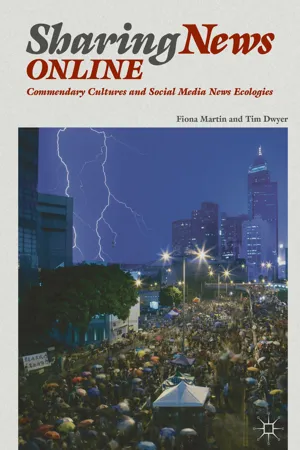
More users also report recirculating digital news than creating it, making online news ‘sharing’ a more significant form of cultural production than citizen journalism. For example, the 2014 Pew Research Center State of the News Media report notes that half of the US social network users surveyed (50%) had shared or reposted news content and 46% had commented on the news, while only 12% posted videos of newsworthy events that they had created and only 11% of online news consumers had submitted original content such as photos or stories to news websites or blogs (Pew Research Center 2014: 5). Overall, 24% of the participants in Reuters’ 2016 world survey said they share news regularly on social media (Newman et al. 2016: 11), although this figure varies by country and platform. Sixty-six per cent of US Twitter users said they shared news regularly with their followers (Rosenstiel et al. 2015). In countries like Turkey and Hong Kong where social media is censored, messaging services like WhatsApp and WeChat increasingly allow users to share news privately (even though news sharing on the latter platform is often censored). During Hong Kong’s ‘Umbrella Revolution’, pictured on the cover of this book, protestors’ use of the mesh networking app FireChat enabled them to share information and mobilise despite government surveillance (Anthony 2014; Lin 2016).
This book investigates the potent nature of social media news sharing, why so many have embraced it so enthusiastically and so quickly, how it has been commodified and what impact commendary culture is having on the news media internationally. It will explore aspects of corporate and technological interdependence that characterise the news sharing ecology, and the role of second wave automation and social analytics in the redistribution of news on social media platforms. Importantly, this book will query common assumptions about the types of stories that trigger news sharing, drawing on research into what news genres and topics people share and what motivates their sharing behaviours. We demonstrate, for example, that politics is still a more important subject worldwide than celebrity or sports. We also reveal that news sharing is not simply driven by egocentric objectives but also by affective, emotional relations to story content, a finding that offers fertile territory for our discursive analysis of most shared stories, the language they employ and the news values they embody. Our chapters on the policy and political implications of social news sharing then show how this activity is shaping our social and cultural worlds.
Sharing News Online concentrates on the fate of news journalism, but our work will be of interest to lobbyists, activists, marketers and communications practitioners—anyone with an interest in what goes viral, or who hopes to influence others to exchange information online. All of these actors have a stake in the future of digital journalism, its shifting boundaries, and its historic claims to legitimacy, authority, privilege and—most significantly—public trust. They depend on news media to credibly amplify their messages. Yet the 2017 Cambridge Analytica scandal, where researchers acquired Facebook user data and provided it to a third-party company which then tried to manipulate political processes in the US and UK, alongside subsequent, widespread instances of social media misinformation campaigns (Allcott et al. 2019; Chadwick and Viccari 2019), have reduced trust in both the platforms and the media more broadly (Edelmann 2018; Knight Foundation 2018).
Critically, this damage comes on top of social media’s economic destabilisation of the legacy news media and the historic financial model for news journalism. Using personalised, behaviourally targeted advertising models, social media platforms have appropriated much of the old media’s advertising revenue—already diminished by the migration of classifieds to specialised web services like EBay, Envato and Craigslist. Social media advertising is finely directed to individual users based on analyses of what they talk about, view, search for, like, buy and repost from other media, as well as metadata about their location, the time of day they choose to interact and on which device. The platforms also sponsor digital influencers like Logan Paul, whose lifestyle commentaries attract millions more subscribers than would pay for traditional news publications. Through these paid vloggers, or digital influencers, the platforms gather even more data on users’ interests and their relationships with those celebrities, who in turn promote brand engagement in ways that traditional news has eschewed. As a result, in 2017, Facebook and Google had reportedly captured half of the world’s online advertising revenue and around 20% of its total advertising spend (Kollewe 2017; Reuters 2017). The drift of advertising income to social media platforms has left legacy journalism in economic freefall, with news organisations restructuring operations and cutting staff, bureaux and publications across the globe. While subscriptions, native advertising, events and sales are beginning to fill the gap, platfor...