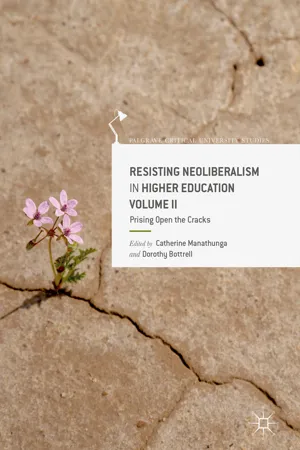
This book outlines the creative responses academics are using to subvert powerful market forces that restrict university work to a neoliberal, economic focus. The second volume in a diptych of critical academic work on the changing landscape of neoliberal universities, the editors and contributors examine how academics 'prise open the cracks' in neoliberal logic to find space for resistance, collegiality, democracy and hope. Adopting a distinctly postcolonial positioning, the volume interrogates the link between neoliberalism and the ongoing privileging of Euro-American theorising in universities. The contributors move from accounts of unmitigated managerialism and toxic workplaces, to the need to decolonise the academy to, finally, illustrating the various creative and counter-hegemonic practices academics use to resist, subvert and reinscribe dominant neoliberal discourses. This hopeful volume will appeal to students and scholars interested in the role of universities in advancing cultural democracy, as well as university staff, academics and students.
eBook - ePub
Resisting Neoliberalism in Higher Education Volume II
Prising Open the Cracks
- English
- ePUB (mobile friendly)
- Available on iOS & Android
eBook - ePub
Resisting Neoliberalism in Higher Education Volume II
Prising Open the Cracks
About this book
Information
Topic
EducationSubtopic
Education Administration© The Author(s) 2019
Catherine Manathunga and Dorothy Bottrell (eds.)Resisting Neoliberalism in Higher Education Volume IIPalgrave Critical University Studieshttps://doi.org/10.1007/978-3-319-95834-7_11. Prising Open the Cracks in Neoliberal Universities
Catherine Manathunga1 and Dorothy Bottrell2
(1)
School of Education, University of the Sunshine Coast, Maroochydore, QLD, Australia
(2)
School of Education and Social Work, University of Sydney, Sydney, NSW, Australia
Keywords
ManagerialismCollegialityCreativityActivismCounter-ontologiesDecolonisationIntroduction
Working in universities in the early twenty-first century is a challenging endeavour. It is hard not to feel overwhelmed as managerialism crushes the lifeblood of inspiration out of academe. It is difficult not to retreat into depression when vivid testimonies abound of the toxicity,1 barbarism2 and horrific psychological cost3 wrought by this shift to bureaucratic/corporate ideas of the university. While our first volume, Resisting neoliberalism in higher education: seeing through the cracks4 sought to expose what life is like within universities, this volume seeks to trace how we might prise open the cracks in neoliberal logic and find ways to “dwell in the ruins”.5 It is about the creative responses academics are currently using to subvert the powerful forces of neoliberalism that have a strangle-hold on the governance of universities.
In this volume, we seek to extend the metaphor of “seeing through the cracks” of neoliberal managerialism, responding to a call from the Critical University Studies field to foreground how academics are negotiating persistent and new dimensions of the managerial ethos. To expose the cracks in neoliberal logics, we must first briefly recount some of the recent examples of managerial ruthlessness that exemplify a range of tools of leverage currently wielded in many universities; tools that discipline, differentiate and punish.
This is not easy to write about. Yet somehow, we must expose the cracks within the neoliberal university that are being prised open in the process of re/creating the conditions of hope.
In this chapter, we outline how radical hope exceeds optimism because it still regards change as possible despite all evidence to the contrary.6 Barcan7 also writes hope into her picture of academic labour in ways that we will draw upon in detail in this chapter. Importantly, this form of hope is radical because it is combined with anger and rage about the ending of all we hold dear.
This chapter provides a brief sketching in of the conditions of possibility that still exist in neoliberal universities for collegiality, creativity and activism and new counter-ontologies of critical resistance and hope. The varied ways of seeing and exploiting the cracks of managerial contradiction and contingency contained in this volume show how it is still possible to resist neoliberalism. These chapters highlight the importance of relational and collective processes, drawing attention to feminist, intersectional and decolonising criticalities that are necessary to mobilise in our struggle: through unions, against rankism and for solidarities that do not paper over the cracks.
Backstory
This book and Volume I grew out of several local and national research events. As the initial work was conducted in Melbourne, Australia, we respectfully acknowledge the Ancestors, Elders and families of the Boonwurrung and Woiwurrung of the Kulin who are traditional custodians of these lands and have been for many centuries. We pay respect to the deep knowledge embedded within the Aboriginal community and unique role of the Kulin Nation’s living culture in the life of this region. We recognise that contemporary universities are shaped by Eurocentric hegemony through the dispossession of First Nations peoples that entailed a “logic of elimination” in settler-colonialism with genocidal intent in Australia, coercive xenophobia elsewhere in the Southern periphery and invasion as a fundamental social structure in all settler-colonial sites.8 In the discussion of the damage neoliberalism has wrought in higher education, we are conscious that our right to fair conditions and to teach, research and engage with communities are rooted in broader social deficits of justice formed in settler sovereignty, rights of governance and the privileges of Whiteness and academic position. We aim to shed light on the politics of privilege, hierarchy and exclusion that continue to be present within universities.9 Tuck and Yang10 argue that the “invasion imperative” persists in varied guises in academic work, especially in knowledge production where the “favored reaping grounds are Native, urban, poor, and Othered communities”. Our search for ways to “prise open the cracks” and expand generative spaces of academic resistance needs to embrace decolonising aims.
The two volumes were inspired by work within the education Discipline Group, Curriculum and Pedagogy as Complex Conversations (CPCC) at Victoria University, Melbourne, our work with eminent critical theorist and Visiting Professor Antonia Darder, Leavey Endowed Chair of Ethics & Moral Leadership, Loyola Marymount University and Professor Emerita University of Illinois, Urbana Champaign and national discussions in the Professional and Higher Education Special Interest Group (SIG) of Australian Association for Researchers in Education (AARE). Discussions during our one-day symposium for academics, academic teaching scholars and PhD students were inspired by Antonia’s keynote on The Legacy of Paulo Freire: The Continuing Struggle for Liberation. This work was further progressed in thought-provoking, creative work led by Antonia at a three-day retreat. These activities were designed to unearth issues of identity, culture, decolonising practice, critical pedagogy and liberation, while we continued to think and write about what it meant to be involved in critical resistance to dominant neoliberal discourses in the academy.
At the 2015 AARE Conference, a panel of speakers offered their insights and provocations about the troubled space of educational research. This followed from the 2014 conference where was a strong feeling of grief and survivalism in reaction to a climate of funding cuts, organisational restructuring and diminished time for research. The panel symposium discussed ways of moving beyond grief and mourning to investigate whether there were any cracks in neoliberalism that could be exploited. These research events then led to the idea of an edited collection and we invited contributions from the SIG and international networks including those connected with the Academic Identities Conference series. There was such a response from colleagues that the planned single volume became two volumes at the publisher’s suggestion.
In the original proposal, we used the metaphor of “seeing through the cracks” (now the subtitle of Volume I) to capture the ideas emerging from local and national research events. The metaphor speaks to the sense of neoliberal capture of higher education and academics’ imprisonment in the neoliberal logics of competitive entrepreneurialism and the idea that we were all in some way engaged in “rattling the cages” of the academy, as one of our Discipline Group colleagues put it. The metaphor speaks to the diminishing space for critical pedagogy and declining time ...
Table of contents
- Cover
- Front Matter
- 1. Prising Open the Cracks in Neoliberal Universities
- Part I
- Part II
- Part III
- Back Matter
Trusted by 375,005 students
Access to over 1.5 million titles for a fair monthly price.
Study more efficiently using our study tools.
Frequently asked questions
Yes, you can cancel anytime from the Subscription tab in your account settings on the Perlego website. Your subscription will stay active until the end of your current billing period. Learn how to cancel your subscription
No, books cannot be downloaded as external files, such as PDFs, for use outside of Perlego. However, you can download books within the Perlego app for offline reading on mobile or tablet. Learn how to download books offline
Perlego offers two plans: Essential and Complete
- Essential is ideal for learners and professionals who enjoy exploring a wide range of subjects. Access the Essential Library with 800,000+ trusted titles and best-sellers across business, personal growth, and the humanities. Includes unlimited reading time and Standard Read Aloud voice.
- Complete: Perfect for advanced learners and researchers needing full, unrestricted access. Unlock 1.5M+ books across hundreds of subjects, including academic and specialized titles. The Complete Plan also includes advanced features like Premium Read Aloud and Research Assistant.
We are an online textbook subscription service, where you can get access to an entire online library for less than the price of a single book per month. With over 1.5 million books across 990+ topics, we’ve got you covered! Learn about our mission
Look out for the read-aloud symbol on your next book to see if you can listen to it. The read-aloud tool reads text aloud for you, highlighting the text as it is being read. You can pause it, speed it up and slow it down. Learn more about Read Aloud
Yes! You can use the Perlego app on both iOS and Android devices to read anytime, anywhere — even offline. Perfect for commutes or when you’re on the go.
Please note we cannot support devices running on iOS 13 and Android 7 or earlier. Learn more about using the app
Please note we cannot support devices running on iOS 13 and Android 7 or earlier. Learn more about using the app
Yes, you can access Resisting Neoliberalism in Higher Education Volume II by Catherine Manathunga, Dorothy Bottrell, Catherine Manathunga,Dorothy Bottrell in PDF and/or ePUB format, as well as other popular books in Education & Education Administration. We have over 1.5 million books available in our catalogue for you to explore.