eBook - ePub
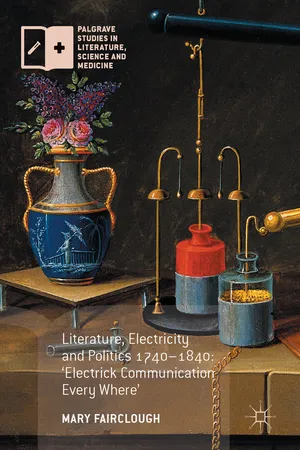
Literature, Electricity and Politics 1740–1840
‘Electrick Communication Every Where’
- English
- ePUB (mobile friendly)
- Available on iOS & Android
eBook - ePub
About this book
Information
© The Author(s) 2017
M. FaircloughLiterature, Electricity and Politics 1740–1840Palgrave Studies in Literature, Science and Medicinehttps://doi.org/10.1057/978-1-137-59315-3_11. Introduction: Electricity, Spectacle and Figuration
Mary Fairclough1
(1)
Centre for Eighteenth Century Studies, University of York, York, United Kingdom
Lectures on Electricity, Lecture II.
VI. Spirits kindled by fire darting from a lady’s eyes (without a metaphor).
Ebenezer Kinnersley, advertisement, Pennsylvania Gazette (18 April 1751).
Their language is vitally metaphorical; that is, it marks the before unapprehended relations of things and perpetuates their apprehension…
Percy Bysshe Shelley, A Defense of Poetry (1821).
Keywords
SpectacleImponderable fluidMetaphorAnalogyRoyal SocietyDuring the eighteenth century, electrical experimentation was both science and spectacle, the subject of legitimate investigation and illegitimate display. Electricity was claimed as evidence of enlightened man’s control over the natural world, and of nature’s limitless and wonderful capacity to elude quantification and taxonomy. Electricity also transcended the divide between elite philosophical institutions and broader social and cultural practices. An article in the Gentleman’s Magazine of April 1745 declared that in the previous two years, experimenters had ‘discovered phenomena, so surprising as to awaken the indolent curiosity of the public, the ladies and people of quality, who never regard natural philosophy but when it works miracles. Electricity became the subject all in vogue.’1 Electricity was indeed natural philosophy ‘in vogue’, as spectacular electrical displays proved immensely fashionable in Germany, France and England. Eighty years later, Humphry Davy upheld the Gentleman’s sense of a surge in interest in electricity during the 1740s, and noted that it had been produced by developments in electrical equipment. The invention of the Leyden jar in 1743 had created a new epoch in electrical experimentation, because it allowed experimenters to store an electric charge and discharge it all at once, with spectacular effects. For Davy, the Leyden jar produced new social as well as experimental phenomena:
No single philosophical discovery, ever excited so much popular and scientific attention…The apparatus soon became an object of public exhibition; and in the same year in which it was discovered, a number of itinerant experimenters procured a livelihood in different parts of Europe, by travelling from place to place, and showing the experiment.2
As the Gentleman’s article and Davy’s lecture both imply, though electrical practitioners discovered ‘phenomena’ through which they could demonstrate the operation of electricity, explanations of its causes were far more difficult to come by, especially given the limited expertise of many ‘itinerant experimenters’. In 1787, even after decades of attempts to explain electrical phenomena, the instrument maker George Adams was forced to agree, declaring that ‘as electricity is in its infancy, when considered as a science, it’s [sic] definitions and axioms cannot be stated with geometric accuracy’.3 Electrical science thus achieves a peculiar status during the eighteenth century. It is a highly visible and popular form of entertainment as well as experiment, but one that resists the attempts of natural philosophers of all kinds to assign it a recognisable cause and stable meaning.4 The most commonly employed explanation of electrical phenomena is that electricity is one of several ‘imponderable fluids’ including heat, light, fire and magnetism, but this model offers few answers about its precise nature.5
The apparently inexplicable quality of electricity makes electrical discourse an important, and troublesome, object of enquiry, not just for historians of science, but for analysts of eighteenth-century culture and thought more broadly. This book will address the peculiar status of electrical discourse in the long eighteenth century, arguing that the language of electricity is never confined to natural philosophy during this period. The occurrence of such language in literary and political writings is not a matter of mere borrowing, but rather a symptom of electricity’s resistance to definition. In the chapters that follow, I trace the use of electrical language in natural and moral philosophical treatises, in newspaper articles and advertisements, in poetry and novels, and in radical and conservative political pamphlets and journals. Such uses of electrical language are evidence that a huge range of eighteenth-century commentators were alert to the multiple valence of electrical language and deployed it for their own rhetorical ends. But writers’ use of such language to describe certain species of phenomena is not an arbitrary choice. Their appropriations of electrical language indicate that ideas about electricity informed ideas about other forms of natural, cultural and political life, in particular the constitution of matter, conceptions of universal or individual vital forces, the nature of sexual attraction, and the source and function of revolutionary communication. But despite the claims of some commentators, electrical language very rarely signals confidence in enlightenment or progress at this period. Electrical imagery and ideas are not used to account for or explain such phenomena but rather to signal mystery and opacity, and their associated threats, frustrations or opportunities. Dealing with the wealth of discussions of electricity produced during the period 1740–1840 has proved a methodological challenge. I have mostly restricted myself to the discussion of Anglophone texts, either British or American works, or European texts available in translation during this period. This approach cannot do justice to all of the cosmopolitan alliances between electricians across Europe and America, but I gesture to the use that English language texts made of such international collaboration and competition.
In 1796, Edmund Burke accounts for the cause and effects of the spread of revolutionary ideology in France using the metaphor of electric communication in his counter-revolutionary polemic Letters on a Regicide Peace. Burke identifies a ‘silent revolution in the moral world [which] preceded the political, and prepared it’, namely the increasingly power financial and political interests of the middle classes. This ‘revolution’ is catalysed through the influence of ‘above all, the press…[which] made a kind of electrick communication every where. The press, in reality, has made every Government, in its spirit, almost democratick.’6 Burke’s phrase ‘electrick communication every where’ seems to be an attempt to account for the speed with which information is transmitted through the newspaper press. But read in the context of eighteenth-century electrical cultures, the implications of his phrase are even more interesting, and more fraught. Burke’s ‘electrick communication every where’ gestures not merely to print on the page, or to the material distribution networks of the newspaper trade, but to the intangible processes through which revolutionary thoughts, actions and feelings are spread from person to person, region to region and nation to nation. Burke seems to signal an anxiety that such electric communication will operate as a catalyst, activating a latent political activism in the individuals that it touches. Electricity in Burke’s text becomes an almost mystical, universal force, one which is apparently universal and intangible, but which has material cultural and political effects.7
The chapters in this book will investigate the discursive characteristics of electricity which, by the end of the century, make statements like Burke’s possible. Each chapter takes as its starting point a development in electrical practice or theory, and considers the ways in which the resulting conceptions of electricity are taken up in other writings. The diverse bodies of work under discussion are united, in each case, by their common need to respond to or probe the implications of these developments, and by a sense of their broader cultural significance. In Chapter 2, I investigate the experimental culture of the 1740s and 1750s which claimed electricity as a species of aether in the manner of Sir Isaac Newton. Far from producing a stable empirical account of electricity, such claims emphasised the degree to which aethereal models overlapped with and supported accounts of electricity as an immaterial, divine spirit or ‘soul of the world’. Such debates over the spiritual nature of electricity have important effects even for later materialist experimenters like Benjamin Franklin and Joseph Priestley, as it remains difficult to declare with certainty whether electricity is a material or immaterial phenomenon. My third chapter analyses medical applications of electricity and the significance of the human body in electrical experiments, focusing on speculative and sensational practices from the 1740s to the 1780s that suggested a connection between electricity and eroticism. The key figure in this discussion is James Graham, who exploits the obscurity of electrical phenomena ...
Table of contents
- Cover
- Front Matter
- 1. Introduction: Electricity, Spectacle and Figuration
- 2. Experiment, Aether and the Soul of the World
- 3. Electrical Medicine, Feeling and Eroticism
- 4. Animal Electricity, Vitality, and Revolution
- 5. Electrochemistry, Matter and Life
- 6. Epilogue: Michael Faraday and a New Electrical Era
- Back Matter
Trusted by 375,005 students
Access to over 1.5 million titles for a fair monthly price.
Study more efficiently using our study tools.
Frequently asked questions
Yes, you can cancel anytime from the Subscription tab in your account settings on the Perlego website. Your subscription will stay active until the end of your current billing period. Learn how to cancel your subscription
No, books cannot be downloaded as external files, such as PDFs, for use outside of Perlego. However, you can download books within the Perlego app for offline reading on mobile or tablet. Learn how to download books offline
Perlego offers two plans: Essential and Complete
- Essential is ideal for learners and professionals who enjoy exploring a wide range of subjects. Access the Essential Library with 800,000+ trusted titles and best-sellers across business, personal growth, and the humanities. Includes unlimited reading time and Standard Read Aloud voice.
- Complete: Perfect for advanced learners and researchers needing full, unrestricted access. Unlock 1.5M+ books across hundreds of subjects, including academic and specialized titles. The Complete Plan also includes advanced features like Premium Read Aloud and Research Assistant.
We are an online textbook subscription service, where you can get access to an entire online library for less than the price of a single book per month. With over 1.5 million books across 990+ topics, we’ve got you covered! Learn about our mission
Look out for the read-aloud symbol on your next book to see if you can listen to it. The read-aloud tool reads text aloud for you, highlighting the text as it is being read. You can pause it, speed it up and slow it down. Learn more about Read Aloud
Yes! You can use the Perlego app on both iOS and Android devices to read anytime, anywhere — even offline. Perfect for commutes or when you’re on the go.
Please note we cannot support devices running on iOS 13 and Android 7 or earlier. Learn more about using the app
Please note we cannot support devices running on iOS 13 and Android 7 or earlier. Learn more about using the app
Yes, you can access Literature, Electricity and Politics 1740–1840 by Mary Fairclough in PDF and/or ePUB format, as well as other popular books in Literature & Social History. We have over 1.5 million books available in our catalogue for you to explore.