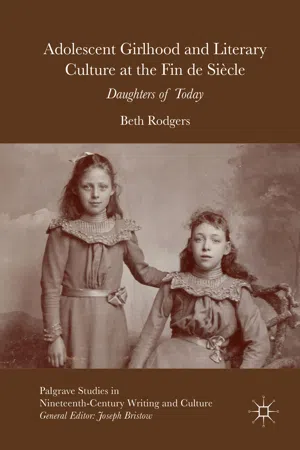
This book examines the construction of adolescent girlhood across a range of genres in the closing decades of the nineteenth century. It argues that there was a preoccupation with defining, characterising and naming adolescent girlhood at the fin de siècle. These 'daughters of today', 'juvenile spinsters' and 'modern girls', as the press variously termed them, occupying a borderland between childhood and womanhood, were seen to be inextricably connected to late nineteenth-century modernity: they were the products of changes taking place in education and employment and of the challenge to traditional conceptions of femininity presented by the Woman Question. The author argues that the shifting nature of the modern adolescent girl made her a malleable cultural figure, and a meeting point for many of the prevalent debates associated with fin-de-siècle society. By juxtaposing diverse material, from children's books and girls' magazines to New Woman novels and psychological studies, the author contextualises adolescent girlhood as a distinct but complex cultural category at the end of the nineteenth century.
eBook - ePub
Adolescent Girlhood and Literary Culture at the Fin de Siècle
Daughters of Today
- English
- ePUB (mobile friendly)
- Available on iOS & Android
eBook - ePub
About this book
Information
© The Author(s) 2016
Beth RodgersAdolescent Girlhood and Literary Culture at the Fin de SièclePalgrave Studies in Nineteenth-Century Writing and Culture10.1007/978-3-319-32624-5_11. Introduction: Debating and Defining Girlhood at the Fin de Siècle
Beth Rodgers1
(1)
Department of English and Creative Writing, Aberystwyth University, Ceredigion, UK
This book argues that adolescent girlhood was a distinct cultural category in late nineteenth-century literary and print culture. ‘There is scarcely a more favourite subject for delineation by poet and artist’, observed Lily Watson in the Girl’s Own Paper in 1887, ‘than the period when childhood is just melting into womanhood’. 1 Poets and artists were not alone in this preoccupation: Watson’s description of herself and her adult peers as ‘elder travellers who long to help [the girl] on her way with advice, warning, encouragement!’ is indicative of a marked interest in defining the characteristics of adolescent girlhood, and in guiding the development of actual adolescent girls, that can be seen across a variety of literary genres and other modes of writing in the closing decades of the nineteenth century. 2 The article is fittingly entitled ‘On the Borderland’: references to borderlands and thresholds as part of a difficult to define, ‘melting’ stage of life between childhood and womanhood proliferate throughout the texts under discussion in this book. These recurrences suggest that adolescence in general, and female adolescence in particular, could represent an ambiguous and difficult concept within Victorian theorizations of gender, sexuality and culture.
This book seeks to probe the integral ambiguity and difficulty that is at the heart of this complex concept. It identifies and interrogates the various characteristics that are used (and not used) to define and construct this life stage in such a way that it attained a new kind of significant symbolic value in the closing decades of the nineteenth century. As I shall show, this symbolic potential is put to use by a range of writers working across literary genres, including girls’ magazines such as the Girl’s Own Paper, Atalanta and Girl’s Realm; the girls’ school stories of L.T. Meade, Mrs George de Horne Vaizey and Raymond Jacberns; the New Woman fiction of Olive Schreiner and Sarah Grand; and both fictional and non-fictional commentaries on the girl as journalist in the work of Ella Hepworth Dixon, W. T. Stead, and others. I therefore examine the extent to which the characteristics and stereotypes that came to define the late nineteenth-century fictional girl (and perhaps also the actual girl) were determined intertextually by a variety of writers who were often in rather unexpected conversation with each other.
This study is one of a number of recent works that seek to challenge the common assumption that adolescence is a mid-twentieth-century phenomenon. In fact, the advent of adolescence as a recognizable life stage between childhood and adulthood can be explicitly connected to the social conditions of the late nineteenth century. Carol Dyhouse, for example, connects it to the history of education, arguing that ‘as industrial society came to subject children and the young to ever longer periods of tutelage and formal schooling, the transition from childhood to a generally recognized adult status became more drawn out and complex.’ 3 This ‘drawn out’ period was not just a growing social concern, but also a preoccupation in the literary and cultural imagination of the period, as Watson’s article, identified above, demonstrates. John Neubauer’s The Fin-de-Siècle Culture of Adolescence (1992) makes the case for the connection between the ‘birth’ of the literary adolescent and the aesthetic and social conditions of fin-de-siècle culture. Neubauer argues that ‘the appearance of these interlocking discourses [of adolescence in psychoanalysis, psychology, criminal justice, literature, and so on] testifies that human life was perceived in terms of a new category by the end of the nineteenth century’. 4 Jon Savage similarly argues for the prehistory of the cultural adolescent before the James Deans and Holden Caulfields of mid-twentieth-century USA or the Teddy Boys of England in his book, Teenage: The Creation of Youth 1875–1945 (2007).
While I broadly agree with the theoretical connections between adolescence and the industrial late nineteenth century made by both Neubauer and Savage, I find it striking that female adolescents, either as historical figures or as fictional representations, make little appearance in either of these studies. For Neubauer and Savage, this ‘new category’ of adolescence is almost wholly a masculine realm, which is exclusively engaged with by male writers and artists. 5 This is a position shared by many social histories of youth and adolescence, such as John Gillis’ Youth and History: Tradition and Change in European Age Relations, 1770–Present (1981). Gillis’ chapter focussing on the development of adolescence as a concept in the late nineteenth century is even entitled ‘Boys will be Boys’. 6 This book, in contrast, seeks to address this omission and interrogate the relationship between those ‘interlocking discourses’ and female adolescence specifically.
The study of girls, girls’ culture and girlhood has flourished in recent years and I am not alone in recognizing and seeking to respond to this omission. Sally Mitchell’s pioneering book, The New Girl: Girls’ Culture in England, 1880–1915 (1995) has inspired a generation of scholars of girlhood and girls’ cultures, so much so that Victorian Periodicals Review recently invited her to write a retrospective marking the twentieth anniversary of the book’s publication. 7 Like many recent scholars, I too am inspired by Mitchell’s New Girl and my research model is influenced by her work in terms of the seriousness with which she treats girls (as informed, intelligent readers) and girls’ fiction (as legitimate material for academic study). Yet this book also departs from Mitchell’s ‘girl-centred’ approach in some important ways. Mitchell’s focus means that she is ‘not particularly interested in what authors were trying to do … but in what girl readers were taking and using from their stories’. 8 My focus on discerning and assessing competing constructions of girlhood across a range of genres at the end of the nineteenth century means that, unlike Mitchell, I am interested in examining both sides of this story—authors and readers—together with the ways in which these two sides may interact. After all, authors are usually also readers, and my discussion will reveal intertextual connections between those who variously sought to define, classify, celebrate and vilify the modern girl of the period. In addition, many of the girl readers who feature in this book made significant attempts to become ‘authors’ themselves—as correspondents in girls’ magazines, as diarists, letter writers and as aspiring literary workers.
More recently, scholars including Sarah Bilston, Michelle Smith, Kristine Moruzi and Hilary Marland have made significant contributions to our understanding of the development of girlhood and girls’ cultures in literature and wider print culture in the nineteenth and early twentieth centuries. 9 Bilston’s book The Awkward Age in Women’s Popular Fiction, 1850–1900 (2004) also responds to the absence of serious discussion about girls and the transition to womanhood within Victorian literature, although her focus is on the ‘place of fantasies and dreams of girlhood in books written by and aimed primarily at adult women readers’, whereas this book considers a much greater deal of material that was aimed at girl readers themselves. 10 Smith’s focus on the role of empire in a range of girls’ books in Empire in British Girls’ Literature and Culture: Imperial Girls, 1880–1915 (2011) and Moruzi’s close consideration of the important role played by girls’ magazines in Constructing Girlhood through the Periodical Press, 1850–1915 (2012) have added considerably to our knowledge of the burgeoning girls’ cultures of the latter half of the nineteenth century. Hilary Marland’s Health and Girlhood in Britain, 1874–1920 (2013), although not primarily a literary study, enhances our understanding of the frequently fraught social concerns over girlhood at this time and the role played by advice literature and periodicals such as the Girl’s Own Paper in shaping and responding to these concerns.
These focussed discussions of girls and girlhood in the late nineteenth century demonstrate that girlhood is not a universal or transhistorical category. In relation to one Victorian commentator’s suggestion that ‘ “girlhood” was an 1890s phenomenon’, Bilson rightly notes that such claims are ‘clearly more polemical than precise’. 11 But the possible significance of this ‘polemical’ sense of the novelty and contemporaneity of girlhood in the late nineteenth century is exactly what is at the heart of this study. There have, of course, always been girls, but what it means to be a girl is not always the same thing across time and circumstance. My focus on girlhood in the period 1880–1906 further nuances the discussions offered by Mitchell, Moruzi, Smith and others by probing in sustained detail the various and sometimes conflicting characteristics that constitute girlhood at this time and enable it to function symbolically for a wide range of writers and commentators.
The difficulty of determining just how we define and understand girlhood echoes throughout the majority of scholarly discussions of girlhood, no matter the historical period under consideration it seems. In her Foreword to Girlhood: A Global History (2010), Miriam Forman-Brunell comments that girlhood is a ‘constructed, changing and contested category of experience and expectations’. 12 In their introduction to Colonial Girlhood in Literature, History and Culture, 1840–1950 (2014), Moruzi and Smith observe that girlhood ‘represents a complex category encompassing various life stages and kinds of femininity, as well as differences based on class and race’. 13 Lynne Vallone and Claudia Nelson concur: ‘Depending not only upon her age but also upon her class, educational attainments, and marital or biological status, a “girl” might be what Charlotte Yonge termed a “home daughter” in her early twenties, a wife and mother aged seventeen, or a self-supporting member of the workforce at twelve.’ 14 Bilston begins her book with a number of texts that ‘demonstrate a lack of consensus about what the awkward age actually is’, noting that ‘[i]t was, in other words, terribly difficult to define the awkward age in an era before theories of adolescence gave maturation a recognizable trajectory and a descriptive vocabulary’. 15 Bilston may note the ‘lack of consensus’ at the time, but the very problem of definition is something of a consensus itself in discussions today. Most of the studies mentioned so far begin by registering this central difficulty of definition at the outset before moving on to consider the specific focus of the study in question. This book, however, seeks to pause over the ambiguities surrounding girlhood as a category at the end of the nineteenth century and probe those ambiguities further. Why exactly is there such variance in terms of age, occupation and marital status when it comes to who is and who is not considered a ‘girl’ in the late Victorian period? To what extent do literary depictions of girls help to shape and construct these characteristics or to what extent do they reflect and respond to debates happening in the wider world? Is t...
Table of contents
- Cover
- Frontmatter
- 1. Introduction: Debating and Defining Girlhood at the Fin de Siècle
- 2. Classifying Girlhood, Creating Heroines: Aspiration, Community and Competition in the Girl’s Own Paper and the Girl’s Realm
- 3. Making Transitions in Fin-de-Siècle Girls’ School Stories, 1886–1906
- 4. ‘Flowering into Womanhood’? The New Woman and the New Girl
- 5. ‘Development and Arrest of Development’: Sarah Grand’s ‘Girls of Today’
- 6. Professionalizing the Modern Girl: Ella Hepworth Dixon, W. T. Stead and Journalism for Girls
- 7. Coda: Voyaging Out
- Backmatter
Trusted by 375,005 students
Access to over 1.5 million titles for a fair monthly price.
Study more efficiently using our study tools.
Frequently asked questions
Yes, you can cancel anytime from the Subscription tab in your account settings on the Perlego website. Your subscription will stay active until the end of your current billing period. Learn how to cancel your subscription
No, books cannot be downloaded as external files, such as PDFs, for use outside of Perlego. However, you can download books within the Perlego app for offline reading on mobile or tablet. Learn how to download books offline
Perlego offers two plans: Essential and Complete
- Essential is ideal for learners and professionals who enjoy exploring a wide range of subjects. Access the Essential Library with 800,000+ trusted titles and best-sellers across business, personal growth, and the humanities. Includes unlimited reading time and Standard Read Aloud voice.
- Complete: Perfect for advanced learners and researchers needing full, unrestricted access. Unlock 1.5M+ books across hundreds of subjects, including academic and specialized titles. The Complete Plan also includes advanced features like Premium Read Aloud and Research Assistant.
We are an online textbook subscription service, where you can get access to an entire online library for less than the price of a single book per month. With over 1.5 million books across 990+ topics, we’ve got you covered! Learn about our mission
Look out for the read-aloud symbol on your next book to see if you can listen to it. The read-aloud tool reads text aloud for you, highlighting the text as it is being read. You can pause it, speed it up and slow it down. Learn more about Read Aloud
Yes! You can use the Perlego app on both iOS and Android devices to read anytime, anywhere — even offline. Perfect for commutes or when you’re on the go.
Please note we cannot support devices running on iOS 13 and Android 7 or earlier. Learn more about using the app
Please note we cannot support devices running on iOS 13 and Android 7 or earlier. Learn more about using the app
Yes, you can access Adolescent Girlhood and Literary Culture at the Fin de Siècle by Beth Rodgers in PDF and/or ePUB format, as well as other popular books in Literature & European Literary Criticism. We have over 1.5 million books available in our catalogue for you to explore.