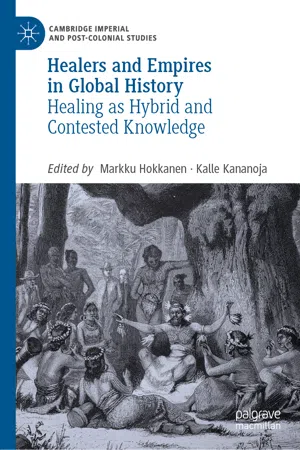
eBook - ePub
Healers and Empires in Global History
Healing as Hybrid and Contested Knowledge
- English
- ePUB (mobile friendly)
- Available on iOS & Android
eBook - ePub
Healers and Empires in Global History
Healing as Hybrid and Contested Knowledge
About this book
This book explores cross-cultural medical encounters involving non-Western healers in a variety of imperial contexts from the Arctic, Asia, Africa, Americas and the Caribbean. It highlights contests over healing, knowledge and medicines through the frameworks of hybridisation and pluralism. The intertwined histories of medicine, empire and early globalisation influenced the ways in which millions of people encountered and experienced suffering, healing and death. In an increasingly global search for therapeutics and localised definition of acceptable healing, networks and mobilities played key roles. Healers' engagements with politics, law and religion underline the close connections between healing, power and authority. They also reveal the agency of healers, sufferers and local societies, in encounters with modernising imperial states, medical science and commercialisation. The book questions and complements the traditional narratives of triumphant biomedicine, reminding readersthat 'traditional' medical cultures and practitioners did not often disappear, but rather underwent major changes in the increasingly interconnected world.
Information
© The Author(s) 2019
Markku Hokkanen and Kalle Kananoja (eds.)Healers and Empires in Global HistoryCambridge Imperial and Post-Colonial Studies Serieshttps://doi.org/10.1007/978-3-030-15491-2_11. Healers and Empires in Global History: Healing as Hybrid and Contested Knowledge
Markku Hokkanen1 and Kalle Kananoja2
(1)
Department of History, University of Oulu, Oulu, Finland
(2)
University of Helsinki, Helsinki, Finland
Introduction
The great-great-uncle of one of the editors of this collection would now probably be called a ‘traditional healer’. He was also a farmer in what is now Russian Karelia—in his lifetime, in the late nineteenth and early twentieth centuries, he was a subject of both the Russian Empire and the independent Republic of Finland. Family history has it that uncle Pekka knew, among other things, how to stop bleeding by saying certain words. He would have passed his skills on, but his nephew, a devout Orthodox Christian, refused to learn what was increasingly considered pagan superstition. 1
By the time our parents were born in the 1940s, the everyday medical world in Finland was rapidly changing, and the world of healers seemed to be fast becoming a thing of the past in large parts of the world. While many people of Pekka’s generation never saw a registered medical practitioner in their lives, by the 1940s and 1950s Finnish children were increasingly born in hospitals and grew up under the scrutiny, supervision and treatment of an increasingly powerful public health system and biomedicine. Vaccinations and antibiotics, among other effective cures, and prophylaxes, together with improved hygiene, ensured that their generation was healthier and lived longer than any of their predecessors. Child mortality rates dropped radically in post-war Finland, which was rapidly catching up to other Nordic, European and Western countries. This pattern was to an extent global. By the 1950s, the world was increasingly witnessing an unprecedented triumphant advance of modern biomedicine, which was often called ‘Western medicine’ outside ‘the West’. 2
In the longue durée history of global healing, this was quite exceptional. While various medical systems have at times held strong, even hegemonic positions locally and regionally, no medical system had, at least ideologically, permeated the world so successfully. Most countries in Asia, Africa and the Americas looked to modern medicine, science and pharmaceuticals as highly desirable things to improve the health of their populations, just like Finnish, Soviet or US governments. In practice, of course, there were huge discrepancies in terms of what was possible or available, as modern medicine and its infrastructure—hospitals and clinics, educated doctors and nurses—was also becoming increasingly expensive. 3
While this ‘triumph of biomedicine’ was never uncontested, and arguably never entirely complete anywhere (even before the growing criticism of and disappointment with medicine in the West in the 1960s), 4 it was remarkable and pervasive. Between 1900 and 1950, the world of medicine and healing changed fundamentally, and in many ways that became interconnected and interdependent across the globe.
The chapters in this book consist of case studies of cross-cultural medical interaction (within an imperial or colonial framework). Broadly speaking, cross-cultural medical encounters can develop in two main (but not mutually exclusive) directions:
- 1.Different healing systems can engage in mutually fruitful interaction, in which all parties more or less openly share medical knowledge and try to learn from each other. This, in turn, leads to the hybridisation of healing practices, or at least to mimesis, as healers selectively adopt elements from different systems.
- 2.Practitioners of different healing systems can be drawn into an open conflict, in which both sides question the legitimacy of the other. However, conflict and contestation do not necessarily concern the effectiveness of healing. Moral, religious and political arguments have often been just as central in conflicts over the authority of healers as any medical or scientific reasoning.
Contestation and hybridisation are not, it should be emphasised, mutually exclusive. Rather, in many cases both developments can often be detected in one way or another. However, it is also possible that different healing systems can exist in parallel in a ‘laissez-faire’ medical culture, largely ignoring one another. In colonial and imperial settings, conflict and hybridisation have been configured spatially and temporally in a myriad of ways, with multiple nexuses between healing and political power. Generally, contests, conflicts and debates tend to be more visible in history than untroubled co-existence, as they generate more source material and attract more attention by contemporaries and later scholars. It must also be acknowledged that cultural encounters do not necessarily have to take place between two, or more, foreign cultures. Encounters with implications for the medical culture can also occur between so-called folk and learned cultures. Furthermore, patients and their kin, religious and political authorities, as well as various intellectuals, all have stakes in cross-cultural medical encounters and exchanges.
When we look back into the past worlds of healing, our view tends to be framed, or dominated, by an apparatus of ‘biomedicine triumphant’, either as a narrative of progress to be celebrated or as a structure of power/knowledge to be criticised and deconstructed. These perspectives, as valuable as they are, tend to obscure the longer-term, more every-day, and less teleological perspectives within the histories of healing. This book aims to bring such perspectives, of healers and patients, of people and institutions of power, into new focus and to consider the methodological possibilities of expanding historical inquiry. It brings together histories of healing from Africa, Asia, the Americas and Europe from the seventeenth century to the late twentieth century. The chapters all question and complement the major narratives of the history of medicine in the era of biomedical triumphs by reminding readers that what could be called ‘alternative’ or ‘traditional’ medical systems, traditions and cultures did not disappear, but underwent considerable changes during this time. 5 To an important extent, these changes took place in response to the development and expansion of biomedicine, modernisation, colonialism, industrialisation and ‘globalisation’. These intertwined histories, in turn, influenced the ways in which millions of people lived, suffered, experienced healing and died.
The Triumph of Modern Medical Science and Counterreactions
In his controversial book Bad Medicine, David Wootton has argued that, prior to Joseph Lister’s pioneering use of antiseptics in 1865, Western medicine was by and large harmful to patients. However, it was not until the advent of penicillin in the 1940s that biomedicine became undoubtedly effective. 6 Wootton’s work can be criticised as a problematic simplification. By focusing on ‘doctors doing harm’, he turns the success story of Western medicine on its head and highlights again the ‘heroes and villains’ of medicine. However, there is no doubt that at the turn of the twentieth century, European doctors and intellectual elites thought that they could finally prove the superiority of medical science when compared to other forms of healing. 7 This had a decisive effect on the slow but steady marginalisation of folk and popular medicine.
In studying healing in global history, we emphasise spatial connections between geographical regions. The worldwide movements of people, commodities, ideas and institutions affect regional and national dynamics. This leads to simultaneous, interconnected developments and to the circulation of knowledge between different continents, regions and localities. Global historical interpretation recognises the problems and limitations of a Eurocentric approach. 8 When focusing on the history of medicine, a global approach is not unprecedented; for example, William McNeill’s classic Plagues and Peoples (1976) demonstrated that placing Europe in the margins can open important new perspectives on world history. 9 The contributions in this volume challenge not only Eurocentric ideas, but also complement the largely Anglophone historiography of medicine and healing that focuses solely on the British Empire. 10 The social history of medicine is a significant subfield for probing the global turn in historical research. For large parts of the world, and for the majority of its peoples, Western medicine has been a marginal and a late newcomer in medical culture. 11
Scholars have used the concept of alternative medicine to refer to healing systems that deviate from Western biomedicine. However, from a global historical perspective alternative medicine is a problematic term, because before the breakthrough and hegemonisation of biomedicine in the twentieth century, Western university medicine was just an alternative among many other medical systems. 12 It was often a marginal and an exclusively urban form of healing. Roberta Bivins has argued that conceptually, Western humoral theory was not far from South Asian and Chinese healing traditions. These premodern medical systems were globally unified by a view of the human body as a microcosm of the universe. Healers with different cultural backgrounds were able to benefit from the thinking of others; linguistic boundaries put more limits on the sharing of ideas than did the differences between medical systems. 13
The term alternative medicine also hides the processes of hybridisation that were part and parcel of medical interaction. These processes took place in cross-cultural contexts, but also in settings where ‘high’ and ‘low’, or academic and folk medicine, interacted. 14 The con...
Table of contents
- Cover
- Front Matter
- 1. Healers and Empires in Global History: Healing as Hybrid and Contested Knowledge
- 2. Traditional Arctic Healing and Medicines of Modernisation in Finnish and Swedish Lapland
- 3. Reports on Encounters of Medical Cultures: Two Physicians in Sweden’s Medical and Colonial Connections in the Late Eighteenth Century
- 4. Tibetan Medicine and Buddhism in the Soviet Union: Research, Repression, and Revival, 1922–1991
- 5. Contestation, Redefinition and Healers’ Tactics in Colonial Southern Africa
- 6. Complicating Hybrid Medical Practices in the Tropics: Examining the Case of São Tomé and Príncipe, 1850–1926
- 7. Doctors, Healers and Charlatans in Brazil: A Short History of Ideas, c. 1650–1950
- 8. Risking Obeah: A Spiritual Infrastructure in the Danish West Indies, c. 1800–1848
- 9. Toward a Typology of Nineteenth-Century Lakota Magico-Medico-Ritual Specialists
- Back Matter
Trusted by 375,005 students
Access to over 1.5 million titles for a fair monthly price.
Study more efficiently using our study tools.
Frequently asked questions
Yes, you can cancel anytime from the Subscription tab in your account settings on the Perlego website. Your subscription will stay active until the end of your current billing period. Learn how to cancel your subscription
No, books cannot be downloaded as external files, such as PDFs, for use outside of Perlego. However, you can download books within the Perlego app for offline reading on mobile or tablet. Learn how to download books offline
Perlego offers two plans: Essential and Complete
- Essential is ideal for learners and professionals who enjoy exploring a wide range of subjects. Access the Essential Library with 800,000+ trusted titles and best-sellers across business, personal growth, and the humanities. Includes unlimited reading time and Standard Read Aloud voice.
- Complete: Perfect for advanced learners and researchers needing full, unrestricted access. Unlock 1.5M+ books across hundreds of subjects, including academic and specialized titles. The Complete Plan also includes advanced features like Premium Read Aloud and Research Assistant.
We are an online textbook subscription service, where you can get access to an entire online library for less than the price of a single book per month. With over 1.5 million books across 990+ topics, we’ve got you covered! Learn about our mission
Look out for the read-aloud symbol on your next book to see if you can listen to it. The read-aloud tool reads text aloud for you, highlighting the text as it is being read. You can pause it, speed it up and slow it down. Learn more about Read Aloud
Yes! You can use the Perlego app on both iOS and Android devices to read anytime, anywhere — even offline. Perfect for commutes or when you’re on the go.
Please note we cannot support devices running on iOS 13 and Android 7 or earlier. Learn more about using the app
Please note we cannot support devices running on iOS 13 and Android 7 or earlier. Learn more about using the app
Yes, you can access Healers and Empires in Global History by Markku Hokkanen, Kalle Kananoja, Markku Hokkanen,Kalle Kananoja in PDF and/or ePUB format, as well as other popular books in History & World History. We have over 1.5 million books available in our catalogue for you to explore.