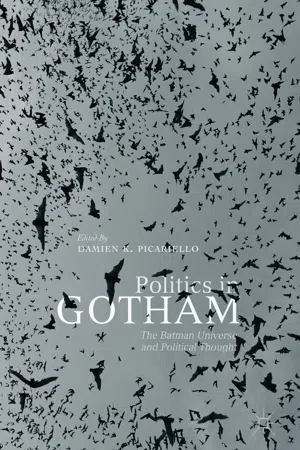
In Politics in Gotham, scholars from a variety of fields—political science, philosophy, law, and others—provide answers to the question: "What does Batman have to do with politics?" Contributors use the Batman canon, from the comics to the feature films, to explore a broad range of issues in politics and political thought. What can Batman's role in Gotham City teach us about democracy? How do Batman's vigilantism and his violence fit within a society committed to the rule of law? What's the relationship between politics in Gotham and politics in our own communities? From Machiavelli to the fake news phenomenon, this book provides a compelling introduction to the politics behind one of the world's most enduring pop culture figures.
- English
- ePUB (mobile friendly)
- Available on iOS & Android
eBook - ePub
About this book
Information
© The Author(s) 2019
Damien K. Picariello (ed.)Politics in Gothamhttps://doi.org/10.1007/978-3-030-05776-3_11. Introduction: “I Don’t Want Batman as President”
Damien K. Picariello1
(1)
University of South Carolina Sumter, Sumter, SC, USA
It’s natural to open up a collection like this and ask, somewhat skeptically, “What does Batman have to do with politics?”
The answer, as I hope you’ll see as you begin to look over our chapters, is: A lot.
Consider Batman’s origin story. The earliest depiction of this story has a young Bruce Wayne making a solemn vow following his parents’ murder: “And I swear by the spirits of my parents to avenge their deaths by spending the rest of my life warring on all criminals.”1
Where’s the politics in that? Well, for starters, bringing criminals to justice is a job that we entrust to our governments. And it’s a complicated job, so complicated, in fact, that it necessitates an entire criminal justice system, with layer upon layer of procedural rules for every step of the process, all of which are subject to public dispute and, if needed, revision.
Compare this to Bruce Wayne’s pledge: He’ll spend the rest of his life “warring on all criminals.” How does this square with our societal commitment to criminal justice? What’s the difference between this commitment and a war on crime of the sort to which Wayne dedicates himself? Are the two compatible, and if so, in what sense? Or are the two opposed, and if so, is Batman’s war on crime good or bad?
Asking this last question points us to the broader question of justice, perhaps the ultimate political question. Is Batman’s war on crime just? If so, then what does this tell us about the relationship between justice and law? If not, then why do we celebrate his actions (at least, most of the time)? And what do we mean by “justice,” anyway? How does the pursuit of justice fit with Batman’s desire to “avenge” his parents’ deaths? If we are committed to building a just society, does this society have a place in it for Batman?
That’s a lot of political questions, and all we did was look at one line from one comic.
As we continue, it’s worthwhile to quote, at length, from an interview with Frank Miller, the primary creative force behind the innovative and seminal The Dark Knight Returns. Miller says:
It’s important to recognize the ways in which Miller’s words ring true, and remind us not to get ahead of ourselves. Miller’s Batman is not going to tell us who to vote for, no matter how much we parse the text and subtext of The Dark Knight Returns. Christopher Nolan’s Dark Knight trilogy, despite the mountain of politically charged interpretation and criticism focusing on the films, does not make a serious, intelligible case for a particular political party or program. As Miller says, “adventure stories” about “a guy who wears a cape and punches out criminals” are not arguments for “how we should live our lives under a political system…”When I create a story I take a very small thing and make it very big. It just happens to be the way I make my fiction. Someone mugs me and I make a Batman comic, to put it in the crudest possible terms. While there is room for political parody and while there is political meaning in all of this, presenting a hero is not presenting a case for political power. I don’t want Batman as president, and I don’t think the book says that at all. There’s a tendency to see everything as a polemic, as a screed, when after all these are adventure stories. They can have a lot of ramifications, they can bring in an awful lot of other material, but anyone who really believes that a story about a guy who wears a cape and punches out criminals is a presentation of a political viewpoint, and a presentation of a program for how we should live our lives under a political system, is living in a dream world.2
At the same time, Batman lives and acts within a political community, and he does things that we tend to think of as the exclusive province of our political authorities. Batman is inescapably political: He may not tell us how to vote, but he can certainly get us thinking about politics. In this sense, Miller is right if we’re thinking about politics as who we should vote for and which policies we should support, but his warning seems a bit less urgent if we take a step back and consider some of the larger questions of politics, the fundamental or permanent questions, questions like those raised earlier, questions like: What is justice? What is a good political community? What is democracy (or liberty, or equality), and what does it require?
The chapters in this book don’t provide definitive answers to these questions, but they do use Batman and the Batman universe as a provocative window through which to approach some of these questions with fresh eyes and to come away, perhaps, with fresh insights.
The chapters to follow explore the politics of Batman from a great many starting points, and they take their discussions in a great many different directions. Nevertheless, they have a couple of important things in common.
The first thing these chapters have in common is that they consider Batman (and, often, other characters in the Batman universe) not in isolation but rather in the context of a broader political community. After all, we can’t talk about the politics of Batman without situating him within a community; politics is something that people do together, not alone. Some of these chapters consider the significance of Batman’s work for the political community of Gotham City, and some of them consider the connections between politics in Gotham and politics in our own communities. Some of them do both. But all of them consider Batman and his allies and adversaries in the context of political community, asking what we might learn from such consideration.
The second thing these chapters have in common is that they all begin with the Batman universe and point outwards. They take an element of the Batman universe—usually, but not always, Batman—and use this as a starting point for a broader discussion of an issue or theme in politics and political thought. The Batman universe works in each of these chapters as a provocation, a spur, pointing us toward larger questions about politics and the political community. Other studies have sought primarily to understand Batman, his evolution, and his place in our culture; the chapters collected here use Batman and the Batman universe as a particularly interesting point of entry into broader conversations.3 Our discussions start with Batman, but they don’t end there.
Our first chapter, “Justice Unmasked” by Alan I. Bailey, begins by discussing the polarized and politically charged reactions to Christopher Nolan’s Dark Knight trilogy. From here, Bailey introduces us to several of the concerns that will occupy much of our volume: The status of Batman as a citizen of Gotham; the differences between law, justice, and vengeance; and the question of Batman’s impact on his political community. All of these themes appear repeatedly in subsequent chapters.
Our next several chapters focus on Christopher Nolan’s Dark Knight trilogy, and they ask about the status of Nolan’s Batman within Nolan’s Gotham. Steven Johnston argues that Nolan’s films raise interesting issues for democratic political communities but ultimately offer unsatisfying answers to these questions. Nolan’s Batman, says Johnston, acts (and encourages others to act) in ways that ultimately undermine the democratic aspirations of his city. In my own chapter, “The Heroism of ‘Sober Expectations,’” I take a different view, and I argue that in not expecting too much from his fellow citizens, Nolan’s Batman has a great deal in common with America’s founders. Finally, William J. Berger uses Nolan’s films to discuss the legitimacy of Batman’s actions and points out the unstable ground on which this legitimacy rests.
Our next few chapters situate Batman in the context of the history of political thought and use concepts drawn from this history to analyze the caped crusader. Ian J. Drake and Matthew B. Lloyd discuss Batman in the context of Plato’s tripartite division of the human soul and ask about the consequences—for the city of Gotham and for Batman himself—of a soul governed by spiritedness rather than reason. Tony Spanakos puts Batman’s actions in the context of Machiavelli’s Discourses on Livy and suggests that Batman functions, in Gotham, as a particular kind of “republican prince,” taking extraordinary action to correct imbalances in the city but never seizing political authority in perpetuity. Following on Spanakos’s discussion of Machiavelli, Daniel J. Goff uses Machiavelli’s The Prince to discuss Bruce Wayne’s adoption of the bat as his animal trademark, as well as the significance of Batman’s brand of theatrics for the city of Gotham.
In our next pair of chapters, our contributors discuss Batman’s unique approach to crime and punishment. Mark D. White discusses Batman in the context of Gotham City’s criminal justice system and asks about Batman’s peculiar relationship to the city’s law enforcement and legal institutions. In “The Retributive Night,” Mohamad Al-Hakim explores Batman’s treatment of criminals and tries to establish the Dark Knight’s philosophy of punishment.
Each of our next three chapters tracks a particular development in American politics beyond the Batman universe and connects this to the development of a particular character or theme within the Batman universe. Christina M. Knopf tracks societal fears over time and connects this with representations of the Scarecrow; Salvatore James Russo examines the role of mass media in Gotham City and contrasts this with changing attitudes toward mass media among Americans; and Carolyn Cocca tracks changes in twentieth-century feminism and connects these to changes in the Batgirl character over time. All three of these chapters try to use the element of the Batman universe they discuss as a window into politics in the “real world.”
Our final chapter follows on an observation that Geoff Klock makes about Frank Miller’s The Dark Knight Returns: Miller’s work is “not so much violent as it is more graphic and more realistic about the violence that has always inhabited superhero narratives.”4 Aidan Diamond extends this insight to Batman v. Superman: Dawn of Justice , asking us to consider the politics of Batman’s violence within (and beyond) this notably violent film.
Nearly all of our contributors—and, yes, even our editor—are academics. But we hope that this collection is of interest to a wide variety of readers, both within the academy and beyond. We come from a variety of academic disciplines—political science, philosophy, communication studies, comparative media, and more—and when we all come together in a collection like this, we know we can’t count on our fellow authors sharing our own academic backgrounds. So we’ve tried as best we can to write in a way that’s both broadly accessible and intellectually rigorous: We’ve tried to write, in a sense, to each other.
Of course, we hope that our audience won’t just be one another! We hope that you, dear reader—whether you’re a professor, a student, a Batman fan, or just someone who liked the cover—will enjoy what we’ve put together and maybe even learn something from it. We invite you to join us as we explore politics and political thought through the lens of the Batman universe.
As editor of this volume, I’d like first and foremost to thank our contributors, who have put together what I think are an excellent group of chapters. I’m grateful for the support of my colleagues at the University of South Carolina Sumter and for funding facilitated by the USC Sumter Summer Stipend Committee and the USC Sumter Williams-Brice-Edwards Faculty and Staff Screening Committee; special thanks are due to Mike Sonntag and Eric Reisenauer for their help and support in this regard. Thanks to Michelle Chen at Palgrave for her enthusiasm for this project and for tirelessly an...
Table of contents
- Cover
- Front Matter
- 1. Introduction: “I Don’t Want Batman as President”
- 2. Justice Unmasked
- 3. The Dark Knight: Toward a Democratic Tragedy
- 4. The Heroism of Sober Expectations
- 5. Deconstructing Batman’s Legitimacy: The Radical Political Critique of Christopher Nolan’s Batman Cycle
- 6. Batman the Noble Dog: The Costs of Spiritedness for the Individual and Society
- 7. The Dark Prince of the Republic: Machiavelli, Batman, and Gotham City
- 8. The Lion, the Fox, and the Bat: The Animal Nature of Machiavelli’s The Prince and Batman
- 9. Criminal Justice in Gotham: The Role of the Dark Knight
- 10. The Retributive Knight
- 11. Politics as “the Product of Everything You Fear”: Scarecrow as Phobia Entrepreneur
- 12. #FAKENEWS in Gotham City
- 13. Batgirls and the Politics of Feminism in Gotham
- 14. Dawn of Justice: Revisioning, Accountability, and Batman in the Twenty-first Century
- Back Matter
Trusted by 375,005 students
Access to over 1.5 million titles for a fair monthly price.
Study more efficiently using our study tools.
Frequently asked questions
Yes, you can cancel anytime from the Subscription tab in your account settings on the Perlego website. Your subscription will stay active until the end of your current billing period. Learn how to cancel your subscription
No, books cannot be downloaded as external files, such as PDFs, for use outside of Perlego. However, you can download books within the Perlego app for offline reading on mobile or tablet. Learn how to download books offline
Perlego offers two plans: Essential and Complete
- Essential is ideal for learners and professionals who enjoy exploring a wide range of subjects. Access the Essential Library with 800,000+ trusted titles and best-sellers across business, personal growth, and the humanities. Includes unlimited reading time and Standard Read Aloud voice.
- Complete: Perfect for advanced learners and researchers needing full, unrestricted access. Unlock 1.5M+ books across hundreds of subjects, including academic and specialized titles. The Complete Plan also includes advanced features like Premium Read Aloud and Research Assistant.
We are an online textbook subscription service, where you can get access to an entire online library for less than the price of a single book per month. With over 1.5 million books across 990+ topics, we’ve got you covered! Learn about our mission
Look out for the read-aloud symbol on your next book to see if you can listen to it. The read-aloud tool reads text aloud for you, highlighting the text as it is being read. You can pause it, speed it up and slow it down. Learn more about Read Aloud
Yes! You can use the Perlego app on both iOS and Android devices to read anytime, anywhere — even offline. Perfect for commutes or when you’re on the go.
Please note we cannot support devices running on iOS 13 and Android 7 or earlier. Learn more about using the app
Please note we cannot support devices running on iOS 13 and Android 7 or earlier. Learn more about using the app
Yes, you can access Politics in Gotham by Damien K. Picariello in PDF and/or ePUB format, as well as other popular books in Politics & International Relations & Film & Video. We have over 1.5 million books available in our catalogue for you to explore.