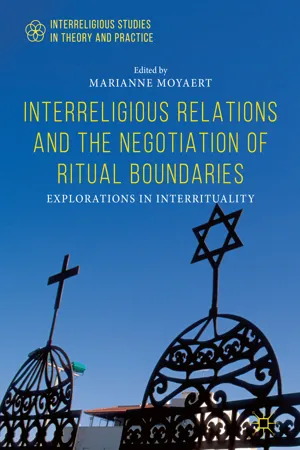
This volume explores the ways in which interreligious encounters happen ritually. Drawing upon theology, philosophy, political sciences, anthropology, sociology, and liturgical studies, the contributors examine different concrete cases of interrituality. After an introductory chapter explaining the phenomenon of interrituality, readers learn about government-sponsored public events in Spain, the ritual life of mixed families in China and the UK. We meet Buddhist and Christian monks in Kentucky and are introduced to rituals of protest in Jerusalem. Other chapters take us to shared pilgrimage sites in the Mediterranean and explore the ritual challenges of Israeli tour guides of Christian pilgrims. The authors challenges readers to consider scriptural reasoning as a liturgical practice and to inquire into the (in)felicitous nature of rituals of reconciliation. This volume demonstrates the importance of understanding the many contexts in which interrituality happens and shows how ritual boundaries are perpetually under negotiation.
eBook - ePub
Interreligious Relations and the Negotiation of Ritual Boundaries
Explorations in Interrituality
- English
- ePUB (mobile friendly)
- Available on iOS & Android
eBook - ePub
Interreligious Relations and the Negotiation of Ritual Boundaries
Explorations in Interrituality
About this book
Information
© The Author(s) 2019
Marianne Moyaert (ed.)Interreligious Relations and the Negotiation of Ritual BoundariesInterreligious Studies in Theory and Practicehttps://doi.org/10.1007/978-3-030-05701-5_1Broadening the Scope of Interreligious Studies: Interrituality
Marianne Moyaert1
(1)
Vrije Universiteit Amsterdam, Amsterdam, The Netherlands
The second half of the twentieth century witnessed a radical shift in the relations between religions (Swidler 1990). As Catherine Cornille explains, “[r]ather than competing with one another over territories, converts or claims, religions have generally come to adopt a more conciliatory and constructive attitude toward one another, collaborating in social projects and exchanging views on common religious questions” (Cornille 2013, p. xii). Different sociopolitical factors such as globalization and various processes of secularization, pluralization, and decolonization, as well as the rise of religious extremism and the ecological crisis, help account for the so-called dialogical turn and the rapid proliferation of interfaith initiatives at local, national, and international levels (Halafoff 2013; Lamine 2004).
Toward a New Field of Interreligious Studies
Today, most mainline religious communities across the globe, whether Buddhist, Jewish, Hindu, or Muslim, share the sense that promoting friendly interreligious relations is to be preferred over polemical competition. Historically speaking, however, dialogue has been predominantly initiated by Christians. Especially after the Second World War and the Shoah, which happened in ‘Christian’ Europe, and the realization of some of the devastating effects of Christian mission on local cultural and religious communities, dialogue offered “less aggressive attitudes … for Christians to approach other religions” (Swamy 2016, p. 1). Starting in the 1960s, both the Vatican and the World Council of Churches promulgated a variety of documents promoting interfaith dialogue or addressing key theological questions related to the meeting between religions. Worldwide, this institutional support has not only given way to numerous centers for interreligious dialogue but also stimulated scholarly reflection on some of the fundamental questions related to the dialogue between religions (Moyaert 2013).
Initially, research efforts focused primarily on intentionally established encounters that took place at a formal (and often theological) level, and scholars interested in the dialogue between religions were mostly Christian theologians, often (though not always) with a Western background, who focused their attention on questions related to truth, salvation, and revelation. Is it possible for non-Christians to be saved? Are other traditions part of God’s plan for salvation? Do other (read non-Christian) faith traditions contain truth? How do Christian claims to uniqueness and finality relate to similar claims made by other religions? Theologically speaking, what enables understanding across traditions? These questions were dealt with in the field of theology of religions and its by now well-known typology of exclusivism, inclusivism, and pluralism, and they were addressed by dialogical pioneers such as John Hick (1995), Paul Knitter (2002), Raimon Panikkar (1981), Alan Race (1983), and Gavin D’Costa (1986, 2000) to name some of the most important figures. However, other questions of a more philosophical/hermeneutical nature were also addressed: What are the conditions for interreligious dialogue? What are the rules for such dialogical engagement? What can we learn from the dialogue with those of other faiths? How is interreligious understanding possible and what are its limits? How do conflicting truth claims relate? But one may also think of fundamental questions about the relation between self and other, identity and alterity, openness and commitment, and questions about the (im)possibility of formulating a global ethos across traditions. Here scholars like Catherine Cornille and Christopher Conway (2008, 2010), Hendrik Vroom (2006), David Cheetham (2013), Paul Hedges (2010), Marianne Moyaert (2014), and Richard Kearney (2011) come to mind.
In the meantime, interreligious initiatives continued to burgeon, taking on a variety of forms ranging from interfaith peacebuilding to scriptural reasoning, from social action across traditions to theological dialogue, from neighborly interactions at the playground to interreligious learning in the classroom, from interfaith peacebuilding to ecological initiatives supported by religious leaders from different traditions. The multiplicity of these encounters (Basset 1996) depends on who is involved, their gender and role in their respective traditions (laypeople, clergy, monks/nuns), the reason or occasion for their engagement (practical, spiritual, or theological concerns), the nature (official/informal, ongoing/one-off) and the scope of the encounter (local, national, international), and the number of traditions (bilateral or multilateral) involved as well as which religions are represented (Buddhism, Hinduism, etc.). As the interfaith movement has outgrown its original theological agenda, research into the phenomenon of interreligious relations has likewise been diversifying, and today scholars from a range of fields are starting to take an interest in the dynamic interaction between people who believe and practice differently. Pedagogues are exploring how to facilitate interreligious learning in classroom settings (Jackson 2006; Ter Avest 2012; Peace Howe 2012), sociologists probe into the impact of the multifaith movement on Western societies (Patel 2017; Halafoff 2013; Lamine 2004), psychologists ask how interreligious dialogue may contribute to a non-violent faith development (Streib 2018), and peace scholars examine the relation between religion, violence, and reconciliation (Hertog 2010; Gopin 1997; Abu-Nimer 2003). As is often the case, the more research is done, the more scholars become aware of the complexity and diversity of interreligious relations, and the more it becomes clear that the dynamic interaction between religious and non-religious communities and their adherents needs to be studied from a variety of disciplinary and theoretical angles.
Since the turn of the twenty-first century, the term interreligious/interfaith studies is being employed to refer to the multidisciplinary scholarly field that includes those scholars who are dedicated to the study of the dynamic encounter (intentional and non-intentional, harmonious and conflictual, collective and individual, and historical and contemporary) between religions and their adherents in a variety of historico-cultural and sociopolitical contexts. “As an academic field, interfaith studies … examine[s] the multiple dimensions of how individuals and groups who orient around religion differently interact with one another, along with the implications of this interactions for communities, civil society, and global politics” (Patel 2013). Its center of gravity is what happens in the space ‘in-between’ the faiths.
Part of the agenda of interreligious studies is to broaden scholarly attention from interreligious theological dialogue to other non-discursive expressions of interreligiosity that may revolve around art, song, ritual, or sociopolitical activism (or a combination of these). Theological exchange is important, but it is only one form of interreligious interaction. To better understand interreligious relations, we have to also take into account other forms of interactions. Some interreligious scholars are, moreover, concerned that a one-sided interest in interreligious dialogue, understood as an encounter between people who represent different traditions, may actually result in a reified understanding of religions and religious identities. Especially feminist and postcolonial interreligious scholars like Kwok Pui-Lan (2004), Anne Hege Grung (2014), and Muthuraj Swamy (2016) argue that the focus on theological dialogues contributes to a problematic presentation of collective and individual religious identities as fixed, bounded, and exclusivist, thereby ignoring the fact that, at a grassroots level, identities are often multiple, fluid, and hybrid. They continue by pointing out that, by focusing on theological interreligious dialogues, the role women play in building bridges across communities tends to go unnoticed. In addition, they take issue with the way theological dialogues have often (though certainly not always) neglected the fact that interreligious relations, both contemporary and historical, cannot be thought of apart from sociopolitical questions and power relations—as if one can discuss traditional beliefs without referencing the context in which they are practiced. To quote Anne Hege Grung, “the space of the dialogue is always connected to other spaces because the people involved are in motion.” She continues highlighting how “the discourse, the conversation and the group process in the dialogue have marks of other discourses, conversations, and relations. In a critical perspective, this observation entails that inter-religious dialogues are marked in different ways by internal and external hierarchies of power and authority connected to gender, culture, ethnicity and class” (Grung 2014). Instead of imagining interreligious encounters as happening in some safe space where representatives of different traditions (often male) meet each other as equals to have a more or less rational exchange about the nature of God, feminist and postcolonial scholars draw attention to the intersectionality of identities, power imbalances, and the fact that interreligiosity is always political (Hill Fletcher 2017). That is why they underscore the importance of shared interreligious activism, whether local, national, or international, in response to concrete oppressions and threats to human flourishing (Egnell 2003, 2009).
Broadening the Scope of Interreligious Studies: Interrituality
The current volume contributes to the critical study of interreligious relations and adds to the ongoing diversification and complexification of interreligious studies. The original idea for the book was inspired by the critical work of interreligious scholars who seek to broaden the scope of interreligious studies to redirect academic attention beyond dialogue-centered models of interfaith engagement (though many contributors, including the editor, participate in dialogue and recognize all that such models bring to theological reflection and the enhancement of friendly interreligious relations). Religion is a practice before it is a theory, and the same goes for interreligion. This volume, however, is original in that it argues that the shift from dialogue-centered models of interfaith engagement to lived interreligion should also include a turn to ritual, that is, to the way interreligious encounters happen via, through, and around age-old or new ritual practices.
Several chapters in the book showcase how a deeper understanding across traditions may be established ritually. This finding is in line with the power of symbolic practices to put together what was first separated. Symbolic actions are actions that unite (cf. sym-ballein): they reconcile previously conflicting parties, join individuals in a community of celeb...
Table of contents
- Cover
- Front Matter
- Broadening the Scope of Interreligious Studies: Interrituality
- Interreligious Events in the Public Space: Performing Togetherness in Times of Religious Pluralism
- Response
- Religious Ritual, Injustice, and Resistance: Praying Politically in Israel/Palestine
- Response
- Scriptural Reasoning as a Ritualized Practice
- Response
- Christian Holy Land Pilgrimage as an Interreligious Encounter
- Response
- Ritual Mixing and Interrituality at Marian Shrines
- Response
- Taking the Liturgical Turn in Comparative Theology: Monastic Interreligious Dialogue as a Supporting Case
- Response
- Rituals of Reconciliation? How Consideration of Ritual Can Inform Readings of Catholic-Jewish Dialogue After the Holocaust
- Response
- Reversals and Reconstructions: The Place of Interreligious Rituals of Reconciliation in Forming a New Relationship Between Indigenous and Non-indigenous Canadians
- Response
- Interrituality in Contemporary China as a Field of Tension Between Abstention and Polytropy
- Response
- The Role of Ritual in Mixed-Faith Families
- Response
- A Philosophical Analysis of Interrituality
- Back Matter
Trusted by 375,005 students
Access to over 1.5 million titles for a fair monthly price.
Study more efficiently using our study tools.
Frequently asked questions
Yes, you can cancel anytime from the Subscription tab in your account settings on the Perlego website. Your subscription will stay active until the end of your current billing period. Learn how to cancel your subscription
No, books cannot be downloaded as external files, such as PDFs, for use outside of Perlego. However, you can download books within the Perlego app for offline reading on mobile or tablet. Learn how to download books offline
Perlego offers two plans: Essential and Complete
- Essential is ideal for learners and professionals who enjoy exploring a wide range of subjects. Access the Essential Library with 800,000+ trusted titles and best-sellers across business, personal growth, and the humanities. Includes unlimited reading time and Standard Read Aloud voice.
- Complete: Perfect for advanced learners and researchers needing full, unrestricted access. Unlock 1.5M+ books across hundreds of subjects, including academic and specialized titles. The Complete Plan also includes advanced features like Premium Read Aloud and Research Assistant.
We are an online textbook subscription service, where you can get access to an entire online library for less than the price of a single book per month. With over 1.5 million books across 990+ topics, we’ve got you covered! Learn about our mission
Look out for the read-aloud symbol on your next book to see if you can listen to it. The read-aloud tool reads text aloud for you, highlighting the text as it is being read. You can pause it, speed it up and slow it down. Learn more about Read Aloud
Yes! You can use the Perlego app on both iOS and Android devices to read anytime, anywhere — even offline. Perfect for commutes or when you’re on the go.
Please note we cannot support devices running on iOS 13 and Android 7 or earlier. Learn more about using the app
Please note we cannot support devices running on iOS 13 and Android 7 or earlier. Learn more about using the app
Yes, you can access Interreligious Relations and the Negotiation of Ritual Boundaries by Marianne Moyaert in PDF and/or ePUB format, as well as other popular books in Social Sciences & Comparative Religion. We have over 1.5 million books available in our catalogue for you to explore.