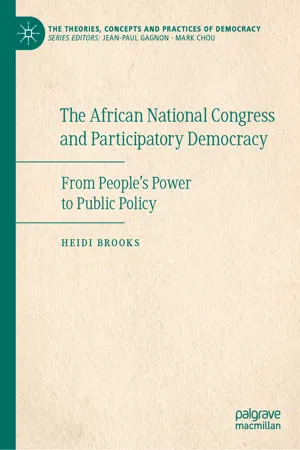
This book examines the development of democratic thought in the African National Congress (ANC) of South Africa, with a focus on the movement's ideas about participatory democracy. It makes particular reference to two key periods: the 1980s 'people's power' movement and the subsequent years of policy formulation from 1990 when the ANC began to design and implement a system of participatory democracy alongside a representative government. Through the examination of historic documents and in-depth interviews with former ANC activists, government officials and those involved in policy development, the author explores the inspiration for the party's commitment to establishing participatory democracy. The book combines democratic theory and political and intellectual history to look at the role of popular participation as part of a broader trajectory of the ANC's democratic thought. It critically engages with concepts used in the party's participatory discourse with a view to deepening our understanding of how ideas have shaped the construction of South Africa's democracy.
eBook - ePub
The African National Congress and Participatory Democracy
From People's Power to Public Policy
- English
- ePUB (mobile friendly)
- Available on iOS & Android
eBook - ePub
The African National Congress and Participatory Democracy
From People's Power to Public Policy
About this book
Information
© The Author(s) 2020
H. BrooksThe African National Congress and Participatory DemocracyThe Theories, Concepts and Practices of Democracyhttps://doi.org/10.1007/978-3-030-25744-6_11. Introduction: A Battle of Ideas
Heidi Brooks1, 2
(1)
Political and International Studies, IIE MSA, Johannesburg, South Africa
(2)
Centre for Social Change, University of Johannesburg, Johannesburg, South Africa
Heidi Brooks
The political landscape of contemporary South Africa is a combination of its past and present. A history of colonialism and apartheid has left deep social and political scarring and a skewing of the nation’s socio-economic trajectory lasting well into the third decade of democracy. Its history of popular political organisation and aspirations for a participatory form of politics have also been carried through to the democratic era. Yet the current political environment is characterised by widespread popular disillusionment with the quality of democracy. Since 2004, South Africa has seen an upsurge in popular protest (Booysen 2007: 24; Alexander 2010), often seemingly triggered by the failures of service delivery but rooted in deeper grievances over lack of representivity, accountability, and disappointment with the fruits of democracy. The spread of community and sectoral unrest in black urban townships, the fateful mineworkers’ strike at Marikana in 2011, and the 2015–2016 #FeesMustFall movement on university campuses provide but a few examples.
The backdrop to the present picture is a long history of struggle politics which fostered not only popular aspirations for a democratic future, but the idea of a democratic state in which South Africa’s citizens would play a decisive part. At the helm of this struggle was South Africa’s largest liberation movement, and now dominant party, the African National Congress (ANC). In recent years, despite a shift in party leadership and the faded prospect of a ‘new era’ of bottom-up organisation, South Africa has witnessed a ruling party increasingly factionalised. The years from 2007, in particular, have been marked by a crumbling of the ANC’s historic alliance with labour, the breakaway and subsequent formation of new parties posing a challenge to the ANC, 1 mounting distrust of the executive, internal leadership challenge, systemic levels of personal aggrandisement in public office, and popular frustration with the unmet promises of freedom.
There has, more positively, been a burgeoning of alternative Left movements. The emergence of a new protest politics has brought with it a revitalisation of civil society organisations and autonomous social movements, not only challenging the status quo, but demanding substantive popular engagement in the governance process. Indeed, it might be suggested that the challenge to centralised power through associational mobilisation from below, represents both a prospering of new spaces for action by an engaged citizenry and the claiming of political rights. 2 Yet, as South Africans have increasingly resorted to ‘invented’ spaces to make their voices heard, this has been seen as symptomatic not only of a popular desire to influence policy but of the failure of formal institutional channels for citizen participation in governance (Benit-Gbaffou 2007, 2008; Sinwell 2010). 3
During both the transition to democracy and since 1994, the ANC has advocated a role for participatory democracy alongside representative institutions. Local government, in particular, has been the focus of this initiative, with participatory democracy being provided for through both constitutional provision and municipal legislation. Yet, despite the intent to engage citizens in decision-making processes about issues that affect their lives, the participatory democratic project in South Africa is largely considered to have failed and has not fulfilled the objectives set out in legislation.
Although, on the part of the ruling party, the presence of formal mechanisms for participatory democracy indicates more than a rhetorical commitment, for an organisation whose ‘mass character’ has long been the vehicle of its political programme, the limitations of its approach to institutionalising citizen participation warrants examination. Many on the Left in the historic ANC alliance continue to lament the post-1994 submergence of the ANC’s participatory traditions in an increasingly ‘thin’ democracy. As a movement, the ANC, as Anthony Butler argues, has “always been constituted in part by how its supporters have conceived of it” (2012: 14). In the context of formal and institutional commitments—and history of the ANC-as-movement, whose very raison d’être lies in its connection with the people—how does one explain the inadequacies of democracy’s depth? Those with an interest in the construction and future trajectory of South African democracy might well ask, what went wrong?
In order to understand the limitations of South Africa’s participatory democracy, this book interrogates the connection between ideas and practice: how deficiencies in the practice of citizen participation might be explained by the ideas that inform it. The deficits of democracy and failures of the democratic promise are witnessed by present day South Africans. Yet the origins and explanations for these deficiencies can be found in the history of its democratic trajectory. Valuable scholarly attention has been given to both procedural and substantive weaknesses in the implementation of participatory mechanisms. Yet the ideas that inform commitments to participatory democracy remain inadequately understood: There has been limited examination of their conceptual underpinnings as an explanatory factor of policy failure. There has also been no analysis to date which takes into account the interconnection between the ANC’s very understanding of ‘democracy’ and its own mass movement history.
1.1 The Intertwining of Movement and Democracy
Despite the weakening of the ANC alliance, the domestic political landscape of South Africa remains indisputably shaped by its dominance—not only as a political party but as a mass movement historically. The increasing strength of political opposition, and notable (if marginal) decline in the ANC’s share of the vote in the 2019 elections, do not nullify the imprint that its democratic discourse has made on the contemporary landscape. For the movement’s activists and intellectuals, as Butler suggests, “the ANC is more than an organisation: it is also an idea” (2012: 14). An important, yet under-theorised, strand in participatory democratic discourse, is linked to the very identity of the ruling party.
The ANC has historically seen itself as engaged in a battle of ideas: an ideological struggle over the vision for the democratic state in which it seeks to mobilise and win hegemony over progressive sectors of society. Although this battle is framed as a national (even global) contestation, between external neo-liberal forces and the objectives of its own ‘national democratic revolution’ (ANC 2013, 2017), there has always been and remains a struggle for ideological dominance within the movement itself.
This book seeks to show how the contestation of ideas in the ANC about the role for the people is played out in participatory democracy. The focal periods of the book are the 1980s ‘people’s power’ movement and the formulation of post-1994 policy. While there is no cut-off date for the period of analysis, the book is concerned with the period of policy formulation: the roots and development of ideas and their conversion into formal commitments. By examining the ANC, first as a liberation movement and then a dominant party, it unravels the theory and ideas within the ANC that inform its policy commitments. Importantly, the discussion highlights how the intellectual history and conceptual underpinnings of the post-apartheid framework have played a critical role in the way democracy is understood and practiced.
1.2 South Africa’s Landscape of Participatory Traditions
Existing research on the 1980s experience of organisational and grassroots struggle ranges from providing a history of the movement itself to case-study-based accounts of popular power in various regions and localities. From the end of the 1970s, with the resurgence of domestic struggle, the growth of organised black labour and advent of a broad civic movement largely aligned to the ANC, a language of mass participation and control became visible in its discourse (Lodge 1999: 5). The period 1985–1986 saw the emergence of township organs of ‘people’s power’, as well as a revival of the 1955 Freedom Charter ’s demand for ‘democratic organs of self-government’. The ANC’s call of 1984 to render South Africa ‘ungovernable’ (Mayibuye 1984) shifted toward a discourse of ‘people’s power’ in which the centre of control was transferred from the apartheid state’s Black Local Authorities to local popular organs informally structured outside of the state.
Thorough accounts of township struggles in the 1980s are to be found in works by Jeremy Seekings (2000), Ineke Van Kessel (2000), Steven Mufson (1990), Tom Lodge and Bill Nasson (1991), and Glen Adler and Jonny Steinberg (2000). Equally, some of the most well-known case studies of popular and civic organisation in the mid-1980s cover townships in the Pretoria-Witwatersrand-Vereeniging region (Seekings 1991, 1992a, b; Marks 2001) and, more specifically, the West Rand (Seekings 1992a; Van Kessel 2000), Alexandra (Bozzoli 2004; Mayekiso 1996; Carter 1991), Atteridgeville/Sausville (Steinberg 2000) and Diepkloof (Marks 2001). Research has also covered areas including Sekhukhuneland (Van Kessel 2000), Port Elizabeth (Cherry 2000a, b) and, to a much lesser extent, Cape Town (Van Kessel 2000; Scharf and Ngcokoto 1990).
Seekings (2000) and Van Kessel (2000) have produced the most thorough written histories of the United Democratic Front (UDF)—an umbrella organisation launched in 1983, originally to campaign against the elections for a tricameral parliament, but which later took on a much broader significance in linking local community and sectoral struggles to demands for national political change (Seekings 1992b; Sisulu 1986: 101–102; Van Kessel 2000: 28). While these popular structures were widely understood by ANC activists and cadres as contributing to mass mobilisation for the liberation struggle, for some they were also understood as pre-figuring a direct and participatory democracy (Adler and Steinberg 2000).
Feeding into the burgeoning civic movement were the traditions and personnel of the independent trade unions . Organised labour, which, from the 1970s, had been implementing democratic shop-floor structures and practices of workplace democracy (Friedman 1985, 1987; Fine and Webster 1989; Adler and Webster 1995, 2000; Erwin 2017), made an imprint on the organisational practices and representative structures taken up by community activists (Fri...
Table of contents
- Cover
- Front Matter
- 1. Introduction: A Battle of Ideas
- 2. Participation in the History of ANC Democratic Thought
- 3. Discourses of ‘People’s Power’
- 4. ‘The People Shall Govern’: The Codification of Ideas
- 5. Post-1994 Policy and Movement Discourse
- 6. Conclusion: The Power of Ideas
- Back Matter
Trusted by 375,005 students
Access to over 1.5 million titles for a fair monthly price.
Study more efficiently using our study tools.
Frequently asked questions
Yes, you can cancel anytime from the Subscription tab in your account settings on the Perlego website. Your subscription will stay active until the end of your current billing period. Learn how to cancel your subscription
No, books cannot be downloaded as external files, such as PDFs, for use outside of Perlego. However, you can download books within the Perlego app for offline reading on mobile or tablet. Learn how to download books offline
Perlego offers two plans: Essential and Complete
- Essential is ideal for learners and professionals who enjoy exploring a wide range of subjects. Access the Essential Library with 800,000+ trusted titles and best-sellers across business, personal growth, and the humanities. Includes unlimited reading time and Standard Read Aloud voice.
- Complete: Perfect for advanced learners and researchers needing full, unrestricted access. Unlock 1.5M+ books across hundreds of subjects, including academic and specialized titles. The Complete Plan also includes advanced features like Premium Read Aloud and Research Assistant.
We are an online textbook subscription service, where you can get access to an entire online library for less than the price of a single book per month. With over 1.5 million books across 990+ topics, we’ve got you covered! Learn about our mission
Look out for the read-aloud symbol on your next book to see if you can listen to it. The read-aloud tool reads text aloud for you, highlighting the text as it is being read. You can pause it, speed it up and slow it down. Learn more about Read Aloud
Yes! You can use the Perlego app on both iOS and Android devices to read anytime, anywhere — even offline. Perfect for commutes or when you’re on the go.
Please note we cannot support devices running on iOS 13 and Android 7 or earlier. Learn more about using the app
Please note we cannot support devices running on iOS 13 and Android 7 or earlier. Learn more about using the app
Yes, you can access The African National Congress and Participatory Democracy by Heidi Brooks in PDF and/or ePUB format, as well as other popular books in Politics & International Relations & African Politics. We have over 1.5 million books available in our catalogue for you to explore.