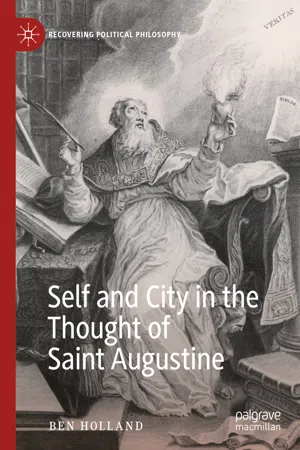
Self and City in the Thought of Saint Augustine explores the analogy between the self and political society in the thought of St. Augustine of Hippo. This analogy is an important theme in the history of political thought. Attempts have been made to understand the state by examining the soul (since Plato), the body (as in medieval theories of the body politic) and the person (surviving to this day in such concepts as international legal personality). This book aims to reinstate the Augustinian part of the story. It argues that Augustine develops three analogies between self and city, as a society ordered by love: self-love in the case of the Earthly City; divided but improving love in the Pilgrim City; and love of others and of God in the City of God. It supplies thereby an overview of Augustine's intellectual 'system' as it touches upon theology, psychology and anthropology, as well as politics, and also provides a new interpretation of Augustine's important definition of the republic.
- English
- ePUB (mobile friendly)
- Available on iOS & Android
eBook - ePub
Self and City in the Thought of Saint Augustine
About this book
Information
© The Author(s) 2020
Ben HollandSelf and City in the Thought of Saint AugustineRecovering Political Philosophyhttps://doi.org/10.1007/978-3-030-19333-1_11. Introduction: St. Augustine of Nottingham
Ben Holland1
(1)
School of Politics and International Relations, University of Nottingham, Nottingham, UK
Keywords
Saint AugustineThe stateThe selfAnalogyThe secularRobert A. MarkusJohn MilbankThe Anthropological Analogy
In Book ii of his Confessions, written shortly after his accession to the bishopric at Hippo Regius in present-day Algeria, Aurelius Augustinus (354–430) recounts an episode from his youth. The dramatic, almost histrionic, terms of his reminiscence seem overwrought in relation to the incident itself, in which a teenager and his friends divested an unlovely tree of its crop of fruit and fed the profits of their enterprise to a herd of swine.
Augustine spends an entire chapter of his spiritual autobiography turning over this event, inquiring into his motives (‘Wretch that I was, what did I love in you, my act of theft, that crime which I did at night in the sixteenth year of my life?’), his intentions (‘What fruit had I, wretched boy, in these things which I now blush to recall …?’), and how he might make restitution (‘What shall I render to the Lord?’) (Conf. ii.6.12–16). ‘I went astray from You, my God, far from Your unmoved stability. I became to myself a region of destitution’ (Conf. ii.10.18). Why does Augustine interrogate the affair at such length, with such intense scrutiny, and in terms so self-flagellating?There was a pear tree near our vineyard laden with fruit, though attractive in neither colour nor taste. To shake the fruit off the tree and carry off the pears, I and a gang of naughty adolescents set off late at night after (in our usual pestilential way) we had continued our game in the streets [described earlier, at Conf. ii.3.8, as the ‘streets of Babylon’]. We carried off a huge load of pears. But they were not for our feasts but merely to throw to the pigs. Even if we ate a few, nevertheless our pleasure lay in doing what was not allowed. Such was my heart, O God, such was my heart. (Conf. ii.4.9)
It has been suggested that one of the reasons that he does so is because his recollection of the event is in fact a parable, pointing allegorically or metaphorically beyond the event itself to several significant biblical themes.1 First, there is original sin. Augustine only ever describes the purloined fruit of the tree as poma, the same generic word used in the Vulgate to refer to the forbidden fruit in the Garden of Eden. He trains his penetrating gaze, moreover, entirely on a single tree. Like Adam, Augustine sinned not because of ‘any lust of the flesh’, but because of ‘a loving concern for mutual friendship’, which directed him away from his telos in God (Gn. litt. xi.49). Second, there is redemption. As Augustine was called by his comrades at the fruit tree to sin, a decade or so later he will understand an overheard children’s (or harvesters’) singsong chant as instructing him to set to reading the Bible, which he will do under a fig tree, the biblical symbol for security (1 Kings 4:25), and at which moment he will make a decision to be baptised as a Christian .2
Here, then, is one elaborate analogy in the writings of St. Augustine. But it is certainly not the only one. Augustine’s writings are saturated by analogy. Often and significantly, analogical relations in Augustine point to real proportions between different aspects of creation. He maintained, for example that the six stages of the history of mankind reflect the six days of creation (Jo. ev. tr. ix.6.1–3). And it was Augustine who posited that the four liberal arts constituted an ascending ladder of knowledge via measurement, from geometry (measuring inert and inorganic spaces), through music (which measured the relationship between the soul and the body) and then astronomy (the movements of heavenly bodies moved by the World Soul), to arithmetic (which was the science of measurement in itself) (Mus. vi.1.1).3 Augustine would surely have agreed with an important contemporary theologian that ‘when we see things as like each other in terms of their differences, we are sensing the involvement of the finite with the infinite’.4
The present book concerns itself with a specific analogy developed by Augustine, namely the analogy of the self and the city, or what more loosely (certainly with respect to the part of the pair designating political community) we could describe as the analogy between the soul and the state, the person and the polis.5 After Plato, Augustine’s was the next canonical elaboration of this analogy, which would go on in one form to nourish the body politic of the Middle Ages, and in another to help breathe life into the personality of the state from the early modern period.6 Chiara Bottici uses the term ‘domestic analogy’ to cover such comparisons between individual and city as have appeared in the history of political philosophy .7 I have found that I need another term, however, because, in the first place, the domestic-analogy notion was coined to describe the presumption that relations between states are patterned on the relations between individuals, and, in the second, it better fits those arguments in the history of political thought which read off the implications of patriarchal, paternal or conjugal relationships for the organisation of political power .8 I therefore use the term ‘anthropological analogy’ as a shorthand for the analogy between self and city.
Technically, in an analogy A is said to stand to B as C stands to D. C and D may be the same (‘God is to me as my father is to me’). Analogy is a cousin of metaphor (A is B), but more complicated, comparing two complex entities rather than a complex to a simple one. That is why Kant could argue that analogy ‘does not mean, as the word is commonly taken, an imperfect similarity of two things, but a perfect similarity of relations between quite dissimilar things’.9 Analogy is also a cousin of simile (A is like B), metonymy (A refers to B and B is commonly associated with A, as when ‘Downing Street’ is used to mean ‘the British government’), synecdoche (A refers to B and is a component of B, as when ‘London’ is used to mean ‘the United Kingdom’, or ‘government’ is used to mean ‘state’) and allegory (B is taken to represent an unmentioned A).10 The strict distinctions between metaphor and its cousins notwithstanding, all are grounded in the idea that A can be pictured as B, so that, in Augustine’s own words, metaphorical or analogical reasoning comprehends all forms of thinking in which ‘one thing is understood from another’ (Trin. xv.9.15).11 These are not mere rhetorical tropes or figures of speech but together run through all human thought and language.12 Their function is to represent but also to ‘persuade others to accept our representations’.13 ‘Everywhere there are things standing for other things’, writes James Alexander, ‘and it is all we can do to make sense of the sense we make in politics ’.14 Augustine’s anthropological analogy is a chapter in one of the greatest stories ever told, a story about how we came to represent the world to ourselves as being constituted in a particular way, and to persuade ourselves of the soundness of that representation. Nobody should be in any doubt about how the analogy between the state and the individual has become practically a dead metaphor, meaning that it pervasively and almost subconsciously reinforces both vernacular and scholarly discourses about politics .15
Tertium Quid?
Augustine’s anthropological analogy has been adverted to many times in passing,16 but to my knowledge only Patricia L. MacKinnon has studied the soul-state analogy in Augustine in any detail.17 MacKinnon demonstrates that for Augustine ‘the relations internal to the individual soul are the index and determining factor of the form of polity’, and thus that the state for Augustine is analogous to the soul, the soul writ in more expansive proportion.18 She confines her analysis, though, to Augustine’s anthropological analogy inasmuch as this bears on what he designated the civitas terrena or Earthly City in his self-described magnum opus, The City of God against the Pagans. This, however, is only one of Augustine’s eschatological cities, the other being the civitas Dei or City of God , to which MacKinnon’s chapter does not attend . What is more, the author of City of God is also the author of The Trinity, a man who sees threes ever...
Table of contents
- Cover
- Front Matter
- 1. Introduction: St. Augustine of Nottingham
- 2. The Goodness of All That Is
- 3. The Prideful Soul and the Pagan City
- 4. The Unself and the Pilgrim City
- 5. The Saint and the City of God
- 6. Conclusion: Distension, Attention, Extension, Intention
- Back Matter
Trusted by 375,005 students
Access to over 1.5 million titles for a fair monthly price.
Study more efficiently using our study tools.
Frequently asked questions
Yes, you can cancel anytime from the Subscription tab in your account settings on the Perlego website. Your subscription will stay active until the end of your current billing period. Learn how to cancel your subscription
No, books cannot be downloaded as external files, such as PDFs, for use outside of Perlego. However, you can download books within the Perlego app for offline reading on mobile or tablet. Learn how to download books offline
Perlego offers two plans: Essential and Complete
- Essential is ideal for learners and professionals who enjoy exploring a wide range of subjects. Access the Essential Library with 800,000+ trusted titles and best-sellers across business, personal growth, and the humanities. Includes unlimited reading time and Standard Read Aloud voice.
- Complete: Perfect for advanced learners and researchers needing full, unrestricted access. Unlock 1.5M+ books across hundreds of subjects, including academic and specialized titles. The Complete Plan also includes advanced features like Premium Read Aloud and Research Assistant.
We are an online textbook subscription service, where you can get access to an entire online library for less than the price of a single book per month. With over 1.5 million books across 990+ topics, we’ve got you covered! Learn about our mission
Look out for the read-aloud symbol on your next book to see if you can listen to it. The read-aloud tool reads text aloud for you, highlighting the text as it is being read. You can pause it, speed it up and slow it down. Learn more about Read Aloud
Yes! You can use the Perlego app on both iOS and Android devices to read anytime, anywhere — even offline. Perfect for commutes or when you’re on the go.
Please note we cannot support devices running on iOS 13 and Android 7 or earlier. Learn more about using the app
Please note we cannot support devices running on iOS 13 and Android 7 or earlier. Learn more about using the app
Yes, you can access Self and City in the Thought of Saint Augustine by Ben Holland in PDF and/or ePUB format, as well as other popular books in Politics & International Relations & Political Philosophy. We have over 1.5 million books available in our catalogue for you to explore.