This study examines the suffering narratives of the Bimo and Christian religious communities of the Yi minority who reside in the remote mountains of Sichuan and Yunnan, China, respectively. It is informed by the theoretical framework of ecological rationality, which posits that religions influence and are influenced by cognitive styles that have co-evolved with the ecological niche of a culture. It was predicted and found that in times of adversity, traditional religious communities differ in emotion expression, causal attribution, and help-seeking behavior, with far-reaching ramifications for how they are uniquely vulnerable to the ravages of modernization. The authors hope that the voices of the study participants, heard through their harrowing narratives, may inspire a deepened sensitivity to the plight of rural Chinese communities as China races to become a superpower in the global economy.
Rachel Sing-Kiat Ting and Louise SundararajanCulture, Cognition, and Emotion in China's Religious Ethnic MinoritiesPalgrave Studies in Indigenous Psychologyhttps://doi.org/10.1007/978-3-319-66059-2_1
Begin Abstract
1. First Things First: Research Orientation and Background Information on Two Yi Communities in Southwest China
Rachel Sing-Kiat Ting1 and Louise Sundararajan2
(1)
School of Sociology, China University of Political Science and Law, Beijing, China
(2)
Rochester, New York, USA
End Abstract
As the first chapter of the first psychological investigation of the two religious communities of the Yi, secluded deep in the mountains of Southwest China, this propaedeutic has the important task of orienting the reader. We begin with an introduction to the purpose and scope of this psychological investigation, and the theoretical framework of our study. Next, we give an overview of the historical background of the Yi, their native Bimo tradition , and the spread of Christianity in Southwest China near the end of the nineteenth century. Then we take the reader on a tour to the two research sites—Meigu and Luquan . Lastly, we outline our research protocol of the mixed method approach, which consists of both qualitative and quantitative measures.
Scope of Our Study: An Unusual Blend of Approaches
This study is a multilayered endeavor, which consists of the warp of theoretical prediction on the one hand, and the weft of phenomenological analysis on the other. These two approaches differ in their levels of analysis . The theoretical approach is abstract and removed from the phenomenal world, whereas the phenomenological approach is deeply immersed in fieldwork, capitalizing on an empathic understanding of the participants in the study. This difference in levels of abstraction may be understood in terms of two types of observations—the bird’s eye view and the worm’s eye view. Corresponding to the theoretical approach, the bird’s-eye perspective gains an overview of things, but does not dwell on details. Corresponding to the phenomenological approach, the worm’s eye view capitalizes on experiential learning, counting each tree on its way to knowledge. These two approaches rarely collaborate in the field; and it is this unusual and synergistic combination of the two that sets this study apart from run-of-the-mill psychological studies.
Theoretical Framework
The theoretical framework that guides this study is ecological rationality (Todd et al. 2012), which posits that cognitive styles shape different types of adaptation in response to varying environmental demands, as well as being shaped by them. This theory is extended by Sundararajan (2015) to explain the difference in cognitive styles across cultures , using strong versus weak ties as ecological niches to replace collectivistic versus individualistic societies/cultures . We here adopt and adapt it further to explain the difference in suffering experiences between two religious communities among the Yi in Southwest China. More specifically, the theory predicts that the differences between the two Yi communities fall along the divide between cognitive styles privileged by strong ties versus weak ties, respectively (see Table 1.1).
Table 1.1
A schematic comparison between Yi-Bimo and Yi-Christians in terms of ecological rationality , defined as cognition co-evolved with the ecological niche
Ecological niche
Strong ties
Weak ties
Cognitive styles
Representation of emotion
Implicit
Explicit
Somatic expressions
Verbal, linguistic, conceptual
Information processing
Perceptual (concrete)
Conceptual (abstract)
Categorizations
Experience-bound
Higher level of abstraction
In-group versus out-group; natural versus Supernatural Causes
Church as all-inclusive group:
God having sovereignty over all things, natural and supernatural
Cognitive orientation
Physical space (external)
Mental space (internal)
Cause of suffering
External Attribution (cause is external to the self)
Internal Attribution (sin)
Responses to suffering
Concrete action (hire a religious specialist to do ritual)
Mental action (prayer, etc.)
Cognitive effort
Low cognitive effort
High cognitive effort
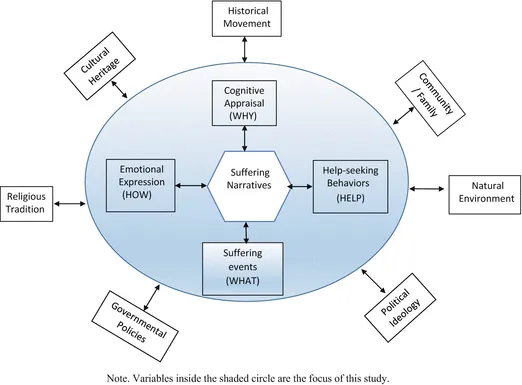
The various cognitive components of suffering , as shown in Table 1.1, will be further examined in Chaps. 3–5 according to the scales we constructed (What , Why , How , Help ). In addition, there are other contributing factors to suffering that we will not analyze. It suffices here to adumbrate them all with a chart (see Diagram 1.1).
Diagram 1.1
A schematic representation of all the contributing factors to suffering experiences
As Diagram 1.1 indicates, our investigation pays selective attention to certain variables, and not others. Note that all the demographic variables (on the outer ring of the diagram), such as governmental policies, historical factors, and so on, are not the focus of our investigation. What we focus on instead are the cognitive styles behind certain behaviors—help-seeking, emotional expression , and causal attributions—associated with suffering . This point can be elaborated by levels of analysis . The variables that show up on our radar screen, as indicated by the shaded circle on Diagram 1.1, are accessible at two levels of analysis —at the abstract, experience-distant level, cognitive styles are conceptualized and predicted by the bird’s-eye approach; at the concrete, experience-near level, data on help-seeking, emotional expression , and causal attributions are collected through sympathetic listening to the sufferingnarratives of the research participants. What falls outside the scope of our investigation is the mid-range level of analysis that focuses on the societal, historical, political, religious, and environmental factors (shown on the outer ring of the diagram) found in anthropology literature.
Aim of Our Study: What Is This Study About?
Due to this difference in levels of analysis , our investigation of the two religious groups of Yi neither asks nor answers the same questions that concern anthropologists. Rather, it asks a different set of questions. Guided by the theory of ecological rationality , we propose that religion as a cultural system co-evolves with the ecological niche and cognitive styles , which have a pervasive impact on the emotional expression and help-seeking behaviors of the local community. Let us spell out more fully what we do and do not include in our research agenda:
1.
This study is not about religion per se, because religion is dissolved into the higher-level analysis of culture . By the same token, this study is not about the religious experience of the individual—we focus only on religious behaviors, such as rituals and prayers , that give us information on cognitive styles and emotional e...
Table of contents
Cover
Front Matter
1. First Things First: Research Orientation and Background Information on Two Yi Communities in Southwest China
2. Narratives of Suffering
3. Suffering and Worldviews
4. Help-Seeking in Suffering
5. Emotions of Suffering
6. Toward a Reflexive Indigenous Psychology
7. Challenges and Future Directions
Back Matter
Trusted by 375,005 students
Access to over 1.5 million titles for a fair monthly price.
Study more efficiently using our study tools.
Frequently asked questions
Yes, you can cancel anytime from the Subscription tab in your account settings on the Perlego website. Your subscription will stay active until the end of your current billing period. Learn how to cancel your subscription
No, books cannot be downloaded as external files, such as PDFs, for use outside of Perlego. However, you can download books within the Perlego app for offline reading on mobile or tablet. Learn how to download books offline
Perlego offers two plans: Essential and Complete
Essential is ideal for learners and professionals who enjoy exploring a wide range of subjects. Access the Essential Library with 800,000+ trusted titles and best-sellers across business, personal growth, and the humanities. Includes unlimited reading time and Standard Read Aloud voice.
Complete: Perfect for advanced learners and researchers needing full, unrestricted access. Unlock 1.5M+ books across hundreds of subjects, including academic and specialized titles. The Complete Plan also includes advanced features like Premium Read Aloud and Research Assistant.
Both plans are available with monthly, semester, or annual billing cycles.
We are an online textbook subscription service, where you can get access to an entire online library for less than the price of a single book per month. With over 1.5 million books across 990+ topics, we’ve got you covered! Learn about our mission
Look out for the read-aloud symbol on your next book to see if you can listen to it. The read-aloud tool reads text aloud for you, highlighting the text as it is being read. You can pause it, speed it up and slow it down. Learn more about Read Aloud
Yes! You can use the Perlego app on both iOS and Android devices to read anytime, anywhere — even offline. Perfect for commutes or when you’re on the go. Please note we cannot support devices running on iOS 13 and Android 7 or earlier. Learn more about using the app
Yes, you can access Culture, Cognition, and Emotion in China's Religious Ethnic Minorities by Rachel Sing-Kiat Ting,Louise Sundararajan in PDF and/or ePUB format, as well as other popular books in Psychologie & Psychologie cognitive et cognition. We have over 1.5 million books available in our catalogue for you to explore.