This book examines how credit and finance schemes affect the financial lives of vulnerable people around the world. These schemes include payday lending, matched savings, and financial literacy in the Global North, and micro-credit and mobile banking in the Global South. Buckland sets these schemes within the context of financialization and seeks to identify strengths, weaknesses, and ways to enhance the well-being of vulnerable people. This book's coverage of a wide range of financial products and geographic regions makes for a unique and innovative perspective on this topic. It presents a balanced critique of credit and finance schemes under the assumption that reform is the most practical means to improve human well-being.
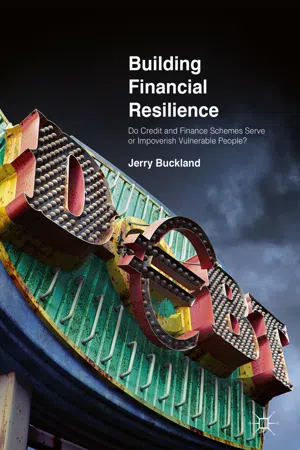
eBook - ePub
Building Financial Resilience
Do Credit and Finance Schemes Serve or Impoverish Vulnerable People?
- English
- ePUB (mobile friendly)
- Available on iOS & Android
eBook - ePub
Building Financial Resilience
Do Credit and Finance Schemes Serve or Impoverish Vulnerable People?
About this book
Information
© The Author(s) 2018
Jerry BucklandBuilding Financial Resiliencehttps://doi.org/10.1007/978-3-319-72419-5_11. Introduction
Jerry Buckland1
(1)
International Development Studies, Menno Simons College, Canadian Mennonite University, & University of Winnipeg affiliate, Winnipeg, MB, Canada
This book examines if credit and finance schemes that span the globe such as microcredit, payday lending, and financial literacy education build financial resilience of vulnerable people. By building financial resilience is meant improving and making more durable an individual’s and community’s income and assets. By vulnerable people is meant people who struggle with material and/or psycho-social poverty so that a temporary or permanent decline in their income and/or assets would have disastrous consequences.
Microcredit is a product (and possibly a movement) associated with development and non-profit agents largely based in the Global South. It has been highly praised in much of the literature and is popular among practitioners and in society more broadly. There are detractors among those who have carefully examined its impact, but they are in the minority. Payday lending, on the other hand, is a commercial product that is common in Anglo-American nations and increasingly in other parts of the world such as Eastern Europe and South Africa. It has been widely criticized, and yet where it operates it attracts a strong and loyal (some say this is based on creating a dependency) following. Financial literacy education, also more common in the Global North, comes in many forms and through many organizations and is premised on the idea that increasing consumers’ knowledge will protect and empower them.
The stories associated with microcredit tend to play up the borrowers who use the loan in a way that boosts their resilience through higher and more durable income which then enables them to repay the loan, a kind of virtuous cycle. Muhammad Yunus’s story of his first loan is an exemplar of this. As he was investigating the micro-economy of poor people in Chittagong District in Bangladesh , he met a basket weaver who had to take out a loan from a money lender at a very high interest rate, perhaps over 100%, in order to purchase the inputs to weave the baskets. He found that by providing her a lower interest rate loan she was able to increase her profits and improve her livelihood. But there are also the “bad news” microcredit stories in which borrowers are unable to make a good investment and end up being unable to repay their loan, sometimes needing to sell off assets to repay it.
However the bad news stories tend to be more commonly associated with payday lending. One payday loan client I recently met in a focus group discussion about payday lending noted that he regularly got into a debt cycle with payday loans. In his most extreme case he reported that he had ten payday loans simultaneously and was unable to pay them off. He eventually required his spouse to take out loans in order to pay his off. This family’s finances are becoming less resilient and payday loans seem to be part of the reason why. Less commonly do we hear the “good stories” about payday loans. In the same focus group discussion another person used payday loans, just occasionally, and to pay for unexpected expenses, in order to not draw down her savings. The payday loan created the external discipline to pay it off without requiring her to reduce her savings. The other types of financial programs that will be discussed in this book—asset building, cash transfers, financial literacy—all have similar “good” and “bad” news stories but they tend to get less media interest. But these stories give a sense of the types of challenges and opportunities that financial products present people.
The book focuses its analysis on a set of common credit and finance schemes. Microfinance, mobile phone-based banking, and financial inclusion are examples of these in the Global South , and asset-building and financial literacy programs are examples from the Global North. It is assumed that underlying the expansion of these schemes is the process of financialization, often defined as the rising influence of financial motives and growth of financial services in society. Financialization is a deep and challenging process that affects many aspects of modern life and is closely tied to neoliberal policies that promote markets and new technologies to foster change that affects us all at a deep socio-cultural level. Financialization has become intertwined in complex ways with development actions. This book considers how these credit and finance schemes affect the poor and vulnerable—people who experience poverty in one or more of its complex manifestations, including material poverty (a gap between material needs and their being met) and psycho-social poverty (gaps in esteem and control).
A note on terminology: financialization refers to the increase of finances in daily life, through the expanding availability of financial products and the growing demand for them. Financial exclusion refers to the situation faced by persons who have insufficient access to mainstream—that is, banks—financial services. Sometimes this is broken down into categories of complete financial exclusion, being unbanked or being under-banked, having insufficient bank financial services. In either case—whether un- or under-banked—the consequence is that the person is reliant on alternative sources for financial services, such as informal providers or fringe banks. Informal providers include corner stores that might cash one’s cheque or a family member who might loan one some cash. Fringe banks are semi-formal operations set up to provide financial services such as pawnshops and payday lenders. Financial inclusion is the process whereby financially excluded people become integrated into the mainstream banking system for all of their financial service needs.
General Approach
This book draws on and extends “ popular finance” theory (Aitken 2007; van der Zwam 2014) and examines the literature, discussed below, and in the cases of payday lending and mobile banking draws on primary research, on a variety of credit and finance schemes from around the world to learn how they affect the financial resilience of vulnerable people. Since we rely heavily on academic and policy literature, rather than primary data, we depend on the indicators (e.g., of financial resilience) used in these studies. An ideal indicator, but one that is not always available, is whether and to what extent vulnerable people themselves value the change. Everyday financialization is an important lens to assess credit and finance schemes because it focuses on the vulnerabilities of ordinary people, people who only recently have been brought into the financial world. But this lens is inadequate to assess finance and credit schemes of vulnerable people because it does not provide a framework to assess the impact on human well-being. What is needed for this is a theory of human well-being, and for this purpose we draw on the work by Goulet (1995) and human capabilities of Sen (1999) and Nussbaum (2006). Financialization proponents might argue that more (money, credit, income, etc.) is better, but scholars of human well-being understand that financialization is only a means but that the end is human improvement. Credit and finance schemes need to be assessed within that lens.
This book argues that finance and credit schemes can help vulnerable people in a limited capacity if they are carefully constructed, but they can also not help and sometimes harm people. This is because, by definition, vulnerable people have limitations and weaknesses that finance and credit providers may be ignorant and/or disinterested in. Moreover, without a clear understanding of the relationship between finances and human well-being, these schemes may not achieve valued outcomes.
Primary research has been completed by the author and colleagues on microcredit, payday lending, and mobile banking over the past several years, and results are published elsewhere. The relevant literatures on credit and finance schemes are dispersed across different disciplines and approaches, including economics, geography, and sociology. This book brings together elements of these literatures, as each contains insights that are useful to understand the others, and by looking at the “forest”, one can better understand the individual “trees”.
The ethical approach taken in this book is that poverty and excessive inequality harm people who are poor and relatively marginalized and this harms wider society. Credit and finance schemes that reduce poverty and inequality add to the common good, while those that increase poverty and inequality undermine it. A critical assumption that guides this analysis is that finances need to be constructed to build financial resilience, not the other way around. Financial services and technologies do not necessarily foster financial resilience, and in fact they can counteract it. That is why the services and technologies need to be designed with the end user in mind, which includes poor people and communities.
This book presents a critical and constructive perspective regarding these credit and finance schemes. It critiques the changes associated with this process while at the same time not idealizing past development practices or socio-economic realities. As a critical analysis, it endeavors to cast particular light on the problematic consequences for poor and marginalized people. In addition, where possible, the analysis identifies and explores constructive responses to these problems.
In terms of political-economic theory, the book is rooted in a reform market approach. That is to say, given that markets are currently the most prominent way to organize the economy but often fail to deliver on important human outcomes, a strong state and civil society response is needed. State and social actors’ roles are critical to ensure that adequate market regulations are in place and enforced and that community needs are identified and planned for.
Because credit and finance schemes directed at vulnerable people are now a global phenomenon, this book examines them from a global perspective. This process has become intertwined in complex ways with development actions in what is known as the Global South—a rich and varied grouping of relatively poorer and geographically more southern nations of Africa, Asia, Latin America, and the Middle East. Here these schemes are manifested through activities such as microfinance, mobile phone-based banking, and financial l...
Table of contents
- Cover
- Front Matter
- 1. Introduction
- 2. Financial Inclusion and Building Financial Resilience
- 3. New Areas of Commercial Banking Directed at Vulnerable People: Payday Lending and Mobile Banking
- 4. Financialization and Consumer Behavior
- 5. Credit, Cash, Savings, and Financial Literacy Delivered Through Civil Society
- 6. The State: Regulating, Nudging, and Educating for Financial Inclusion
- 7. Conclusion
- Back Matter
Trusted by 375,005 students
Access to over 1.5 million titles for a fair monthly price.
Study more efficiently using our study tools.
Frequently asked questions
Yes, you can cancel anytime from the Subscription tab in your account settings on the Perlego website. Your subscription will stay active until the end of your current billing period. Learn how to cancel your subscription
No, books cannot be downloaded as external files, such as PDFs, for use outside of Perlego. However, you can download books within the Perlego app for offline reading on mobile or tablet. Learn how to download books offline
Perlego offers two plans: Essential and Complete
- Essential is ideal for learners and professionals who enjoy exploring a wide range of subjects. Access the Essential Library with 800,000+ trusted titles and best-sellers across business, personal growth, and the humanities. Includes unlimited reading time and Standard Read Aloud voice.
- Complete: Perfect for advanced learners and researchers needing full, unrestricted access. Unlock 1.5M+ books across hundreds of subjects, including academic and specialized titles. The Complete Plan also includes advanced features like Premium Read Aloud and Research Assistant.
We are an online textbook subscription service, where you can get access to an entire online library for less than the price of a single book per month. With over 1.5 million books across 990+ topics, we’ve got you covered! Learn about our mission
Look out for the read-aloud symbol on your next book to see if you can listen to it. The read-aloud tool reads text aloud for you, highlighting the text as it is being read. You can pause it, speed it up and slow it down. Learn more about Read Aloud
Yes! You can use the Perlego app on both iOS and Android devices to read anytime, anywhere — even offline. Perfect for commutes or when you’re on the go.
Please note we cannot support devices running on iOS 13 and Android 7 or earlier. Learn more about using the app
Please note we cannot support devices running on iOS 13 and Android 7 or earlier. Learn more about using the app
Yes, you can access Building Financial Resilience by Jerry Buckland in PDF and/or ePUB format, as well as other popular books in Economia & Finanza. We have over 1.5 million books available in our catalogue for you to explore.