eBook - ePub
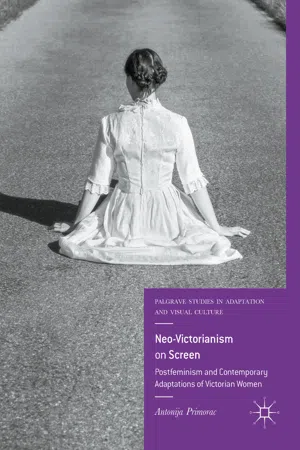
Neo-Victorianism on Screen
Postfeminism and Contemporary Adaptations of Victorian Women
- English
- ePUB (mobile friendly)
- Available on iOS & Android
eBook - ePub
Neo-Victorianism on Screen
Postfeminism and Contemporary Adaptations of Victorian Women
About this book
This book broadens the scope of inquiry of neo-Victorian studies by focusing primarily on screen adaptations and appropriations of Victorian literature and culture. More specifically, this monograph spotlights the overlapping yet often conflicting drives at work in representations of Victorian heroines in contemporary film and TV. Primorac's close analyses of screen representations of Victorian women pay special attention to the use of costume and clothes, revealing the tensions between diverse theoretical interventions and generic (often market-oriented) demands. The author elucidates the push and pull between postcolonial critique and nostalgic, often Orientalist spectacle; between feminist textual interventions and postfeminist media images. Furthermore, this book examines neo-Victorianism's relationship with postfeminist media culture and offers an analysis of the politics behind onscreen treatment of Victorian gender roles, family structures, sexuality, and colonial space.
Information
Subtopic
Film & Video© The Author(s) 2018
Antonija PrimoracNeo-Victorianism on ScreenPalgrave Studies in Adaptation and Visual Culturehttps://doi.org/10.1007/978-3-319-64559-9_11. Introduction: Neo-Victorianism on Screen and Postfeminist Media Culture
Antonija Primorac1
(1)
Faculty of Humanities and Social Sciences, University of Split, Split, Croatia
In his Generation X: Tales of an Accelerated Culture, Douglas Coupland introduces two related concepts: ‘legislated nostalgia ’, which he uses to describe a phenomenon whereby ‘a body of people… [is] force[d] to have memories they do not actually possess’, and the ‘Now Denial: To tell oneself that the only time worth living in is the past and that the only time that may ever be interesting again is the future’ (Coupland 1991, p. 41). Published in 1991, Coupland’s book captures the fragmented, self-consciously retro ennui of the early 1990s in the West with uncanny precision. This postmodern, self-conscious backward gaze has found prominent expression since the early 1990s in a proliferation of historical fiction set in the Victorian past and in screen adaptations of Victorian literature and culture. Whether they have sought to retrieve the certainties of the pre-modernist narrative and its attendant social structures or if they aimed to challenge received ideas about the past through a critical rewriting and re-visioning of the Victorians, what all these adaptations and appropriations of the Victorian era have in common is a desire to retrieve and re-present the past by translating it into a vocabulary understandable and relatable to contemporary audiences. The representations of the long nineteenth century that have been brought to life on the big and small screens alike can be read as variants of Coupland ’s ‘legislated nostalgia’ and examples of the ‘now denial’: as cultural products created for, and often consumed as anachronistic cultural memories by, audiences in the Anglosphere , and which, more often than not, end up disseminating their versions of legislated nostalgia on a global scale.
Whereas before 2012 it was unusual to come across the adjective outside academia, ‘neo-Victorian’ has by now become a widely accepted term used to describe these adaptations and appropriations of Victorian literature and culture across media. 1 As Cora Kaplan pointed out in one of the first studies of the phenomenon, Victoriana: Histories, Fictions, Criticism (2007), the interest in the material remnants of the Victorian era started in Britain in the 1960s and gradually expanded so that all other aspects of the period came to be appropriated and used in art, literature and design (pp. 2–3), and also, crucially, since the 1980s, in political discourse: first through the appropriation of the ‘Victorian Values—thrift, family, enterprise’ by Thatcher ’s Conservative government, which was followed by Blair ’s retooling of ‘Christian Socialism’ in his branding of New Labour (Kaplan 2007, pp. 5–7). Neo-Victorianism has gathered momentum in the last couple of decades, and it now refers not only to the numerous screen adaptations of Victorian literature and Victorian-inspired TV series and films, fiction and graphic novels, but also to the ways in which fashion, art and interior design have hearkened back to the Victorian era, which has also led to a mainstreaming of the Steampunk and Goth subculture s’ aesthetic. 2 After some terminological jousting in which the prefix neo won out over the backward looking ones of post and retro , 3 neo-Victorian studies has emerged as an academic field of endeavour, and this was solidified with the launch of the open access journal Neo-Victorian Studies in 2008. 4
However, even though neo-Victorian studies has grown rapidly in the last decade, its critical spotlight has, so far, primarily been directed at fiction (including, to a smaller degree, graphic novels 5 ), resulting in, as Caterina Grasl noted, the marginal status of neo-Victorianism on screen in the field (Grasl 2015, p. 21). What attention has been paid to film and theatre 6 adaptations of Victorian and/or neo-Victorian fiction has usually been in the context of a broader discussion of the relevant adapted text 7 ; indeed, neo-Victorianism on screen as a subject in its own right has rarely been dealt with independently 8 : it is usually a part of the bigger argument about neo-Victorian afterlives. 9 Like the two special issues of Neo-Victorian Studies (2:2 and 4:2), 10 book-length studies of neo-Victorian screen adaptations have primarily focused on filmic adaptations of Victorian literature that critically interpret the lacunae of Victorians’ attitudes to gender , race , class and empire . 11 This does not come as a surprise, since the field itself took off within literature studies, with focus on explorations of self-conscious, postmodern takes on the historical novel set in the Victorian period; as such, it has generally been aligned to the genre of historiographic metafiction. What is surprising, as the adaptation studies scholar Imelda Whelehan notes (2012), is the persistent reluctance to approach neo-Victorianism on screen on equal terms with neo-Victorian literature, especially as from its inception as a discipline, neo-Victorian studies scholars recognised adaptation as ‘a fundamental part of neo-Victorianism as a concept’ (Heilmann and Llewellyn 2010, p. 244). Whelehan stresses that neo-Victorian studies ’ approach to neo-Victorian adaptations (understood as both adaptations of classics that offer new readings of Victorians’ silenced or marginal points of view, and screen adaptations of neo-Victorian texts) has mostly treated them as secondary to literary texts:
A favoring of reading over spectating and a nagging belief that reading is better because “adaptations often flatten out the complexities of Victorian fiction” (Hadley 2010, 142) positions screen adaptation as the ersatz “nineteenth-century dress-ups,” as if historical authenticity (even reimagined history) is the peculiar domain of fiction. Neo-Victorian fiction’s intertextual universe is part of “a cultural memory, to be re-membered, and imaginatively re-created, not revised or understood” (Mitchell 2010, 7); whereas adaptation’s intertextual potentialities roam across eras and genres in fantastic and dangerous liaisons yet to be emulated by the neo-Victorian novel. (Whelehan 2012, p. 289)
The hierarchical approach to neo-Victorianism on screen is all the more vexing because, as Whelehan points out, ‘neo-Victorian literary texts are themselves adaptations; even when they do not refer back to a single Urtext, they remain compatible with contemporary definitions of adaptation and appropriation’ (Whelehan 2012, p. 272). Since screen adaptations of Victorian classics by and large belong to the genre of costume drama , these connections are all the more pertinent because, in Julianne Pidduck ’s words, ‘historical fiction and costume drama alike depict the past through the stylistic, critical and generic vocabularies of present cultural production’ (Pidduck 2004, p. 4). So far, the only monograph dealing solely with the nineteenth century on screen that gives equal space to adaptations of classics as well as to neo-Victorian meta-adaptations (original screenplays set in the nineteenth century) is Iris Kleinecke-Bates ’s Victorians on Screen: The Nineteenth Century on British Television, 1995–2005 (2014). Kleinecke-Bates...
Table of contents
- Cover
- Frontmatter
- 1. Introduction: Neo-Victorianism on Screen and Postfeminist Media Culture
- 2. Postfeminism and Screen Adaptations of Sherlock Holmes Stories: The Case of Irene Adler
- 3. Re-presenting the Past: Gender, Colonial Space and Cultural Nostalgia in Neo-Victorianism on Screen
- 4. In the Grip of the Corset: Women as Caged Birds in Contemporary Victoriana on Screen
- 5. Re-fashioning Victorian Heroines and Familyfamily Relations: Tailoring and Shape-Shifting as Queer Adaptation and Appropriation
- 6. Conclusion: No Country for Old Women
- Backmatter
Trusted by 375,005 students
Access to over 1.5 million titles for a fair monthly price.
Study more efficiently using our study tools.
Frequently asked questions
Yes, you can cancel anytime from the Subscription tab in your account settings on the Perlego website. Your subscription will stay active until the end of your current billing period. Learn how to cancel your subscription
No, books cannot be downloaded as external files, such as PDFs, for use outside of Perlego. However, you can download books within the Perlego app for offline reading on mobile or tablet. Learn how to download books offline
Perlego offers two plans: Essential and Complete
- Essential is ideal for learners and professionals who enjoy exploring a wide range of subjects. Access the Essential Library with 800,000+ trusted titles and best-sellers across business, personal growth, and the humanities. Includes unlimited reading time and Standard Read Aloud voice.
- Complete: Perfect for advanced learners and researchers needing full, unrestricted access. Unlock 1.5M+ books across hundreds of subjects, including academic and specialized titles. The Complete Plan also includes advanced features like Premium Read Aloud and Research Assistant.
We are an online textbook subscription service, where you can get access to an entire online library for less than the price of a single book per month. With over 1.5 million books across 990+ topics, we’ve got you covered! Learn about our mission
Look out for the read-aloud symbol on your next book to see if you can listen to it. The read-aloud tool reads text aloud for you, highlighting the text as it is being read. You can pause it, speed it up and slow it down. Learn more about Read Aloud
Yes! You can use the Perlego app on both iOS and Android devices to read anytime, anywhere — even offline. Perfect for commutes or when you’re on the go.
Please note we cannot support devices running on iOS 13 and Android 7 or earlier. Learn more about using the app
Please note we cannot support devices running on iOS 13 and Android 7 or earlier. Learn more about using the app
Yes, you can access Neo-Victorianism on Screen by Antonija Primorac in PDF and/or ePUB format, as well as other popular books in Media & Performing Arts & Film & Video. We have over 1.5 million books available in our catalogue for you to explore.