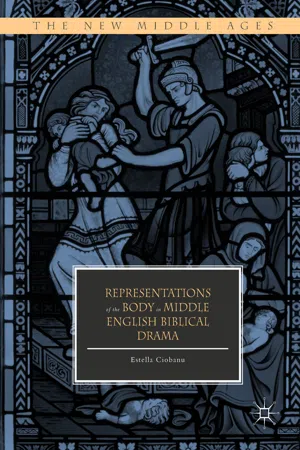
Representations of the Body in Middle English Biblical Drama combines epistemological enquiry, gender theory and Foucauldian concepts to investigate the body as a useful site for studying power, knowledge and truth. Intertwining the conceptualizations of violence and the performativity of gender identity and roles, Estella Ciobanu argues that studying violence in drama affords insights into the cultural and social aspects of the later Middle Ages. The text investigates these biblical plays through the perspective of the devil and offers a unique lens that exposes medieval disquiets about Christian teachings and the discourse of power. Through detailed primary source analysis and multidisciplinary scholarship, Ciobanu constructs a text that interrogates the significance of performance far beyond the stage.
- English
- ePUB (mobile friendly)
- Available on iOS & Android
eBook - ePub
Representations of the Body in Middle English Biblical Drama
About this book
Information
Topic
LittératureSubtopic
Critique littéraire en théâtre© The Author(s) 2018
Estella CiobanuRepresentations of the Body in Middle English Biblical DramaThe New Middle Ageshttps://doi.org/10.1007/978-3-319-90918-9_11. Introduction: The Demonic/-ised Subaltern’s In-sight
Keywords
BodyArgument typesTruth–power–knowledgeViolenceRepresentationEn-genderingPositioningSatan Harrowing of Hell‘I order you to get prepared and, should he keep on doing mischief, make him sorry!’—‘Yeah—easier said than done! Why don’t you come to make him sorry yourself!’ 1 The argumentative speaker is Beelzebub defying Satan , his liege lord, in the York Harrowing of Hell pageant (Y37/201–6). If a demon does not set a bad example to humans, who else will?
‘I shall prove to you by arguments that you’re leading these people into trouble: God himself struck them down into hell for their disobedience; you have always taught people what is reasonable and righteous; so aren’t you contradicting yourself to come now and claim what’s been rightfully mine by God’s order?’ Satan reasons ex concessis, in the same York pageant (Y37/254–64), to refute Christ ’s claim to the souls confined in the patriarchs’ limbo. Indeed, Satan’s is a strong rebuttal which proves Christ’s claim argumentatively fallacious: If Christ is who he pretends, God’s son (234–52), then his claim that he is now following his father ’s orders (225–8) blatantly contradicts God’s early decree (known to both parties), whilst also contradicting Jesus’s early outward conduct and teachings. 2 This is the ex concessis (argument from commitment), here in its negative form, inconsistent commitment: one does not do what one preaches (Walton 2005, 120–5). Notwithstanding, Christ’s rejoinder introduces a new thesis: ‘my prophets have preached that I will liberate them after my death—that I will redeem them through my suffering’ (Y37/265–76). Confronted with this argumentum ad verecundiam (‘appeal to authority ’, here prophecy), the Christian audiences may have overlooked Christ’s deliberate ignoring of Satan’s refutation, or non sequitur (‘does not follow’). Alternatively, Christ prefers enthymemes , arguments which merely imply one of their premises (or the conclusion), here the yet unidentified pre-text: God’s later order rescinds the early one by fiat.
Ay, there’s the rub: reasoning and argumentation fail when early performatives (in John Austin’s sense) are overturned on the fly in a bid to win the argument or distract attention from its propositions. Dogma —any hardened ideology—bypasses or warps the protocols of argumentation every time its champions prove or legitimate a moot point by fiat, or alternatively by a flimsy argumentum ad verecundiam . Such argumentation becomes fallacious through appeal to the prestige of the auctoritates—authoritative texts (e.g., Holy Writ ) and figures (e.g., God , angels , prophets) or authors (e.g., the Church Fathers )—instead of reasoning to truth . To revert to the York Harrowing, in contending that his suffering has altered the early juridical dispensation, Christ makes a move extraneous to the early argument : he argues that a third party can intervene in a dispute to re-settle its terms retroactively, and that this can involve bodily intervention external to the propositional content. It is, in part, what I mean in this book by an oft-repeated phrase, the body of argument : appeals that the body can/should intervene and (re)shape the argument, its goals, protocols and means. Before I examine York’s argumentatively astute demons, a conceptual clarification is necessary—about argumentation , truth and the body , all paramount in this book.
1.1 Why Argue about Arguments Anyway?
Let us return to York ’s Satan –Christ dispute to consider the implications of an argumentative strategy, the argumentum ad verecundiam (‘appeal to authority’), 3 which validates the truth value of a statement, hence the overall argument , by explicit reference to the assumed authority of its source. Such recourse does not yield an argument from moderation, restraint or diffidence (OLD, s.v. ‘uerēcundia’) on the speaker’s part. Rather, according to John Locke, who christened it thus, this ‘awe-directed argument’ (or ‘argument of shame’) should prompt listeners to humbly accept ‘the authority to which the speaker appeals in the argument’ (van Eemeren et al. 2009, 7) 4 and may therefore force uncritical acceptance. Accordingly, the term is often used nowadays for ‘a fallacy that involves a wrong appeal to an authority’ (van Eemeren et al. 2009, 7): the argument insists on the speaker’s or their source’s socio-political prestige, rather than on the cognitive element originating from the speaker’s expertise, when relevant to the topic (Tindale 2007, 128–9; Woods et al. 2004, 42–5). 5 Characters in Middle English plays, like medieval people themselves, especially the clergy, often appeal to external sources of authority , like God /Christ —affirmed to be the indisputable transcendental signifier of truth —or the scriptures, to support a particular proposition, whether or not derived from an article of faith. All intra-dramatic ad verecundiam cases depend on the speaker’s traditionally sanctioned authority in the audience’s eyes as much as on the auctoritates (authorities) the arguer appeals to. On gospel template, the drama’s risen Christ often resorts to external legitimation of his claims or acts. Sometimes, however, the devil literally appears in the argumentative detail to point to an argument’s fallacy . It is the contention of this book that in the later Middle Ages, as the plays suggest, certain arguments from authority could sound unconvincing enough to be challenged—necessarily by the devil , so as to safeguard dogmatic truth . Indeed, the religious argumentum ad verecundiam may fail to persuade non-believers and believers alike—when both adopt a critical distance—due to its circularity : believe me for who I am or who/what I name as my guarantor.
What is an argument , though? Broadly, it consists of ‘two or more explicit and/or implicit claims, one or more of which [the premise(s)] supports or provides evidence for the truth or merit of another claim, the conclusion’ (Damer 2009, 14), and is aimed to ‘persuade others to accept that claim’ (13). Furthermore, reason-giving through arguments aims precisely ‘to support or criticize a claim that is questionable, or open to doubt ’, which ‘implies that there are always two sides to an argument, and thus that an argument takes the form of a dialogue’ (Walton 2005, 1).
According to Douglas Walton, the ‘notion of an argument is best elucidated in terms of its purpose when used in a dialogue’ (2005, 1) rather than as a self-standing set of premises leading to a conclusion. Dialogues, therefore, supply ‘conventional frameworks that make rational argumentation possible’, even as they ‘can also contain explanations, instructions on how to do something, and so forth’ (2). As a goal-directed conversation, the dialogue for argumentation can b...
Table of contents
- Cover
- Front Matter
- 1. Introduction: The Demonic/-ised Subaltern’s In-sight
- Part I. Skeletons in the Closet of Religious Dramas
- Part II. Travestied Social Dramas
- Back Matter
Trusted by 375,005 students
Access to over 1.5 million titles for a fair monthly price.
Study more efficiently using our study tools.
Frequently asked questions
Yes, you can cancel anytime from the Subscription tab in your account settings on the Perlego website. Your subscription will stay active until the end of your current billing period. Learn how to cancel your subscription
No, books cannot be downloaded as external files, such as PDFs, for use outside of Perlego. However, you can download books within the Perlego app for offline reading on mobile or tablet. Learn how to download books offline
Perlego offers two plans: Essential and Complete
- Essential is ideal for learners and professionals who enjoy exploring a wide range of subjects. Access the Essential Library with 800,000+ trusted titles and best-sellers across business, personal growth, and the humanities. Includes unlimited reading time and Standard Read Aloud voice.
- Complete: Perfect for advanced learners and researchers needing full, unrestricted access. Unlock 1.5M+ books across hundreds of subjects, including academic and specialized titles. The Complete Plan also includes advanced features like Premium Read Aloud and Research Assistant.
We are an online textbook subscription service, where you can get access to an entire online library for less than the price of a single book per month. With over 1.5 million books across 990+ topics, we’ve got you covered! Learn about our mission
Look out for the read-aloud symbol on your next book to see if you can listen to it. The read-aloud tool reads text aloud for you, highlighting the text as it is being read. You can pause it, speed it up and slow it down. Learn more about Read Aloud
Yes! You can use the Perlego app on both iOS and Android devices to read anytime, anywhere — even offline. Perfect for commutes or when you’re on the go.
Please note we cannot support devices running on iOS 13 and Android 7 or earlier. Learn more about using the app
Please note we cannot support devices running on iOS 13 and Android 7 or earlier. Learn more about using the app
Yes, you can access Representations of the Body in Middle English Biblical Drama by Estella Ciobanu in PDF and/or ePUB format, as well as other popular books in Littérature & Critique littéraire en théâtre. We have over 1.5 million books available in our catalogue for you to explore.