This collection of essays examines the legacy of H.P. Lovecraft's most important critical work, Supernatural Horror in Literature. Each chapter illuminates a crucial aspect of Lovecraft's criticism, from its aesthetic, philosophical and literary sources, to its psychobiological underpinnings, to its pervasive influence on the conception and course of horror and weird literature through the twentieth and early twenty-first centuries. These essays investigate the meaning of cosmic horror before and after Lovecraft, explore his critical relevance to contemporary social science, feminist and queer readings of his work, and ultimately reveal Lovecraft's importance for contemporary speculative philosophy, film and literature.
eBook - ePub
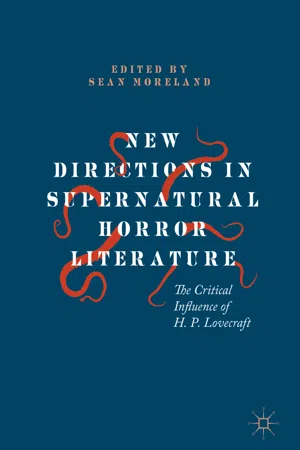
New Directions in Supernatural Horror Literature
The Critical Influence of H. P. Lovecraft
- English
- ePUB (mobile friendly)
- Available on iOS & Android
eBook - ePub
New Directions in Supernatural Horror Literature
The Critical Influence of H. P. Lovecraft
About this book
Information
© The Author(s) 2018
Sean Moreland (ed.)New Directions in Supernatural Horror Literaturehttps://doi.org/10.1007/978-3-319-95477-6_11. Introduction: The Critical (After)Life of Supernatural Horror in Literature
Sean Moreland1
(1)
University of Ottawa, Ottawa, ON, Canada
Sean Moreland
In 1925, writer and publisher W. Paul Cook (1881–1948) invited his friend and fellow amateur journalist H. P. Lovecraft (1890–1937) to write a historical and critical survey of supernatural literature. Already an avid reader, and increasingly an accomplished writer, of such fiction, Lovecraft committed to this task with an ambitious course of reading including acknowledged classics, less well-known historical works, and many contemporary fictions of the strange and supernatural, most of them by British and American writers. His research and preparation was such that it took Lovecraft nearly two years to submit the manuscript to Cook for publication.1
The initial, and only partial, first publication of the essay occurred in 1927, in what turned out to be the sole volume of Cook’s journal, The Recluse. Lovecraft’s most ambitious and influential critical work, Supernatural Horror in Literature (hereafter SHL) would reach only a handful of readers at this time. Nevertheless, by the end of the twentieth century, SHL was widely recognized as exerting an unparalleled influence over the development and reception of Anglophone supernatural, horrific, and weird literature. The essay’s core critical concepts continued to evolve in Lovecraft’s later career; one trajectory of this development, Lovecraft’s changing assessment of the “titans” of early twentieth-century weird fiction, is detailed by S. T. Joshi’s chapter in this volume. During Lovecraft’s lifetime these critical concepts would reach a wider audience than the essay itself due to their embodiment in his fictions and exposition via his voluminous letters, many of them to an epistolary circle of writers who adopted and adapted his critical framework through their own writings, as John Glover’s chapter elaborates.
SHL itself would posthumously reach a wider audience with its publication by Arkham House, first as part of The Outsider and Others (1939) and then as part of Dagon and Other Macabre Tales (1965). Even at that point, few could have predicted how its critical and popular influence would continue to grow, with Dover publishing an inexpensive paperback edition in 1973 to a greatly expanded readership. SHL’s public profile rose with the onset of the mass market “Horror Boom” of the late 1970s and 1980s. In 1981, it received a belated endorsement in Stephen King’s biographically inflected survey of horror, Danse Macabre, which suggested, “If you’d like to pursue the subject [of earlier supernatural fiction] further, may I recommend H. P. Lovecraft’s long essay Supernatural Horror in Literature? It is available in a cheap but handsome and durable Dover paperback edition.” King’s immensely popular writings, as Alissa Burger’s chapter explores, did much to renew public interest in Lovecraft’s work in general.2
In 1987, influential editor and anthologist David G. Hartwell more forcefully emphasized SHL’s importance to the development of modern horror. His seminal anthology The Dark Descent: The Evolution of Horror describes Lovecraft as “the most important American writer of horror fiction in the first half of” the twentieth century, as well as “the theoretician and critic who most carefully described the literature” with SHL, which provides “the keystone upon which any architecture of horror must be built: atmosphere .”3 Hartwell rightly singles out atmosphere as SHL’s most important idea, as expressed in one of the most widely cited statements in the essay. Atmosphere, Lovecraft insists, is the “all-important thing, for the final criterion of authenticity is not the dovetailing of a plot, but the creation of a given sensation” (23). The “true weird tale” (22) creates an “atmosphere of breathless and unexplainable dread of outer, unknown forces,” with “a hint, expressed with a seriousness and portentousness becoming its subject,” of “a malign and particular suspension or defeat” of the laws of nature (23).4
Because of its insistence on atmosphere, Hartwell claims SHL is “the most important essay on horror literature.”5 This assessment has been echoed many times since. In More Things than Are Dreamt of: Masterpieces of Supernatural Horror (1994), James Ursini and Alain Silver state, “Lovecraft’s fame rests almost as heavily on his work as a scholar as that of a writer of fiction,” due to his “now classic” survey of the field. They locate SHL’s importance in its “expansive analysis of supernatural horror and fantasy contrasted with the condescending tone of earlier essayists.”6 Cumulatively, such estimates reinforce S. T. Joshi’s claim, in the preface to his annotated edition of SHL, that it is “widely acknowledged as the finest historical treatment of the field.”7
Lovecraft took supernatural fiction very seriously, and was among the first critics or theoreticians to do so consistently. He saw it as a crucial literary tradition with significant cultural value, deeply rooted in the evolved nature of humanity and tied to the state of society, and therefore eminently worthy of close study and focused aesthetic appreciation.
SHL reflects its author’s historical and cultural moment, his enthusiasms, prejudices, and anxieties , as much as his insights and capacity for rigorous thought. It is Lovecraft’s most sustained attempt to reconcile what a 1927 letter describes as his own “parallel natures”:
The world and all its inhabitants impress me as immeasurably insignificant, so that I always crave intimations of larger and subtler symmetries than these which concern mankind. All this, however, is purely aesthetic and not at all intellectual. I have a parallel nature or phase devoted to science and logic, and do not believe in the supernatural at all – my philosophical position being that of a mechanistic materialist of the line of Leucippus, Democritus, Epicurus and Lucretius – and in modern times, Nietzsche and Haeckel.8
Hardly a disinterested survey, SHL is Lovecraft’s attempt to think through feeling, situating his “purely aesthetic” cravings intellectually by providing a historical account of a literary form defined through an objectification of affect. Both descriptive history and prescriptive canonization, it opens with the resounding statement, “the oldest and strongest emotion of mankind is fear, and the oldest and strongest kind of fear is fear of the unknown,” (21) and then proposes that its ability to evoke this emotion is the standard whereby the “literature of cosmic fear” should be judged (23). SHL explains the appeal of supernatural and weird fiction across history and cultures by presenting Lovecraft’s “intimations of larger and subtler symmetries” as an elementary, “if not always universal” (21), aspect of human psychology. The appeal of supernatural fiction is linked to what Lovecraft elsewhere calls “the most ineradicable urge in the human personality ,” which is the desire “for ultimate reality.” This desire is “the basis of every real religion” and philosophy, and “anything which enhances our sense of success in this quest, be it art or religion, is the source of a pricelessly rich emotional experience—and the more we lose this experience in religion, the more we need to get it in something else.”9 Lovecraft sees supernatural literature’s chief value as its provision of such a rich emotional experience in the form of “atmosphere.”
Lovecraft also took atmosphere very seriously. Like the notion of a “structural emotion” or dominant tone developed by T. S. Eliot’s “Tradition and the Individual Talent” (1919), Lovecraft’s atmosphere derives to a large extent from Poe’s aesthetic criterion, the “Unity of Effect .” Atmosphere offers a sense of expansion, a “feeling of magnification in the cosmos—of having approached the universal a trifle more closely, and b...
Table of contents
- Cover
- Front Matter
- 1. Introduction: The Critical (After)Life of Supernatural Horror in Literature
- Section I. “The Oldest and Strongest Emotion”: The Psychology of Cosmic Horror
- Section II. “A Literature of Cosmic Fear”: Lovecraft, Criticism, and Literary History
- Section III. “The True Weird”: (Re)Defining the Weird
- Back Matter
Trusted by 375,005 students
Access to over 1.5 million titles for a fair monthly price.
Study more efficiently using our study tools.
Frequently asked questions
Yes, you can cancel anytime from the Subscription tab in your account settings on the Perlego website. Your subscription will stay active until the end of your current billing period. Learn how to cancel your subscription
No, books cannot be downloaded as external files, such as PDFs, for use outside of Perlego. However, you can download books within the Perlego app for offline reading on mobile or tablet. Learn how to download books offline
Perlego offers two plans: Essential and Complete
- Essential is ideal for learners and professionals who enjoy exploring a wide range of subjects. Access the Essential Library with 800,000+ trusted titles and best-sellers across business, personal growth, and the humanities. Includes unlimited reading time and Standard Read Aloud voice.
- Complete: Perfect for advanced learners and researchers needing full, unrestricted access. Unlock 1.5M+ books across hundreds of subjects, including academic and specialized titles. The Complete Plan also includes advanced features like Premium Read Aloud and Research Assistant.
We are an online textbook subscription service, where you can get access to an entire online library for less than the price of a single book per month. With over 1.5 million books across 990+ topics, we’ve got you covered! Learn about our mission
Look out for the read-aloud symbol on your next book to see if you can listen to it. The read-aloud tool reads text aloud for you, highlighting the text as it is being read. You can pause it, speed it up and slow it down. Learn more about Read Aloud
Yes! You can use the Perlego app on both iOS and Android devices to read anytime, anywhere — even offline. Perfect for commutes or when you’re on the go.
Please note we cannot support devices running on iOS 13 and Android 7 or earlier. Learn more about using the app
Please note we cannot support devices running on iOS 13 and Android 7 or earlier. Learn more about using the app
Yes, you can access New Directions in Supernatural Horror Literature by Sean Moreland in PDF and/or ePUB format, as well as other popular books in Literature & Literature General. We have over 1.5 million books available in our catalogue for you to explore.