This volume argues that international security in the Asia-Pacific lends itself to contradictory analyses of centrifugal and centripetal trends. Transitional polycentrism is intrinsically awkward as a description of the security of states and their populations; it implies the loosening of state control and the emergence of newly asserted authority by mixed constellations of intergovernmental organizations and non-state actors. It implies a competition of agendas: threats to the integrity of borders and human security threats such as natural disasters, airliner crashes, and displacement by man-made pollution and food scarcity. Conversely, polycentrism could also imply a return to a more neo-realist oriented international order where great powers ignore ASEAN and steer regional order according to their perceived interests and relative military superiority. This book embraces these contradictory trends as a foundation of analysis and accepts that disorder can also be re-described fromthe perspective of studied detachment as polycentric order.
eBook - ePub
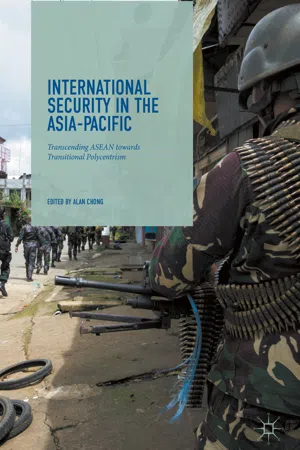
International Security in the Asia-Pacific
Transcending ASEAN towards Transitional Polycentrism
- English
- ePUB (mobile friendly)
- Available on iOS & Android
eBook - ePub
International Security in the Asia-Pacific
Transcending ASEAN towards Transitional Polycentrism
About this book
Information
© The Author(s) 2018
Alan Chong (ed.)International Security in the Asia-Pacifichttps://doi.org/10.1007/978-3-319-60762-7_11. International Security in the Asia-Pacific: Transcending ASEAN Towards Transitional Polycentrism—An Introduction
Alan Chong1
(1)
Centre for Multilateralism Studies, S. Rajaratnam School of International Studies, Singapore, Singapore
Alan Chong
Alan Chong
is an associate professor at the Centre for Multilateralism Studies, S. Rajaratnam School of International Studies, Nanyang Technological University in Singapore. He has published widely on the notion of soft power and the role of ideas in constructing the international relations of Singapore and Asia. His publications have appeared in The Pacific Review, the Review of International Studies, and Armed Forces and Society.
Transitional polycentrism is intrinsically awkward as a description of the security of states and their populations. It implies the loosening of state control and the emergence of newly asserted authority by mixed constellations of intergovernmental organizations and non-state actors. It could also imply a competition of agendas between threats to the integrity of borders and the amorphous range of human security threats such as natural disasters, airliner crashes, displacement by man-made pollution, and food scarcity. More conventionally, it could also refer to the decline of ASEAN (the Association of Southeast Asian Nations) as the collective security actor that once enjoyed primacy as the lowest common denominator reference for the great powers in Asia to establish community with the weaker states of the region. Conversely, polycentrism could equally imply a return to a more neo-realist-oriented international order where great powers ignore ASEAN and steer regional order according to their perceived interests and relative military superiority. If this is the recurring reality, then Southeast Asia appears doomed to reprise its historical trajectory of struggling for autonomy from outside influences. It is not surprising that the international security situation in the Asia-Pacific in the second decade of the twenty-first century lends itself to overwhelming and occasionally contradictory analyses of centrifugal and centripetal trends. Authoring and editing a textbook on Asia-Pacific security is therefore a risky endeavour in this context where there is no tangible clarity to what most observers take to be an obvious ‘security disorder’ in the neo-realist sense of the term. This book however embraces these contradictory trends as a foundation of analysis. It accepts that disorder can be re-described from the perspective of studied detachment as polycentric order.
In the past two decades, two types of events have come to crystallize the increasing drift of the idea of ASEAN centrality steering Asia-Pacific security: the frequent re-ignition of the South China Sea island dispute and other forms of direct great power rivalry; and the increasing frequency of the so-called non-traditional security threats to states along the Indo-Pacific Rim heralded by the 2004 Indian Ocean tsunami . These events contain new features that seriously undermine two pre-existing critical pillars of the regional security order. The first pillar is the idea that sovereign borders must be kept sacrosanct at all costs. The second pillar is that ASEAN can artfully manage the pace of evolution and agenda setting for a pan-regional security architecture whereby persistent Great Power bilateral deadlock invites ASEAN states to act collectively as an indispensable security manager operating according to a lowest political common denominator (Ba 2009, pp. 176–192; Chong 2011). The emerging security order dilutes ASEAN’s centrality by exposing the critical weakness and non-sustainability of the original intramural ASEAN ‘contract’ that maintained that a comprehensive respect for sovereignty is the centrepiece of a long lasting regional peace for national development and self-determination. Additionally, the increased unilateral behaviour of Asia’s emerging great powers of China, India, and Japan have imposed strenuous demands on the ASEAN-managed security order that call attention to the political and economic weaknesses of the organization (Goh, Winter 2007/2008; Buzan 2003; Foot and Walter 2010).
Great Power Rivalries and ASEAN: The Challenge of Managing Territorial Disputes and the Rising Temptation of Unilateralism and Bilateralism
Take the South China Sea dispute for instance. Its temperature was raised when China began, from 2010 onwards, to patrol more aggressively the disputed Spratly islands using a combination of quasi-civilian maritime surveillance vessels, oceanic survey ships, the occasional naval ship, and most recently the tendentious movement of oil rigs in and out of islands and waters claimed by Brunei , Malaysia, the Philippines and Vietnam. At the ASEAN summit in Phnom Penh that preceded the East Asia Summit of 2012, China successfully goaded Cambodia , an ASEAN member and non-claimant, to declare without prior consultation within ASEAN that the grouping had decided not to ‘internationalize’ the Spratlys dispute. This led Philippine President Benigno Aquino to break ASEAN protocol by openly demurring: ‘For the record, this was not our understanding. The ASEAN route is not the only route for us’ (Torode 2012). Consequently, the Philippines decided to formally lodge a case at the Permanent Court of Arbitration at The Hague to treat the Spratlys as maritime territories in dispute with China. The Philippine ploy was intended to compel China under international law, to desist from further provocations in the South China Sea. These provocations ranged from arresting fishermen from rival claimant states, harassing the patrol and naval vessels of the Philippines and Vietnam, building permanent settlement and transportation structures upon China’s claimed islets and moving oil rigs throughout the disputed area without prior permission (Ramzy 2014). Between May and August 2014, the movement of a Chinese manned oil rig known as HD981 stirred a fresh row between Hanoi and Beijing over the ownership of the Spratlys . At one point, the row provoked what appeared to be Hanoi’s officially sanctioned rioting against Chinese owned factories in Vietnam’s industrial parks. The rioters unfortunately did not distinguish Chinese investments and workers from those operated by Taiwanese, Japanese, South Korean and Singaporean firms. It was also known that despite the soured atmosphere over the Spratlys, Sino-Vietnamese oil exploration was undisturbed in another bilaterally disputed corner of the South China Sea—the Paracel Islands. Through a combination of private channels and indirect public statements, the ASEAN states, Japan, and to some extent India as well, coaxed the USA to up the ante on the Spratlys dispute.
Repeating a historical pattern, the script that emerged from Washington did not however completely match the preferences of its Asian allies and neutrals (Godement 2003; Mastanduno 2009). In 2011, the Obama presidency finally responded by announcing a significant rebalancing of US forces to Asia. This was fleshed out in stages with the deployment of US Marines to a permanent base in Darwin, Australia, and the rotational deployment of four of the US Navy’s Littoral Combat Ships (LCS) to Singapore for patrolling the adjacent sea lanes. In 2015, the US Navy daringly sailed into the vicinity of Chinese controlled islets in the archipelago in a dramatic gesture of underscoring the freedom of navigation within waters understood by the majority of Asia-Pacific states, including its ASEAN claimants, to be contested waters. The Obama Administration began to mention Chinese predatory behaviour in the Spratlys as a key obstacle to US –China ties along with cyber espionage and human rights practices. Apart from the Philippines and Japan, no other Asian state openly praised the form of American ‘gunboat diplomacy’ in the Spratlys. The US Navy and other analysts preferred a politically correct term for the American naval patrols—the freedom of navigation operation patrol (FONOP) (Sa and Resnick 2015; Douglas 2015). Both terms mean the same thing: the American naval vessels flew the flag to assert the right of innocent passage in tense geopolitical situations whereby American-leaning neutrals and allies were hedging against Chinese non-military and military retaliation by not going beyond loud diplomatic protests against Beijing’s aggressiveness. The Trump Administration’s evolving foreign policy position towards China appears to be a continuity with Obama’s, notwithstanding the short-lived euphoria that accompanied the first Trump-Xi summit in 2017. The American security role therefore deserves scrutiny by two very contrasting chapters authored by Philippine scholars. One explores how successfully Southeast Asian states ‘arm twist’ Washington to do their bidding vis-à-vis China by manipulating discourses. The other argues that the weak states and great power rivals of China need only to actively link the spokes of the pre-existing ‘hub and spokes’ security alliances forged by the USA and its Asian allies during the Cold War.
It is helpful that the contributors to this book are deliberately and provocatively neo-realist, neo-liberal or constructivist in their occasionally undeclared assumptions vis-à-vis empirical analyses. The US–China relationship is complex and unpredictable as it pertains to the security situation in the Asia-Pacific or Indo-Pacific arenas (Simon 1996; Foot and Walter 2010). David Shambaugh has helpfully cast doubt on the straightforward definition of a Cold War between Beijing and Washington, preferring to describe the relationship as one of ‘coopetition’, characterized by simultaneous cooperation and strategic competition (2014, pp. 15–16). While both great powers are at loggerheads over China’s military assertiveness all around its maritime peripheries from the Sea of Japan to the South China Sea and into the Indian Ocean, Beijing is performing a useful service for the American economy by holding large amounts of US official debt in the form of Treasury Bonds. Sino-US trade is also another linchpin of collaboration between the world’s two largest economies. The fact that Apple Incorporated outsourced most of its iPhone and iPad manufacturing to China speaks volumes of the reality of liberal economic interdependence between the two powers. Moreover, Chinese consumers have developed an almost insatiable demand for high end luxury goods from the USA even as Chinese factories fulfil orders for low technology consumer products found in US department stores. The USA and China have from time to time collaborated at the UN Security Council, and forged common cause in fighting terrorism especially after the events of 11 September 2001. Significant levels of Sino-US student flows cement the complex relationship between the two powers at a people-to-people level. Duke, Johns Hopkins, New York and Harvard Universities currently maintain collaborative arrangements with educational partners in China. Moreover, even as both powers are antagonistic over the issue of undeclared cyberattacks launched by one against the other, major US software firms such as Microsoft, Yahoo, Cisco and Intel are heavily invested in the China market and have no intention of withdrawing anytime soon.
Ironically, it may also be claimed that in many indirect ways, the ASEAN-pioneered ‘regional security architecture’ appears to have succeeded in habituating the great powers to initiating conversations amongst themselves without waiting for intermediation through ASEAN (Gill 2005; Yahuda 2005; Goh, Winter 2007/2008). It is no surprise that presidents Xi Jinping of China and Barack Obama of the USA have felt comfortable enough to initiate their own bilateral summits. China, South Korea and Japan too have taken initial steps since 2010 to participate in an annual trilateral summit notwithstanding on-going tensions amongst themselves over island disputes. Likewise, India’s Prime Minister Narendra Modi has gone out of his way to openly court Chinese investment by hosting the first state visit by a Chinese President in eight years, while also creating the impression of having built up a special relationship with Prime Minister Shinzo Abe of Japan by spending five days in that country on his first official visit. While in Tokyo, Prime Minister Modi signalled, to the pleasure of his hosts, that the world order was currently being divided into two camps, that of believers in ‘expansionist policies’, and that of believers in development, and hence there was a need for India and Japan to show leadership towards steering likeminded states on the path to development (Barry 2014). Hence, it was necessary for some contributors to this volume to address the question of great power initiatives to forge cooperative relationships amongst themselves outside of the ASEAN-driven framework.
On its own, China seems to have taken on a more activist orientation in its foreign policy in pursuit of its national interests as an emerging great power (Zhang and Tang 2005). This was particularly pronounced under the current President, Xi Jinping . Notwithstanding China’s domestic challenges of a widening gap between the rich and poor, environmental degradation and increasingly a nexus between non-Han ethnic separatism and Islamic fundamentalism emanating from the Middle East, Xi’s government proposed the Asian Infrastructure Investment Bank (AIIB) as a rival to both the World Bank and Asian Development Bank . Xi’s government encompassed the AIIB vision within a ‘One Belt One Road’ initiative that sought to capture the twenty-first-century vision of China embracing its ‘manifest destiny’ as an economic locomotive for reinvigorating a pan-Asian economy. This One Belt initiative was intended to tap on the imagined geo-economic potential in the ancient precedent of the much storied ‘Silk Road’ linking Europe to East Asia through Central and South Asia. Beijing was hoping to positively compare the potential of linkages of peace, trade and cultural interchange in the age of sail, horse, and camel between the Roman and Chinese empires and the kingdoms in between with the untapped present-day dynamism of a pan-Asian economy in the era of modern container ships, high speed rail, booming air travel links, cyber connectivity and newly enriched middle-class populations that featured China as a benign Asian leader. In this picture, ASEAN becomes a secondary player, and the USA and Japan peripheral partners. What Xi left unstated in the One Belt initiative was that Asian states should no longer perceive the USA as primus inter pares among great powers in the Asia-Pacific. China mattered more as a boost to Asian states’ national development since recipients of its aid, loans, investments and tourists could afford to augment economic growth without having to put up with ‘Washington Consensus’ style strictures on budget balancing, cultivating friendship with Washington, human rights probity and politically charged debates about official development assistance in the US Congress. Historically, communist China has since 1949 developed very diverse and bilaterally specific relations with most of its Asian neighbours rang...
Table of contents
- Cover
- Frontmatter
- 1. International Security in the Asia-Pacific: Transcending ASEAN Towards Transitional Polycentrism—An Introduction
- 2. Southeast Asia: No Longer Peripheral to Global Events
- 3. Defence and Security Cooperation in East Asia: Whither ASEAN Centrality?
- 4. ASEAN’s Limitations in Conflict Resolution
- 1. The Great Powers: Going their Own Way or Tempering Rivalry with Some Reference to ASEAN?
- 2. Defence Diplomacy in the Asia-Pacific
- 3. Non-Traditional Security Threats as Security Interdependence and the Challenge to Military Missions in East Asia
- Backmatter
Trusted by 375,005 students
Access to over 1.5 million titles for a fair monthly price.
Study more efficiently using our study tools.
Frequently asked questions
Yes, you can cancel anytime from the Subscription tab in your account settings on the Perlego website. Your subscription will stay active until the end of your current billing period. Learn how to cancel your subscription
No, books cannot be downloaded as external files, such as PDFs, for use outside of Perlego. However, you can download books within the Perlego app for offline reading on mobile or tablet. Learn how to download books offline
Perlego offers two plans: Essential and Complete
- Essential is ideal for learners and professionals who enjoy exploring a wide range of subjects. Access the Essential Library with 800,000+ trusted titles and best-sellers across business, personal growth, and the humanities. Includes unlimited reading time and Standard Read Aloud voice.
- Complete: Perfect for advanced learners and researchers needing full, unrestricted access. Unlock 1.5M+ books across hundreds of subjects, including academic and specialized titles. The Complete Plan also includes advanced features like Premium Read Aloud and Research Assistant.
We are an online textbook subscription service, where you can get access to an entire online library for less than the price of a single book per month. With over 1.5 million books across 990+ topics, we’ve got you covered! Learn about our mission
Look out for the read-aloud symbol on your next book to see if you can listen to it. The read-aloud tool reads text aloud for you, highlighting the text as it is being read. You can pause it, speed it up and slow it down. Learn more about Read Aloud
Yes! You can use the Perlego app on both iOS and Android devices to read anytime, anywhere — even offline. Perfect for commutes or when you’re on the go.
Please note we cannot support devices running on iOS 13 and Android 7 or earlier. Learn more about using the app
Please note we cannot support devices running on iOS 13 and Android 7 or earlier. Learn more about using the app
Yes, you can access International Security in the Asia-Pacific by Alan Chong in PDF and/or ePUB format, as well as other popular books in Politics & International Relations & Asian Politics. We have over 1.5 million books available in our catalogue for you to explore.