This book analyzes privatization reforms, property rights, and raiders in post-Soviet Russia. The author surveys the existing literature in the context of predatory raiding in Russia and introduces the notion and concept of this phenomena; he suggests that the study may serve as an explanatory model for corporate, property, and land raiding in Russia. Building on previous scholarship, this monograph conceptualizes the predatory character of corporate hostile takeovers in Russia and links it with the coercive nature of the ruling authoritarian regime. This project will appeal to scholars, graduate students, and researchers in Russian and Post-Soviet politics, capitalism, corruption, and property rights.
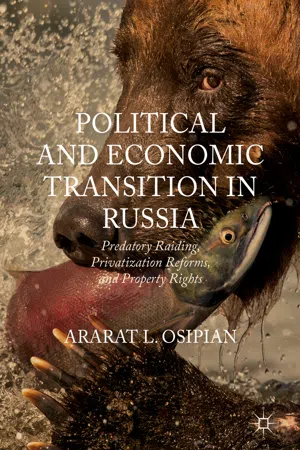
eBook - ePub
Political and Economic Transition in Russia
Predatory Raiding, Privatization Reforms, and Property Rights
- English
- ePUB (mobile friendly)
- Available on iOS & Android
eBook - ePub
Political and Economic Transition in Russia
Predatory Raiding, Privatization Reforms, and Property Rights
About this book
Information
© The Author(s) 2019
Ararat L. OsipianPolitical and Economic Transition in Russiahttps://doi.org/10.1007/978-3-030-03831-1_11. Introduction: Raiding Russia
Ararat L. Osipian1
(1)
University of Wisconsin–Madison, Madison, WI, USA
Ararat L. Osipian
Corporate Hostile Takeovers
Corporate hostile takeovers, also referred to as corporate raiding, are perceived to be actions with the help of which enterprises are transferred from the hands of less capable managers into the hands of more capable management teams. Corporate raiders have an arsenal of financial and legal tools at their disposal in order to take over enterprises against the will of their ineffective managers and to convert them into more successful firms. The transformation of unsuccessful or poorly managed firms into successful and financially stable ones may occur in cases of hostile takeovers, but not always. Sometimes raiders fail in their task to improve the financial situation of a targeted firm, despite such efforts as restructuring, new management, and investment in technologies and human capital. Sometimes raiders simply blackmail current management in order to profiteer on their rights as minority shareholders; this trick is known as greenmail. Nevertheless, corporate raiders in the western world play a positive role, performing the function of market cleaners. With the help of hostile takeovers, enterprises are released from under the rule of ineffective management teams and transferred to more effective ones. Ineffective, incapable, or financially weak firms are being weeded out from the market. At the end, not only raiders win, but consumers do too.
Corporate raiding denotes a situation on the stock market when an investor, be it a company, investment bank, or a group of investors, is buying a majority stake or a significant minority stake in a publicly traded company such that it can dismiss the current management team and appoint its own managers. Raiding often occurs when the company’s share price has recently fallen significantly, especially if this value depreciation is only expected in the short run.1 Corporate raiding is frequently called a hostile takeover. Accordingly, a hostile takeover is defined as takeover of a company against the will of the current management and the board of directors by an acquiring company or raider. Hostile takeover is the acquisition of one company by another without the consent of the target company’s leadership. Raiders buy stock directly from shareholders, sometimes by offering a particularly high price. The acquiring company may buy up to 5 percent of the targeted company without registering the move with the Securities & Exchange Commission (SEC).2 The SEC is a US governmental agency that serves at the primary regulator of the securities trade. SEC’s functions include ensuring that all trades are fair and that no price manipulation or insider trading occurs, promoting full disclosure, and monitoring mergers and acquisitions (M&A) to ensure competitiveness. The SEC was created in 1934, as part of the New Deal, to prevent excessive speculation.3
Another well-known form of corporate raiding is called greenmail. Greenmail literally means receiving a pack of US dollars by mail.4 In reality, of course, this does not happen. In the corporate world, greenmail describes the situation with the holding of a large block of stock of a targeted company by raiders, with the goal of forcing the targeted company to repurchase the stock at a substantial premium. Why would a joint-stock company buy a block of its shares at a highly inflated price? The targeted company may want to do so in order to prevent a potential hostile takeover in the future. A professional corporate raider buys a certain amount of stock from another publicly traded company and starts blackmailing this company, creating all kinds of procedural inconveniences, and clearly abusing his/her shareholder rights. With no intention of actually buying or managing the targeted company, a greenmail raider merely seeks to profit from the buyback. Greenmail is also referred to as a defensive maneuver, in which the targeted company purchases shares of its own stock from a raider, at a price above that available to other stockholders, who are ordinarily excluded from the transaction. If the raider holds a significant stock of shares, the targeted company may have to borrow funds to finance greenmail stock repurchase.5 If the targeted company is already in a difficult financial situation, it may end up with substantial additional debt. This is how corporate raiding works in the West.
Introducing some characteristics of Wall Street type raiding may be of help in order to highlight the differences, later in the study, and show how Russian predatory raiding differs from western raiding. Adding some discussion of raiding in other transition countries, especially Ukraine, may also be of help. Ukraine’s problems with the rule of law, property protection, predatory raiding, and corruption have persisted for many years. More on divergent paths of different countries in the post-socialist transitioning space, oligarchy, and economic and social consequences of restructuring in Russia and Ukraine can be found in Havrylyshyn (2006, 2017) and Bruk and Lehmann (2012).
Russia continues its nonlinear, extremely slow, and highly controversial move to the market-based economy. It builds market infrastructure and reforms its legislature in order to achieve the level of economic effectiveness on par with developed market economies. Russian enterprises are in much stronger need of more effective management than are their western counterparts. There are corporate predatory raiders that may be found on the changing Russian business landscape, and so western businessmen and politicians may hold a view that they play the same overall positive role for the development of the economy and perform the same functions, as do their western counterparts. Or do they? Unlike in the West, hostile takeovers in Russia are done by quite distinct market operators. Although called raiders, they are very different from their western counterparts. Russian predatory raiders use different tools, utilize different means, pursue different goals, and achieve different ends. There are plenty of semi-legal, quasi-legal, would-be-legal, and clearly illegal tools in their master toolkit.
In order to achieve a more or less high level of the rule of law in the national economy, Russian society first has to transform into a developed market economy and democracy. Such a process takes place in the post-Soviet space and continues for three decades, but its pace varies by region and differs in each former Soviet republic. For instance, the situation with predatory raiding in Central Asia is not clear at all. The landscape of hostile takeovers in this region remains unknown, while the situation with corruption and the rule of law is clearly below any imaginable standard. The mix of different forms of economic activities, varying from semi-feudal, monarchic, and militaristic, to pseudo-market, liberal, and libertarian, leaves enough space for predatory raiding, because raiding as a method of property redistribution can coexist with other noneconomic methods, widely used in such systems.
Ukraine, the second largest of all former Soviet republics, is quite similar to Russia in terms of corporate predatory raiding and equally so it is quite different from western corporate practices. At the same time, there are a few specifics that make Ukraine distinct from Russia. Although these differences are not fundamental, they are nevertheless significant and merit a brief mention. First, due to its on-going political turmoil and war, Ukraine is overwhelmed with the new powerful wave of predatory raiding, with violent clashes being recorded by the media almost daily. Russia is relatively stable in this sense, indicating no major distinct waves of raiding. Second, in distinction of Russia, ...
Table of contents
- Cover
- Front Matter
- 1. Introduction: Raiding Russia
- 2. Wild-West Capitalism in the East
- 3. Parasitism and Corporate Predation
- 4. Mass Privatization: Virtual Reality, Volatile Rights, and Violent Raiding
- 5. Prospects of Raiding Evolution: Prognosis Is Optimistic
- 6. The Invisible Hand of the Market and Indivisible Hand of the State
- 7. The Invisible Hand of the Market and Invincible Hand of the Raider
- 8. Organizational Forms of Raiding: Client, Organizer, and Executor
- 9. Foot Soldiers and Firepower: Prices on Raiding Services
- 10. Conclusion
- Back Matter
Trusted by 375,005 students
Access to over 1.5 million titles for a fair monthly price.
Study more efficiently using our study tools.
Frequently asked questions
Yes, you can cancel anytime from the Subscription tab in your account settings on the Perlego website. Your subscription will stay active until the end of your current billing period. Learn how to cancel your subscription
No, books cannot be downloaded as external files, such as PDFs, for use outside of Perlego. However, you can download books within the Perlego app for offline reading on mobile or tablet. Learn how to download books offline
Perlego offers two plans: Essential and Complete
- Essential is ideal for learners and professionals who enjoy exploring a wide range of subjects. Access the Essential Library with 800,000+ trusted titles and best-sellers across business, personal growth, and the humanities. Includes unlimited reading time and Standard Read Aloud voice.
- Complete: Perfect for advanced learners and researchers needing full, unrestricted access. Unlock 1.5M+ books across hundreds of subjects, including academic and specialized titles. The Complete Plan also includes advanced features like Premium Read Aloud and Research Assistant.
We are an online textbook subscription service, where you can get access to an entire online library for less than the price of a single book per month. With over 1.5 million books across 990+ topics, we’ve got you covered! Learn about our mission
Look out for the read-aloud symbol on your next book to see if you can listen to it. The read-aloud tool reads text aloud for you, highlighting the text as it is being read. You can pause it, speed it up and slow it down. Learn more about Read Aloud
Yes! You can use the Perlego app on both iOS and Android devices to read anytime, anywhere — even offline. Perfect for commutes or when you’re on the go.
Please note we cannot support devices running on iOS 13 and Android 7 or earlier. Learn more about using the app
Please note we cannot support devices running on iOS 13 and Android 7 or earlier. Learn more about using the app
Yes, you can access Political and Economic Transition in Russia by Ararat L. Osipian in PDF and/or ePUB format, as well as other popular books in Politics & International Relations & European Politics. We have over 1.5 million books available in our catalogue for you to explore.