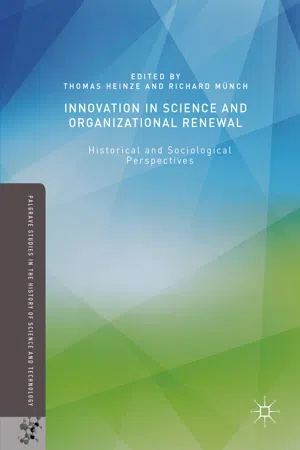
This book looks at the types of new research organizations that drive scientific innovation and how ground-breaking science transforms research fields and their organization. Based on historical case studies and comparative empirical data, the book presents new and thought-provoking evidence that improves our knowledge and understanding about how new research fields are formed and how research organizations adapt to breakthroughs in science. While the book is firmly based in science history, it discusses more general sociological and policy propositions regarding scientific innovations and organizational change. The volume brings together leading scholars both from the United States and Europe.
eBook - ePub
Innovation in Science and Organizational Renewal
Historical and Sociological Perspectives
- English
- ePUB (mobile friendly)
- Available on iOS & Android
eBook - ePub
Innovation in Science and Organizational Renewal
Historical and Sociological Perspectives
About this book
Information
© The Author(s) 2016
Thomas Heinze and Richard Münch (eds.)Innovation in Science and Organizational RenewalPalgrave Studies in the History of Science and Technology10.1057/978-1-137-59420-4_11. Editors’ Introduction: Institutional Conditions for Progress and Renewal in Science
Thomas Heinze1 and Richard Münch2
(1)
University of Wuppertal, Wuppertal, Germany
(2)
University of Bamberg, Bamberg, Germany
Keywords
Scientific innovationsDisciplinary diversityOrganizational renewalInstitutional changeHistory of scienceSociology of scienceNational research system1.1 Progress and Renewal in Science
In the history, philosophy, and sociology of science, there is a consensus that the primary goal of scientific research is the continuous renewal of knowledge and technology. In this context, renewal refers not only to the generation of new ideas, theories, methods, and instruments or to the discovery of previously unknown phenomena but also to the diffusion of innovative scientific developments, and the institutionalization of such advances in existing scientific communities and ultimately as new academic fields. Accepting the premise that the renewal of knowledge and technology is the objective of scientific research, we can then ask what are institutional conditions for successful renewal.
This edited volume contributes to the debate about renewal in science by addressing two interrelated questions. First, this volume explores the capability of research organizations to generate original and transformative intellectual contributions, such as new theories, methods, instrumentation, and empirical discoveries. Second, this volume addresses the capability of national research systems and research organizations to absorb new intellectual developments and to institutionalize new fields of research. Through detailed historical and comparative case studies, this volume presents new and thought-provoking evidence that improves our conceptual knowledge and empirical understanding about how new research fields are formed, how research organizations adapt to changes both in the sciences and in their societal environment, and how research sponsors strike the balance between support for new research areas and continuity for established lines of disciplinary research.
Investigating the complex connections between scientific innovation and institutional change requires a long-term perspective. Therefore, the volume assembles scholars in science history, as well as in sociology of science and research policy. Yet, the distinctive contribution of this volume is that while being firmly based in science history, it strives for broader and more general sociological and policy propositions regarding renewal in science. Through the juxtaposition between science history and the sociology of science and research policy, we attempt to narrow the gap between detailed microhistories of particular entities or episodes and overgeneralized sociological propositions on institutional change in science.
In this introductory chapter, we argue that renewal within the organizations that conduct scientific research, as well as within their environment, is contingent upon at least three institutional conditions: (1) investments in exploration, (2) facilitation of meso-level competition, and (3) organizing interdisciplinary research. What follows below is a discussion of these three institutional conditions, how each chapter in this edited volume contributes to their analysis, and finally, extended abstracts of all chapters.
1.2 Investments in Exploration
Generally speaking, scientists face two opposing expectations. First, they are expected to seek fundamentally new knowledge and to move beyond established doctrine. Second, they are expected to develop and maintain an inventory of disciplinary knowledge that can be passed on from generation to generation. These two expectations are conflicting, and they operate as antipodal values under various labels: innovation versus tradition, originality versus relevance, dissent versus conformity, rebellion versus discipline, exploration versus exploitation, search versus production, experimentation versus implementation, or risk taking versus refinement.
Michael Polanyi argues that the tension between these two opposing expectations pervades the entire institutional structure of scientific research: “This internal tension is essential in guiding and motivating scientific work. The professional standards of science must impose a framework of discipline and at the same time encourage rebellion against it. They must demand that … an investigation should largely conform to the currently predominant beliefs about the nature of things, while allowing in order to be original it may to some extent go against these.”1
That there is a fundamental tension between seeking new and refining existing knowledge implies that depending on historical circumstances and institutional context there may either be a delicate balance between the two, or one pole will dominate the other. Polanyi argues that the institutional structure of science—in general—tends to be biased toward the refinement of existing knowledge. Taking peer review as an example, he claims that publications are primarily evaluated in terms of their plausibility and scientific value, and thus with respect to their contribution toward an inventory of disciplinary knowledge. Publications have to be plausible and valuable extensions of existing knowledge for them to be accepted by the scientific community. In contrast, publications of sufficient plausibility and scientific value may vary considerably with respect to their originality, that is, the degree of surprise which they arouse among scientists. Hence, not every publication, no matter how plausible and valuable it may be, is novel and original.
In a similar vein, Richard Whitley argues that despite the strong institutional commitment to the exploration of fundamentally new knowledge in modern science, “the extent of originality and novelty in research goals and procedures is restricted by the need to convince specialist colleagues of the significance of one’s work in reputational work organizations. … The degree of innovation is thus diminished and constrained by the necessity of showing how new contributions fit in with, and are relevant to, existing knowledge.”2 Hence, Whitley asserts that the scientific elite holds the innovators in check. Novel ideas and artifacts are accepted only if they can be connected to previous knowledge and thus prove their scientific relevance.
The view that the institutional structure of science gives considerably more weight to the plausibility of contributions and their connectability to previous research than to originality and surprise has garnered empirical support in recent years. Many commentators argue that during the past three decades, the funding of public research organizations has increasingly shifted toward external, peer-reviewed sponsorship despite that such funding tends to favor mainstream and risk-averse projects.3 Thus, the proliferation of peer review in funding decisions most likely has deepened existing knowledge paths at the expense of finding fundamentally new ones.
In his essay on exploration versus exploitation in organizational learning, James March warns that “systems that engage in exploitation to the exclusion of exploration are likely to find themselves trapped in suboptimal stable equilibria.” He concludes that “maintaining an appropriate balance between exploration and exploitation is a primary factor in system survival and prosperity.”4 In this respect, it is interesting that several private and public research sponsors, among them the Volkswagen Foundation, the Wellcome Trust, the MacDonnell Foundation, the Howard Hughes Medical Institute, and the European Research Council, set up funding programs dedicated to the support of unconventional research that has the potential for groundbreaking results.5 Many of these programs are intended to counterbalance the dominant exploitation-mode inherent in research council funding. Yet, typically they command small budgets, operate under heightened evaluation requirements, and rely a fortiori on traditional peer review.6
The two observations in the literature that the institutional structure of science tends to be biased toward the refinement of existing knowledge, and that research funding in recent decades has strengthened established knowledge paths have led sociologists of science and organizational scholars alike to reconsider institutional conditions in support of explorative and path-breaking research. The common theme in these contributions is that the forces of exploration need to be strengthened to balance the two conflicting orientations in the institutional structure of science. This plea for investments in exploration is articulated either from a comparative historical perspective,7 from an organizational sociology perspective,8 from an individual’s research strategy view,9 or from a research policy viewpoint.10
The present volume contributes to this renewed discussion by asking (1) how and why investments in exploration have occurred historically and (2) more generally, how the two opposing orientations of innovation and tradition are balanced in different institutional settings. In contrast to the current emphasis on funding structure, this volume puts emphasis on new organizational forms and internal organizational change. Several chapters in this volume present evidence that investments in exploration are made by building entirely new forms of research organizations, such as the university-based microfabrication user facility (Mody), the National Center for Ecological Analysis and Synthesis (Hackett and Parker), and the space research laboratories and consortia that built the two satellites ANS and IRAS (Baneke); or new forms of conferences, such as the Solvay Conferences or the Seven Pines Symposia (Stuewer). These new organizations or conferences are examples of an ongoing process of renewal in the institutional arrangements of science that have considerable effects on intellectual opportunities and innovations. In addition, several chapters in this volume present cases of adaptation and internal change of existing research organizations, including the Deutsches Elektronensynchrotron (DESY) and the Stanford Linear Accelerator Center (SLAC) (Hallonsten and Heinze), or the Goddard Space Flight Center at the National Aeronautics and Space Administration, NASA (Launius). As shown by these chapters, internal organizational changes oftentimes occur gradually, particularly in institutional environments in which entrance of new forms of research organizations is either difficult or imp...
Table of contents
- Cover
- Frontmatter
- 1. Editors’ Introduction: Institutional Conditions for Progress and Renewal in Science
- 2. Fabricating an Organizational Field for Research: US Academic Microfabrication Facilities in the 1970s and 1980s
- 3. From Salomon’s House to Synthesis Centers
- 4. The Seventh Solvay Conference: Nuclear Physics, Intellectual Migration, and Institutional Influence
- 5. “Preservation of the Laboratory Is Not a Mission.” Gradual Organizational Renewal in National Laboratories in Germany and the USA
- 6. Institutional Context and Growth of New Research Fields. Comparison Between State Universities in Germany and the USA
- 7. Organizing Space: Dutch Space Science Between Astronomy, Industry, and the Government
- 8. “We Will Learn More About the Earth by Leaving It than by Remaining on It.” NASA and the Forming of an Earth Science Discipline in the 1960s
- 9. Interdisciplinary Research and Transformative Research as Facets of National Science Policy
- Backmatter
Trusted by 375,005 students
Access to over 1.5 million titles for a fair monthly price.
Study more efficiently using our study tools.
Frequently asked questions
Yes, you can cancel anytime from the Subscription tab in your account settings on the Perlego website. Your subscription will stay active until the end of your current billing period. Learn how to cancel your subscription
No, books cannot be downloaded as external files, such as PDFs, for use outside of Perlego. However, you can download books within the Perlego app for offline reading on mobile or tablet. Learn how to download books offline
Perlego offers two plans: Essential and Complete
- Essential is ideal for learners and professionals who enjoy exploring a wide range of subjects. Access the Essential Library with 800,000+ trusted titles and best-sellers across business, personal growth, and the humanities. Includes unlimited reading time and Standard Read Aloud voice.
- Complete: Perfect for advanced learners and researchers needing full, unrestricted access. Unlock 1.5M+ books across hundreds of subjects, including academic and specialized titles. The Complete Plan also includes advanced features like Premium Read Aloud and Research Assistant.
We are an online textbook subscription service, where you can get access to an entire online library for less than the price of a single book per month. With over 1.5 million books across 990+ topics, we’ve got you covered! Learn about our mission
Look out for the read-aloud symbol on your next book to see if you can listen to it. The read-aloud tool reads text aloud for you, highlighting the text as it is being read. You can pause it, speed it up and slow it down. Learn more about Read Aloud
Yes! You can use the Perlego app on both iOS and Android devices to read anytime, anywhere — even offline. Perfect for commutes or when you’re on the go.
Please note we cannot support devices running on iOS 13 and Android 7 or earlier. Learn more about using the app
Please note we cannot support devices running on iOS 13 and Android 7 or earlier. Learn more about using the app
Yes, you can access Innovation in Science and Organizational Renewal by Thomas Heinze, Richard Münch, Thomas Heinze,Richard Münch in PDF and/or ePUB format, as well as other popular books in History & World History. We have over 1.5 million books available in our catalogue for you to explore.