This edited book explores the digital challenge for cultural-creative organizations and industries, and its impact on production, meaning-making, consumption and valuation of cultural-creative products and experiences. Discussing digital changes such as user-generated content, social media, business model innovation and product development, the chapters challenge deep-seated definitions of creative individuals, organizations and industries, offering insights into how this creative aspect is argued and legitimized. Placing an emphasis on research that deals with the digital challenge, this collection theorizes its significance for the nature and dynamics of creative industries as well as its impact on the mediation of experiences and the creation and consumption of cultural-creative products.
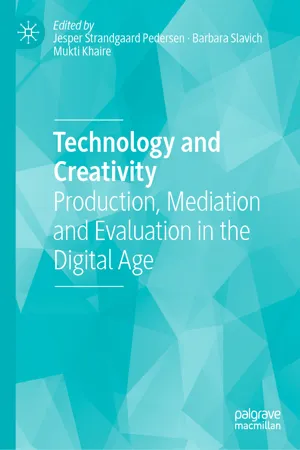
eBook - ePub
Technology and Creativity
Production, Mediation and Evaluation in the Digital Age
- English
- ePUB (mobile friendly)
- Available on iOS & Android
eBook - ePub
Technology and Creativity
Production, Mediation and Evaluation in the Digital Age
About this book
Information
© The Author(s) 2020
J. Strandgaard Pedersen et al. (eds.)Technology and Creativityhttps://doi.org/10.1007/978-3-030-17566-5_11. Technology and Creativity: Production, Mediation and Evaluation in the Digital Age
Jesper Strandgaard Pedersen1 , Barbara Slavich2 and Mukti Khaire3
(1)
Department for Organization, Copenhagen Business School, Københavns, Denmark
(2)
IÉSEG School of Management, Paris, France
(3)
Cornell University, Ithaca, NY, USA
Barbara Slavich
Introduction
Technology and creativity seem to be two core constructs that have dominated recent debates for understanding the driving forces in twenty-first-century economies, and in particular capitalist economies, debated under such terms as ‘Experience Economy ’ (Pine & Gilmore, 1999) or ‘Name Economy ’ (Moeran, 2003) or the more general term ‘New Economy ’ to mention but a few of the terms coined. On the connection between technology and creativity, Lampel, Shamsie and Lant (2006) outline their view on the role of technology in the evolution of the cultural industries by stating that,
Cultural industries owe their existence to a series of technical innovations such as electrical sound recording, motion picture photography, television broadcasting and the Internet. These technologies opened new frontiers that grew into great industries. The expansion phase, however, was championed not by the technologically knowledgeable, but by the creative and business talent. (Lampel et al. 2006: 12)
Thus, emphasizing the significance of the technology as a driver, but not as an end in itself, Lampel et al. (2006) also emphasize the importance of content and that the technology at the end of the day is in the minds and hands of creative individuals and business organizations. The editors sympathize and concur with this view, but also propose that it is important, nonetheless, to understand the implications and influence on creative and cultural industries of technological advances , especially recent digital technologies , which have had far-ranging and rapidly evolving impact. This volume attempts to shed light on these changes, while still placing them in the broader historical, institutional, cultural and economic context in which these industries operate.
Recent economic transformation, technological advances and globalization seem to continue to alter how organizations and individuals define and organize work and how societies consume what organizations and individuals produce. The development of the Internet, in particular, has played an increasingly important role in such economic and sociocultural change. An array of Information and Communication Technology (ICT) tools has allowed for increased digitalization of information media and social interactions, and consumers are turning to digitally mediated communication in their social and professional connectivity, decision-making as well as to digital channels for consumption (Munar et al. 2013).
These recent technological advances have increasingly influenced organizations and individuals in creative industries, by leading to a ‘disintermediation’ and resulted in a loss of power of traditional actors, such as critics and producers (Hirsch & Gruber, 2015), as well as in an increased power of consumers. Indeed, the development has taken place by bringing (traditionally conceived) passive consumers of creative products to being active agents in the creative process . This takes place through different processes and developments. For example, by opening up new opportunities for collaborations and by offering new ways of consuming cultural products (Munar & Gyimóthy, 2013). Examples of these changes include for instance the high-end restaurant industry1 where diners post online comments on their experiences on platforms such as TripAdvisor, influencing restaurants’ reputation and reducing the traditional impact of critics’ reviews (Müller, 2018). In music and performing arts, online platforms such as YouTube give artists the opportunity to publish their music and contents online entering into a direct contact with the audiences.
The current digitalization has also pushed a deinstitutionalization of media conglomerates, which leads to new opportunities for creators to reach wider audiences (Hirsch & Gruber, 2015). Furthermore, new business models, made possible by digital technologies , allow creators to generate and appropriate more value from their own work. Social media platforms grow by creating value from users’ contributions. This is made possible due to the digitization of, for example, text, sound and images. Users contribute with knowledge and creativity in a fast-expanding global upload–download phenomenon, and user-generated content (UGC) has become massively popular, shaping and changing the public perception of products and organizations. Thus, ICT and social media change the traditional production function to co-create value across historical producer–consumer boundaries and redefine the role of intermediaries , gatekeepers and experts, which has greater implications in the creative industries than in others, due to their very nature, described below.
Creative Industries: Creativity at the Center
The broad term ‘creative industries’ refers to a number of sectors that derive value through the creativity involved in the products developed and the processes used (Jones, Lorenzen, & Sapsed, 2015). These industries, for example, such as architecture, advertising, fashion, design, film, the fine arts and haute cuisine, encompass individuals and organizations that produce, develop and distribute products or experiences that convey symbolic and aesthetic value (Caves, 2000; Lampel et al., 2006). Several studies have tried to understand what industries should be seen as creative, and there has been a lot of debate around the use of the term ‘creative’ versus ‘cultural industry,’ with several scholars agreeing on the view of cultural industries as a subset of creative industries (Jones et al. , 2015). In his influential work, ‘Creative industries: Contracts between art and commerce,’ the economist Richard Caves (2000) suggested a number of properties defining what characterizes creative industries—‘Nobody knows,’ ‘Art for art’s sake,’ ‘Motley crew,’ ‘Infinite variety,’ ‘A list/B list,’ ‘Time flies’ and ‘Ars longa’ (Caves, 2000: 2–10)—in an attempt to define and capture the creative industries. Based on these properties, Caves came up with the following list of creative industries,
They include book and magazine publishing, the visual arts (painting, sculpture), the performing arts (theatre , opera, concerts, dance), sounds recordings, cinema and TV films, even fashion and toys and games. (Caves, 2000: 1)
In spite of this ground-breaking and influential work, Caves’ list from 2000 also illustrates very well the problem of such a list. Rather than asking, ‘what is the creative industries?’ another approach (and probably a more interesting question to ask) is to contextualize to a particular time and place—‘who is considering what goods and activities to be creative expressions and therefore belonging to the creative industries?’ Therefore no final or universal list of the creative industries makes sense or could meaningfully be listed, as it is a social construction and a dynamic one at that. Creative industries develop due to industry change and become more (or less) artistic and experience-driven over time (e.g., the culinary field) and new industries emerge driven by new technologies (e.g., video games and virtual reality). Finally, what is considered to belong to the category of creative industries is ...
Table of contents
- Cover
- Front Matter
- 1. Technology and Creativity: Production, Mediation and Evaluation in the Digital Age
- 2. Innovators’ Acts of Framing and Audiences’ Structural Characteristics in Novelty Recognition
- 3. The Alchemy of Painting: How the Technology of Oil Paint Transmuted Art
- 4. Industry or Field? The Value of the Field Construct to Study Digital Creative Industries
- 5. The Internet as Liberating Space for the Visual Arts: Political Hopes and Sociological Realities
- 6. Evaluation and Producers’ Attention to Ratings in the Chocolate Confectionery Markets
- 7. Alone or in Concert? Creative Entrepreneurs and the Role of Multiple Institutional Logics in Crowdfunding Pitches
- 8. Museums and Technology for Value Creation
- 9. Reassembling Cultural Journalism in the Digital Age
- 10. Digital Transformation and Business Model Innovation in the Film Industry: The Case of Movieday.it
- 11. Afterword
- Correction to: Innovators’ Acts of Framing and Audiences’ Structural Characteristics in Novelty Recognition
- Back Matter
Trusted by 375,005 students
Access to over 1.5 million titles for a fair monthly price.
Study more efficiently using our study tools.
Frequently asked questions
Yes, you can cancel anytime from the Subscription tab in your account settings on the Perlego website. Your subscription will stay active until the end of your current billing period. Learn how to cancel your subscription
No, books cannot be downloaded as external files, such as PDFs, for use outside of Perlego. However, you can download books within the Perlego app for offline reading on mobile or tablet. Learn how to download books offline
Perlego offers two plans: Essential and Complete
- Essential is ideal for learners and professionals who enjoy exploring a wide range of subjects. Access the Essential Library with 800,000+ trusted titles and best-sellers across business, personal growth, and the humanities. Includes unlimited reading time and Standard Read Aloud voice.
- Complete: Perfect for advanced learners and researchers needing full, unrestricted access. Unlock 1.5M+ books across hundreds of subjects, including academic and specialized titles. The Complete Plan also includes advanced features like Premium Read Aloud and Research Assistant.
We are an online textbook subscription service, where you can get access to an entire online library for less than the price of a single book per month. With over 1.5 million books across 990+ topics, we’ve got you covered! Learn about our mission
Look out for the read-aloud symbol on your next book to see if you can listen to it. The read-aloud tool reads text aloud for you, highlighting the text as it is being read. You can pause it, speed it up and slow it down. Learn more about Read Aloud
Yes! You can use the Perlego app on both iOS and Android devices to read anytime, anywhere — even offline. Perfect for commutes or when you’re on the go.
Please note we cannot support devices running on iOS 13 and Android 7 or earlier. Learn more about using the app
Please note we cannot support devices running on iOS 13 and Android 7 or earlier. Learn more about using the app
Yes, you can access Technology and Creativity by Jesper Strandgaard Pedersen, Barbara Slavich, Mukti Khaire, Jesper Strandgaard Pedersen,Barbara Slavich,Mukti Khaire in PDF and/or ePUB format, as well as other popular books in Business & Business General. We have over 1.5 million books available in our catalogue for you to explore.