eBook - ePub
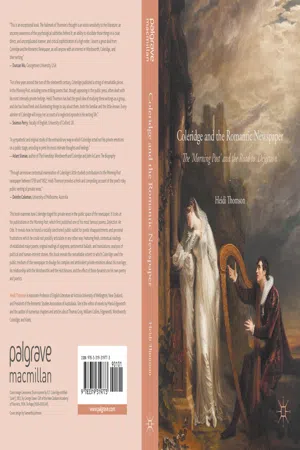
Coleridge and the Romantic Newspaper
The 'Morning Post' and the Road to 'Dejection'
- English
- ePUB (mobile friendly)
- Available on iOS & Android
eBook - ePub
About this book
Information
© The Author(s) 2016
Heidi ThomsonColeridge and the Romantic Newspaper10.1007/978-3-319-31978-0_11. Introduction: A Character in the Antithetical Manner
Heidi Thomson1
(1)
Victoria University of Wellington, Wellington, New Zealand
A Night or two after a worse Rogue there came,
The head of the Gang, one Wordsworth by name—
“Ho! What’s in the wind?” Tis the voice of a Wizzard!
I saw him look at me most terribly blue!
He was hunting for witch-rhymes from great A to Izzard,
And soon as he’d found them made no more ado
But chang’d me at once to a little Canoe.
From this strange Enchantment uncharm’d by degrees
I began to take courage & hop’d for some Ease,
When one Coleridge, a Raff of the self-same Banditti
Past by—& intending no doubt to be witty,
Because I’d th’ill-fortune his taste to displease,
He turn’d up his nose,
And in pitiful Prose
Made me into the half of a small Cheshire Cheese.
(‘A Soliloquy of the Full Moon, She Being in a Mad Passion’, PW 2.692–3, 24–40)
While the image of the ‘Gang’ suggests solidarity and camaraderie, Coleridge also draws attention to the hierarchy among its members, with Wordsworth as ‘head of the Gang’ and himself as the producer of ‘pitiful prose’. The Moon’s defiant dissociation from all metaphoric control, her insistence to be herself and true to herself only, was, in Coleridge’s mind, not unlike Wordsworth’s assertion of poetic and domestic independence. Sara Hutchinson, the original addressee of the depressed ‘Verse Letter’, included the Moon’s ‘Soliloquy’ as the opening poem in Sarah Hutchinson’s Poets, a manuscript collection which would include ten other Coleridge poems, eight of which were also published in the Morning Post (Whalley 5, 28). The choice was fitting: this poem was after all about her ‘poets’, Wordsworth and Coleridge, who, together with Dorothy Wordsworth and Mary Hutchinson, made up their ‘Gang’. Together with Wordsworth, she was also the object of Coleridge’s most passionate interest. Neither Wordsworth nor Sara Hutchinson, however, was as obsessed with Coleridge as he was with them. Coleridge’s reluctant, painful realization of this, and the need to publicize it, is, broadly, the topic of this book. As the Janus-faced coexistence of the depressed ‘Verse Letter’ and the jocular ‘Soliloquy of the Full Moon’ already indicated, Coleridge’s feelings were complex and contradictory, comprising love, admiration, resentment, and envy. His gaze, like the characters in his poems, wanted to soar upwards, but it was often forced downwards. His ideas about poets and poetry were to a surprising degree associated with his frustrated expectations of domestic happiness.
Sara Hutchinson embodied what he wished for and found wanting in his own wife, while Wordsworth was the great bard he himself would never be but from whom he expected the implementation of his poetic vision. In addition, Wordsworth did not follow the path towards the kind of poetic greatness that Coleridge had planned for him. These two strands of thought, the concurrent obsessions with Sara Hutchinson and William Wordsworth, constituted a double helix of poetic inspiration in Coleridge’s mind, with interconnecting strands of the domestic, the erotic, and the poetic. Coleridge’s passion for Sara Hutchinson as a creative muse was intertwined with his admiration of, sexual envy of, and disaffection from, Wordsworth’s strong sense of domestic and poetic purpose. Gradually Coleridge had to recognize that Wordsworth, like the Moon in the ‘Soliloquy’, would be Wordsworth himself only and not a metaphoric incarnation of Coleridge. The main focus of this study is how Coleridge expressed his emotions and ideas about the Gang in the press, how he broadcast connected passions in a public medium between 1799 and 1802. Like John Worthen’s The Gang: Coleridge, the Hutchinsons & the Wordsworths in 1802 (2001), this study is about a few people in a narrow time frame, but my focus is firmly on Coleridge’s view of the ‘webs of interlocution’ he engages with and finds himself trapped in. 3 While I take from Worthen the idea of examining this group of connected lives, I also privilege one particular focus or angle: Coleridge’s compulsion to publish matters of an extraordinarily sensitive personal nature in the unambiguously public space of the newspaper.
As I will indicate later in this chapter in more detail, the ‘Gang’ is less self-contained than might seem at first sight. No matter how exhaustively or conclusively we detail the events of their lives, as Worthen explicitly undertakes to do, every account or narrative of these people’s intertwined lives is inevitably biased by the record of transmission and by our interpretations of that record. Worthen associates an exhaustive record with biographical transparency or sincerity: ‘If we miss things out on the grounds that they are unimportant, or because we have not space to include them, or because they do not fit the story we are trying to tell, then all we do is conceal our prejudices’ (1). I believe, however, that ‘prejudices’, no matter how unintentional, are inevitable, and instead, I propose in this study an admission and awareness of a prejudicial slant which, broadly, amounts to a record of Coleridge’s expressed emotions about his personal and poetical relationships between 1799 and 1802. Similarly, while Worthen associates single subject biographies with ‘hero-worshipping’ (6), I do not believe that this is necessarily the case. Worthen asserts that we make a mistake by writing ‘biographies of individuals as islands’ because we ‘live as part of the main’ (6). Yet, a perspective of the ‘main’ through the eyes of an individual also highlights just to what extent we are islands. While my study avoids vindicating Coleridge against Wordsworth (or vice versa), it also clarifies the extent to which Coleridge felt like an ‘island’ amidst the ‘main’.
On 4 October 1802, the wedding day of his best friend William Wordsworth and the seventh anniversary of his own unhappy marriage, Coleridge published ‘Dejection. An Ode, Written April 4, 1802’ in a London newspaper, the Morning Post. The poem was signed ΕΣΤΗΣΕ, and it became, together with Wordsworth’s ‘Intimations Ode’ and ‘Resolution and Independence’, one of ‘the most celebrated poems of the century’ (Parrish Coleridge’s Dejection 1). Every biography and critical study of Coleridge and Wordsworth has discussed the crucial significance of ‘Dejection. An Ode’ for our understanding of Coleridge’s life and poetic career and its vital role in the poetic dynamic between the two friends. 4 Why, you may well ask, another book inspired by ‘Dejection’? Briefly: because I wanted to find out more about Coleridge’s compulsive, public expression of what could be considered private matters. I have never been entirely convinced by readings which define this poem as a ‘gift’ to Wordsworth on his marriage to Mary Hutchinson, an epithalamium or ‘a tribute [to Wordsworth] with no trace of conscious irony’ (PW 2.696). 5 At the same time, however, I do not subscribe to John Worthen’s categorical verdict: ‘Dejection is a sad and self-mocking tribute rather than a present’ (264). Worthen’s take on the poem as a ‘deeply ironical, self-regarding gift to a man already married, and unable to marry again’, as ‘a kind of un-wedding present’, reacts too neatly to ‘gift’ interpretations and it categorizes the poem too narrowly as confessional self-expression (264–5). The poem signifies, perhaps, all of those things, but it does more than that: it pulls together a number of poetic and domestic developments of a period which started with Coleridge’s return from Germany in 1799 and which culminated in 1802, an episode which coincided precisely with Coleridge’s employment by the Morning Post newspaper. Yet, the fact that ‘Dejection. An Ode’, Coleridge’s most poignant poetic expression of private despair, was published in a newspaper has never been the subject of a separate critical enquiry. My focus is not so much on Coleridge’s career as a journalist as on those publications, particularly the poetry and selected prose pieces, which bear upon the tumultuous events leading up to the publication of the poem: his infatuation with Sara Hutchinson (who became Wordsworth’s sister-in-law on the day of the publication of ‘Dejection’) and the despair about his own marriage, his poetic friendship with Mary Robinson and his alienation from Wordsworth, his uneasy settlement in the Lakes and his awareness of Wordsworth’s felicitous domestic settlement in a chosen place, surrounded by the women who adored and supported him, his expulsion from the second edition of Lyrical Ballads, and the mixture of envy and admiration he felt for the connection of domestic bliss and poetic productivity in the Wordsworth household.
While my study is biographical, it is also textual and contextual. At the risk of sounding somewhat like a real estate agent (‘location, location, location’), I situate the turmoil of Coleridge’s private and poetic life very specifically within his newspaper publications during his employment as a writer for Daniel Stuart’s Morning Post from 1799 until 1802. Coleridge’s intense involvement with the Morning Post during this period is a useful window for unlocking his personal and poetic interests. Already in 1998, Paul Magnuson argued for the importance of reading Romantic poems in their original publications because the ‘public significance of a literary work rests, not in itself, not within its own generic boundaries, but in its locations for the simple reason that without precise location, there is no cultural significance’ (Reading Public Romanticism 3). Inspired by my teacher Jack Stillinger, I have taken on board that the ‘knottiest problem in textual theory … is the relationship of the words of a text to the physical document embodying them’ (Coleridge and Textual Instability 133). The ways in which Coleridge wrote and rewrote his poems for publication in the newspaper are revealing, with the differences in other versions highlighting his particular private concerns at the moment of publication. In addition, the newspaper versions of Coleridge’s poems are sometimes accompanied by, or surrounded by, materials which provide a fascinating insight into the possible significance of the poem. Gérard Genette has identified paratextuality in the context of print culture as ‘those liminal devices and conventions, both within the book (peritext) and outside it (epitext), that mediate the book to the reader’, such as titles, pseudonyms, forewords and afterwords, dedications, epigraphs and epilogues, authorial correspondence. 6 The same applies to Coleridge’s newspaper contributions, with signatures, prefaces, allusions, accompanying pieces, and editorial correspondence illuminating the significance of the poems.
Some of the poems I will discuss in the following chapters are now little discussed, but they were very popular at the time of their publication, and Daniel Stuart’s concerted efforts to coax newspaper copy out of Coleridge through endless patience, unstinting support, and financial rewards were an indication of how worthwhile Coleridge’s contributions were. Coleridge himself thought very highly of many of the poems he published between 1799 and 1802 in the Morning Post. 7 Much newspaper versifying would indeed have conformed to George Crabbe’s condemnation:But, clearly, the Morning Post’s ‘Original Poetry’ section was not a ‘fatal nursery’ for the poems which Coleridge published between 1799 and 1802. 8 The lack of attention to the publication of poems in newspapers may have something to do with the disposable, short-lived, transient nature of the newspaper. It is a genre which is fundamentally at odds with, even inimical to, the canonical, monumental, and, therefore, timeless status we now associate with famous poems. The immediacy and urgency associated with newspaper reporting and the vital importance of a continuously changing narrative (‘news’) are diametrically opposed to the rhetoric of the Romantic lyric in which a particular moment encapsulates the seemingly timeless disposition of the lyric speaker. Yet, Coleridge’s poems appealed to the newspaper reader, providing additional comment to, or re...
Last in these ranks and least, their art’s disgrace,
Neglected stand the Muse’s meanest race;
Scribblers who court contempt, whose verse the eye
Disdainful views, and glances swiftly by:
This Poet’s Corner is the place they choose,
A fatal nursery for an infant Muse. (26)
Table of contents
- Cover
- Frontmatter
- 1. Introduction: A Character in the Antithetical Manner
- 2. The Return from Germany
- 3. The Morning Post and ‘Introduction to the Tale of the Dark Ladie’
- 4. Mothers, Sons, and Poets in the Morning Post
- 5. Homeless at Grieta Hall
- 6. The 1800 Lyrical Ballads, Mary Robinson, and ‘The Mad Monk’
- 7. Mary Robinson and the Poet Coleridge
- 8. ‘Merely the Emptying Out of My Desk’
- 9. Conclusion: ‘Dejection. An Ode’ in the Morning Post as a Palimpsest
- Backmatter
Trusted by 375,005 students
Access to over 1.5 million titles for a fair monthly price.
Study more efficiently using our study tools.
Frequently asked questions
Yes, you can cancel anytime from the Subscription tab in your account settings on the Perlego website. Your subscription will stay active until the end of your current billing period. Learn how to cancel your subscription
No, books cannot be downloaded as external files, such as PDFs, for use outside of Perlego. However, you can download books within the Perlego app for offline reading on mobile or tablet. Learn how to download books offline
Perlego offers two plans: Essential and Complete
- Essential is ideal for learners and professionals who enjoy exploring a wide range of subjects. Access the Essential Library with 800,000+ trusted titles and best-sellers across business, personal growth, and the humanities. Includes unlimited reading time and Standard Read Aloud voice.
- Complete: Perfect for advanced learners and researchers needing full, unrestricted access. Unlock 1.5M+ books across hundreds of subjects, including academic and specialized titles. The Complete Plan also includes advanced features like Premium Read Aloud and Research Assistant.
We are an online textbook subscription service, where you can get access to an entire online library for less than the price of a single book per month. With over 1.5 million books across 990+ topics, we’ve got you covered! Learn about our mission
Look out for the read-aloud symbol on your next book to see if you can listen to it. The read-aloud tool reads text aloud for you, highlighting the text as it is being read. You can pause it, speed it up and slow it down. Learn more about Read Aloud
Yes! You can use the Perlego app on both iOS and Android devices to read anytime, anywhere — even offline. Perfect for commutes or when you’re on the go.
Please note we cannot support devices running on iOS 13 and Android 7 or earlier. Learn more about using the app
Please note we cannot support devices running on iOS 13 and Android 7 or earlier. Learn more about using the app
Yes, you can access Coleridge and the Romantic Newspaper by Heidi Thomson in PDF and/or ePUB format, as well as other popular books in Literature & Literary Criticism in Poetry. We have over 1.5 million books available in our catalogue for you to explore.