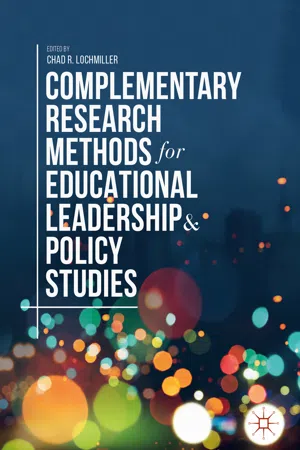
This edited volume brings together leading scholars from the fields of educational leadership and policy studies to discuss qualitative, quantitative, and mixed research methods in an accessible and pedagogically well-designed volume. Authors discuss ways in which various research methodologies and methods can productively be brought together to expand our current understanding of leadership issues and the contemporary policy context that surrounds them. Chapters provide both practical recommendations for using the methods discussed as well as suggestions for further reading.
eBook - ePub
Complementary Research Methods for Educational Leadership and Policy Studies
- English
- ePUB (mobile friendly)
- Available on iOS & Android
eBook - ePub
Complementary Research Methods for Educational Leadership and Policy Studies
About this book
Information
Topic
EducationSubtopic
Education Administration© The Author(s) 2018
Chad R. Lochmiller (ed.)Complementary Research Methods for Educational Leadership and Policy Studieshttps://doi.org/10.1007/978-3-319-93539-3_11. Complementary Research Methods: An Introduction and Overview
Chad R. Lochmiller1
(1)
School of Education, Indiana University, Bloomington, IN, USA
Interest in educational research has grown substantially both because of federal research investments and a burgeoning literature base about research methods appropriate to the study of educational policy (Bascia et al. 2005; Fuhrman et al. 2007; Sykes et al. 2009). Oddly, there has been relatively limited discussion of the (dis)connections between the fields of educational leadership and policy. Despite their separate treatment as research disciplines, these fields have grown increasingly connected within the context of educational practice. In part, this connection reflects the important role that superintendents, principals, and other formal administrative leaders have come to hold within various policy processes as policy actors, advocates, and implementers (Cranston 2013; Knapp and Feldman 2012; Koyama 2011, 2014). Indeed, as policy actors, these titular leaders not only help shape policymaker’s interpretations of educational challenges but are charged with the implementation of policy within the local context of schools. Policy researchers have thus increasingly considered the potential impact of educational practice on policy processes and have even gone so far as to suggest that leaders develop policy from their various administrative practices (Honig 2003). Knapp (2002) observed that policy influences a variety of day-to-day decisions about teaching and learning. A cursory review of recent policies finds that many policy-driven educational reforms, such as increased pressure to improve the achievement outcomes of the lowest performing schools as codified by the Every Student Succeeds Act (ESSA), have necessitated fundamental changes in the work of educators and reflect increasing awareness by those on the front lines of educational organizations about the shortcomings of previous policy prescriptions.
Despite this convergence, however, a considerable divergence still exists between the fields of educational leadership and policy at both a substantive level (i.e., what we study) and methodological level (i.e., how we study it). Indeed, one need not look further than most doctoral training programs to find that much of the policy curriculum within these programs often focuses on leadership or policy, but rarely both. Many students are not mentored to see leadership as being situated within a policy context nor encouraged to explore how the policy context may itself be a product of local educational practices. Instead, students opt into tracks that focus on policy or leadership as discreet research foci and thus reinforce the appearance that these are, in fact, two separate disciplines. Many research-intensive universities are thus intentionally and unintentionally training policy students and future educational researchers to view leadership practice as a by-product of the policy environment rather than as a key influence within it. This training does not invite students to consider how leaders’ actions influence, shape, and potentially necessitate particular policy responses. Thus, questions related to the (dis)connections between policy and leadership are left unexamined. Readings focus primarily on issues stemming from the legislative process, the generation and distribution of resources through various taxation mechanisms, economic factors, identification of programmatic responses to student populations, and the effects of large-scale reforms. Students are invited to apply perspectives from economics, political science, psychology, public affairs, sociology, and other traditional academic disciplines. All of this represents a fundamental challenge for doctoral faculty who, like myself, conduct research at the intersection of policy and leadership . Indeed, we often find that our students are prepared as policy scholars who cannot or do not wish to grapple with questions related to the study of leadership . To be fair, there are many doctoral programs that focus on leadership that do not expose their students to questions about policy in a substantive manner. In some cases, leadership students—many of whom are preparing for future work as superintendents—do not complete coursework related to the education policy process let alone research methods used by policy scholars. At best, their training focuses almost exclusively on managing politics generated by the school board and to a lesser extent the surrounding community.
Few leadership and policy scholars have explicitly described how these fields should inform each other, in what ways their dominant research methods might be brought together to investigate shared lines of inquiry, and precisely what topics leadership and policy scholars might explore collaboratively as part of a shared research agenda. Desimone (2009) observed that “policy research can include the study of policy formation, implementation , effects, and cost-benefit analyses” (p. 163). This description positions specific methods, such as multisite qualitative case studies (Herriott and Firestone 1983) and cost-benefit analyses (Levin et al. 2017), as being central to the study of policy. Yet, for many scholars who study educational leadership , such methods might not support their research foci or raise questions that relate to practice. Conversely, much of what the field of educational leadership knows is based on “a limited set of methodological approaches” (Young and Crow 2017, p. 8). These approaches include descriptive qualitative case studies, surveys, and cross-sectional studies which are often anchored within specific preparation program contexts. Many of these approaches help generate descriptive accounts of local programs but do not contribute as much to the larger discourse around policies impacting leadership preparation nor expand our understanding to help us see how localized leadership interventions can support large-scale improvement. The tendency in both fields has been for scholars to retreat to their respective encampments without considering the rich middle ground between these fields where questions about the intersections and connections between leadership and policy abound (Orland 2009).
Envisioning a Leadership and Policy Research Continuum
Assuming opportunities for integration between these fields exist and are meaningful, particularly at a methodological level, I use this volume to offer a different view of the relationship between leadership and policy research. This view proceeds from the belief that leadership and policy scholars are part of the same academic community. Thus, I view these fields as being situated at two ends of the same research continuum. On one end of this continuum, policy researchers engage in research that aims to inform policymakers’ understanding by describing the design, effects, and impact of their policies. In particular, these scholars seek to describe the broader policy context and various legislative processes that shapes, informs, and ultimately guides leaders’ work in schools and districts. I conceive of this end of the continuum as one being focused on traditional policy research or traditional policy analysis, a type of policy research characterized broadly by efforts to “assess information needed to understand, design, plan, problem solve, and implement effective educational policies and practices” (Diem et al. 2014, p. 1071). This end of the continuum is thus principally concerned with studying how policy comes to exist, what it aspires to do within the public sphere, and whether it is effective at doing it.
The other end of the continuum describes what I refer to as applied policy research. This research is principally concerned with understanding how policy influences practice and conversely how practice influences policy. As such, scholars who work at this end of the continuum are intrinsically focused on policy-to-practice connections and thus aim to extrapolate how policy contributes to the work of practitioners (Knapp 2002). This end of the continuum necessarily invites questions about leadership, instruction, and learning. Thus, previously, such research has been traditionally focused on educational leadership. Yet, as scholars nest their studies of leadership within the broader policy environment, it becomes necessary to reevaluate our contemporary understanding of the aims and objectives of policy research. At this end of the continuum, scholars are less concerned with the ways in which policy is designed or assessed than about the ways in which policy is implemented or enacted within particular organizational or institutional contexts. The questions asked by these scholars focus on what policy does under specific conditions and in light of specific leadership activities.
Formulated in this manner, policy and leadership are not the dichotomous fields we have at times assumed. Instead, they are related fields that are part of the same broad research area. Within this area, scholars with different research foci can engage collaboratively to understand the full effect of policy and/or the full influence of leadership. This view has important implications for how scholars think about research methods. First and foremost, instead of viewing methods as being either for policy or leadership, a continuum of this sort suggests that scholars might bring multiple methods to bear on a single issue in order to understand its complexity in total. For instance, a scholar who is interested in the issue of teacher quality might not only employ sophisticated value-added models to assess teacher’s contributions to student learning (as discussed in Chap. 11) but also conduct multi-site case studies to understand how leaders make sense and interpret the results of such models as they design supports for classroom teachers’ practice (as discussed in Chap. 3). Within such an agenda, a scholar might extend on this work to examine how leaders talk about performance within the context of preobservation and postobservation conferences using various language-based methodologies (as discussed in Chap. 4). While any one of these lines of inquiry is clearly sufficient, in combination they provide a comprehensive assessment of the design, implementation , and impact of the policy.
Second, this perspective invites policy and leadership scholars to tackle the inherent complexity of contemporary leadership and policy issues and thus see it through multiple methodological approaches, theoret...
Table of contents
- Cover
- Front Matter
- 1. Complementary Research Methods: An Introduction and Overview
- Part I
- Part II
- Part III
- Back Matter
Trusted by 375,005 students
Access to over 1.5 million titles for a fair monthly price.
Study more efficiently using our study tools.
Frequently asked questions
Yes, you can cancel anytime from the Subscription tab in your account settings on the Perlego website. Your subscription will stay active until the end of your current billing period. Learn how to cancel your subscription
No, books cannot be downloaded as external files, such as PDFs, for use outside of Perlego. However, you can download books within the Perlego app for offline reading on mobile or tablet. Learn how to download books offline
Perlego offers two plans: Essential and Complete
- Essential is ideal for learners and professionals who enjoy exploring a wide range of subjects. Access the Essential Library with 800,000+ trusted titles and best-sellers across business, personal growth, and the humanities. Includes unlimited reading time and Standard Read Aloud voice.
- Complete: Perfect for advanced learners and researchers needing full, unrestricted access. Unlock 1.5M+ books across hundreds of subjects, including academic and specialized titles. The Complete Plan also includes advanced features like Premium Read Aloud and Research Assistant.
We are an online textbook subscription service, where you can get access to an entire online library for less than the price of a single book per month. With over 1.5 million books across 990+ topics, we’ve got you covered! Learn about our mission
Look out for the read-aloud symbol on your next book to see if you can listen to it. The read-aloud tool reads text aloud for you, highlighting the text as it is being read. You can pause it, speed it up and slow it down. Learn more about Read Aloud
Yes! You can use the Perlego app on both iOS and Android devices to read anytime, anywhere — even offline. Perfect for commutes or when you’re on the go.
Please note we cannot support devices running on iOS 13 and Android 7 or earlier. Learn more about using the app
Please note we cannot support devices running on iOS 13 and Android 7 or earlier. Learn more about using the app
Yes, you can access Complementary Research Methods for Educational Leadership and Policy Studies by Chad R. Lochmiller in PDF and/or ePUB format, as well as other popular books in Education & Education Administration. We have over 1.5 million books available in our catalogue for you to explore.