eBook - ePub
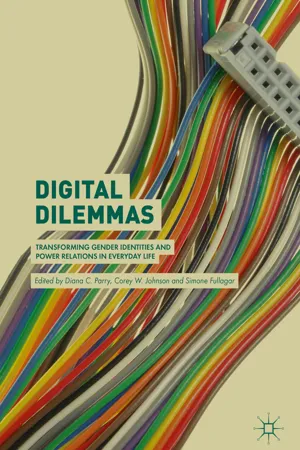
Digital Dilemmas
Transforming Gender Identities and Power Relations in Everyday Life
- English
- ePUB (mobile friendly)
- Available on iOS & Android
eBook - ePub
Digital Dilemmas
Transforming Gender Identities and Power Relations in Everyday Life
About this book
The proliferation of digital technologies, virtual spaces, and new forms of engagement raise key questions about the changing nature of gender relations and identities within democratic societies. This book offers a unique collection of chapters that brings together scholars from diverse backgrounds to explore how gender experiences and identities are being transformed by digital technologies in ways that affirm or deny social justice.
Information
© The Author(s) 2019
Diana C. Parry, Corey W. Johnson and Simone Fullagar (eds.)Digital Dilemmashttps://doi.org/10.1007/978-3-319-95300-7_6Writing Recovery from Depression Through a Creative Research Assemblage: Mindshackles, Digital Mental Health, and a Feminist Politics of Self-Care
Simone Fullagar1 and Iesha Small2
(1)
Department for Health, University of Bath, Bath, UK
(2)
Mindshackles, Hertfordshire, UK
Iesha Small
Introduction
Mindshackles volunteers are gay, straight and people who don’t want to be labelled. We are entrepreneurs, unemployed and nine to fivers. One thing unites us, we have all had significant problems with our mental health during at least one point of our lives, or we care for somebody else who has, and we have made it through the other side. Some of us continue to experience ongoing mental health problems but each time we find a way to get out of bed and live another day. The majority of Mindshackles volunteers are people with a deep passion for something or someone and that aids our recovery. We want to tell our stories as part of our own journey to self-acceptance and ongoing recovery and to help others (and their loved ones) understand that they are not alone. Many of us have used our participation in the project to start conversations with our own families and friends about mental health. (Mindshackles, Volunteers1).
Trisha: ‘When I come off the dancefloor I think, “‘That was a good night, oooh I danced my socks off!” *laughs* I’ve cleared my mind, whatever problems I had before it doesn’t seem to really bother me, once I’ve come off. I have to say, my mind’s blank, I don’t think of anything. A lot of the music’s from Brazil, Columbia, Italian, Portuguese, it’s a different language but music is universal. You don’t have to be able to understand exactly what they are saying to be able to dance to the music. I’m just on that dance floor and that’s that. I’m just listening to the music thinking, “Oooh that’s a lovely record,” *laughs* “Oooh I like that record. Let’s find somebody to dance with”’. (Trisha: Rhythm of joy, Mindshackles)
Trisha’s story on the Mindshackles website provides us with a unique point of departure for exploring how both leisure and digital practices can creatively transform public understanding about mental (ill) health and the possibilities of recovery. Our chapter is written through an academic-arts collaboration, or ‘creative research assemblage’ (Fox & Alldred, 2016; Fox, 2015), to explore the dilemmas surrounding cultural representations of women’s experiences of recovery from depression. We focus our discussion on the Mindshackles2 website that was developed by Iesha, to offer ‘personal stories about reclaiming life from mental ill health’. As a documentary photographer (and teacher, parent, youth advocate), Iesha created the site in 2013 as a means of using digital technology to share the experiences and voices of different people to publicly counter the stigmatisation surrounding mental health issues. The Mindshackles site and its associated Twitter handle offer an alternative, creative approach that seeks to capture and evoke everyday moments significant in the ongoing experience of recovery for different women (and also some men). It was Mindshackles’ focus on everyday leisure practices in people’s recovery that began our conversations and connected our creative, personal, political, and academic interests. In our dialogue, we identified connections that emerged in our own distinct research and creative practices around different notions of recovery. Later in the chapter, we take up these threads of conversation as a means to collaboratively write through some of the digital dilemmas in producing creative-activist-academic knowledge. We focus largely on one personal story and photograph—Trisha: rhythm of joy—from the Mindshackles site as an evocative example for our discussion.
In writing this chapter, we drew inspiration from the traditions of creative analytic practice (Sjollema & Yuen, 2017; Berbary, 2015; Parry & Johnson, 2007; Richardson, 2000), arts-based methods (Boydell et al., 2016), post-humanism (Fox, 2012, 2015; Duff & Sumartojo, 2017), and post-qualitative inquiry (St. Pierre, 2014) to show how creative-activist-academic collaborations can generate different ways of ‘doing’ both digital and gendered mental health. Simone approached the Mindshackles project with a feminist interest in the possibilities of creatively articulating a politics of self-care that invites different ways of engaging with personal stories as political and affective sites of social change (on the politics of self-care, see Fullagar, 2008b). Critical insights from feminist theories of embodiment, affect theory, and digital assemblages provide a way of exploring the micropolitics of leisure and well-being and troubling normalised biomedical perspectives on mental illness/health as an individualised issue. lesha was interested in alternative representations of mental health, where mental ill-health status was known and accepted but not actually the focus of the digital representations. The project gave the volunteers an opportunity to present a version of themselves beyond their mental health status that focused on experiences that provided them joy.
Creativity, Leisure, and Recovery: Digital Mental Health Practices
We draw upon Fox (2012, 2015) and Duff and Sumartojo’s (2017) notion of a creativity- assemblage to conceptualise Mindshackles as a digital project of cultural activism. We employ different representational practices to unsettle the binaries of real/representation, fact/fiction, digital/analogue, labour/leisure, and mind/body. In this way, we position the writing-reading of digital sites as practices of ‘cultural making’ (Swist, Hodge, & Collin, 2016) that generate creative and critical forms of entanglement; as we write or read, we are also written through creativity as an embodied flow of affective meaning. Writing is not simply a rational, objective practice of producing knowledge that presumes to ‘represent’ a world that pre-exists it. Moving beyond a representational logic, writing-reading are understood as material practices through which a range of affects act upon us, as we write to affect others (pleasure, joy, sadness, anger, shame, etc.). In contrast to notions of creativity that privilege cognition, individual genius, or only specialised artistic practice, Fox (2015) argues more broadly that creativity is a profoundly affective aspect of everyday relations and embodied capacities that involve both human and non-human elements.
As a site for digital mental health promotion, Mindshackles produces an approach to recovery that emphasises the experience of creating-becoming that is oriented around diverse pleasures and leisure practices (as distinct from ‘expert’ biomedical definitions of symptoms, diagnoses, or treatment protocols). ‘Readers/users’ are engaged through affective and sensory relations that materialise through text and images. We can feel drawn to individual stories, compelled or repelled by certain images that move us (pleasurably, shamefully, empathically) as we connect, disconnect, react, or shun the everyday emotional lives of others that are grouped collectively (but not bound by diagnostic illness categories) around ‘recovery’ as a process of becoming. Digital re-presentations are thus read through the body, evoking memory, senses, and diverse affects that can produce new capacities, relations, and hence forms of agency. As Fox (2012, p. 499) states, ‘Affects are “becomings” (Deleuze & Guattari, 1988: 256) that represent a change of state of an entity and its capacities: this change may be physical, psychological, emotional, or social’.
The experience of contemporary subjectivity and common mental health issues is profoundly shaped by diverse assemblages that produce meaning across physical and digital space-time. The sense-making process of understanding distress is often mediated by digital practices, such as, searching Google in waiting rooms, Instagram images on the bus, writing-reading blogs on ...
Table of contents
- Cover
- Front Matter
- Digital Dilemmas: Transforming Gender Identities and Power Relations in Everyday Life
- Section I. Theory in Digital and Leisure Contexts
- Section II. Methodological Discussions and Guideposts
- Section III. Dilemmas at the Intersection of Gender, Gender Identity, and Digitality
- Back Matter
Trusted by 375,005 students
Access to over 1.5 million titles for a fair monthly price.
Study more efficiently using our study tools.
Frequently asked questions
Yes, you can cancel anytime from the Subscription tab in your account settings on the Perlego website. Your subscription will stay active until the end of your current billing period. Learn how to cancel your subscription
No, books cannot be downloaded as external files, such as PDFs, for use outside of Perlego. However, you can download books within the Perlego app for offline reading on mobile or tablet. Learn how to download books offline
Perlego offers two plans: Essential and Complete
- Essential is ideal for learners and professionals who enjoy exploring a wide range of subjects. Access the Essential Library with 800,000+ trusted titles and best-sellers across business, personal growth, and the humanities. Includes unlimited reading time and Standard Read Aloud voice.
- Complete: Perfect for advanced learners and researchers needing full, unrestricted access. Unlock 1.5M+ books across hundreds of subjects, including academic and specialized titles. The Complete Plan also includes advanced features like Premium Read Aloud and Research Assistant.
We are an online textbook subscription service, where you can get access to an entire online library for less than the price of a single book per month. With over 1.5 million books across 990+ topics, we’ve got you covered! Learn about our mission
Look out for the read-aloud symbol on your next book to see if you can listen to it. The read-aloud tool reads text aloud for you, highlighting the text as it is being read. You can pause it, speed it up and slow it down. Learn more about Read Aloud
Yes! You can use the Perlego app on both iOS and Android devices to read anytime, anywhere — even offline. Perfect for commutes or when you’re on the go.
Please note we cannot support devices running on iOS 13 and Android 7 or earlier. Learn more about using the app
Please note we cannot support devices running on iOS 13 and Android 7 or earlier. Learn more about using the app
Yes, you can access Digital Dilemmas by Diana C. Parry, Corey W. Johnson, Simone Fullagar, Diana C. Parry,Corey W. Johnson,Simone Fullagar in PDF and/or ePUB format, as well as other popular books in Social Sciences & Gender Studies. We have over 1.5 million books available in our catalogue for you to explore.