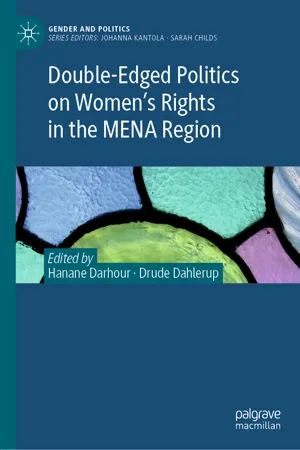
While the Arab Uprisings presented new opportunities for the empowerment of women, the sidelining of women remains a constant risk in the post-revolutionist MENA countries. Changes in the position of women are crucial to the reconfiguration of state-society relations and to the discussions between Islamist and secular trends. Theoretically framed and based on new empirical data, this edited volume explores women's activism and political representation as well as discursive changes, with a particular focus on secular and Islamic feminism, and changes in popular opinions on women's position in society. While the contributors express optimistic as well as more pessimistic views for the future, they agree that this is a period of uncertainty for women in the region, and that support by ruling elites towards women's rights remains ambiguous and double-edged.
eBook - ePub
Double-Edged Politics on Women’s Rights in the MENA Region
- English
- ePUB (mobile friendly)
- Available on iOS & Android
eBook - ePub
Double-Edged Politics on Women’s Rights in the MENA Region
About this book
Information
© The Author(s) 2020
H. Darhour, D. Dahlerup (eds.)Double-Edged Politics on Women’s Rights in the MENA RegionGender and Politicshttps://doi.org/10.1007/978-3-030-27735-2_11. Introduction: The Arab Uprisings and the Rights of Women
Drude Dahlerup1, 2 and Hanane Darhour3
(1)
Stockholm University, Stockholm, Sweden
(2)
Institute of Social Sciences and Business, Roskilde University, Roskilde, Denmark
(3)
Faculty of Languages, Arts and Human Sciences, Ibn Zohr University, Ait Melloul, Morocco
Drude Dahlerup
Keywords
Arab UprisingsWomen’s rightsAge of uncertaintyPolitical representationIdeological positioningAuthors have contributed equally to this introduction.
End AbstractGender equality and women’s empowerment are broadly addressed as core democratic and development concerns. Research on how democracy intersects with gender equality has centered around three theories. The first prominent position is that democratic states tend to strengthen gender equality through increasing civic space for women’s activism and expanding women’s engagement in the political process through voting (Paxton 1997; Beer 2009). The second view, however, reverses the link, regarding gender equality as a driver of democratization through increased economic and political empowerment (Balaev 2014). The third explanation posits that the most important explanatory factor of the relationship is modernization, which in turn drives cultural change toward progressive liberal values, including democracy and gender equality (Inglehart et al. 2002).
The path-breaking events in the MENA region often named the Arab Spring or, less expectant, the Arab Uprisings created openings for women’s agency and raised great expectations, which, however, in many cases were not followed by substantive changes. The post-spring period has been a time of empowering and, at the same time, sidelining of women. Many patriarchal structures have remained intact or reemerged in new forms; yet, many traditional norms have changed. The Middle East and North Africa is still the least free region of the world, and instability continues to threaten possibilities for democratization in many of its countries and uncertainty looms especially on the future of women’s rights. However, seeing so many women in protests and demonstrations, raised in Marwa Shalaby’s words “the hopes that Arab women were finally breaking their silence, defying the status quo and fighting for their own rights” (Shalaby and Moghadam 2016: 1). Yet, the question remains how women in this predominantly Muslim region can gain greater control, through their mobilization and contestation, over the circumstances that influence their lives and contribute to processes of democratization
The Aim of the Book
The purpose of this book is to analyze changes in women’s position in public life, including the changing discourses on gender in the periods just before, during and after the uprisings. It presents new research, theoretically framed and based on empirical investigations, including analyses of development of women’s activism, women’s political representation and position in political life in the MENA countries. The analyses of the discursive development focus especially on secular and Islamic feminism, and changes in popular opinions on women’s position in society. The book includes chapters on individual countries, and chapters, which compare several MENA countries. The focus is North Africa and the Middle East (the MENA region), but some chapters widen the perspective to encompass all Arab countries.
The book considers frequently less studied issues, including how the recent mobilizations and regime changes in MENA countries have altered the opportunity structures and allowed for an increase in women’s political representation and activism, partly through the adoption of gender quotas , but at the same time remained resistant to change with respect to several pernicious forms of discrimination against women in public and private life. Addressing the lacuna in the literature on this issue, this book opens new avenues of thought and research on the status of women’s rights in the MENA region with a special focus on the mobilization and contestation aspects around the political arena that followed the Arab Spring Uprisings. This edited volume does not present one unified position on these historical changes. Optimistic as well as more pessimistic views for the future are represented; however, all gathered under the position that this is a period of uncertainty for women in the MENA region, and that the support by part of the ruling elites toward women’s rights and empowerment of women is ambiguous and double-edged.
This introduction will present and discuss some of the key issues of this book around recent development in the MENA region. It offers an overview over women’s position in the public sphere in the MENA region seen in a global perspective as well as over recent law reforms and national machineries for women/gender equality. The significant issue of the relation between feminism and Islam, a subject of several chapters of the book, will be introduced. At the end of this introduction, the reader will find a summary of the individual chapters of the book.
Democratization in the MENA Region
The link between the inclusion of women and processes of democratization is of special importance to the MENA region. Caldwell (1982) has identified the region as part of the “patriarchal belt” and Kandiyoti (1988) named it as the world of “classic patriarchy”. Sharabi (1988) rather talked about MENA “neopatriarchy” which referred to the entrenched traditional hierarchical relations in a modernizing context. In 2002, the Arab Human Development Report drew a gloomy picture of a region lagging behind the rest of the world because of major deficits in freedom, women’s empowerment and education, and called for the inclusions of women in all spheres of life.
When the UN Arab Human Development Report from 2002 stated, that the three deficits of “freedom, empowerment of women, and knowledge” represent the key challenge to the development in the Arab region, it was the first time that women’s widespread illiteracy, lack of bodily freedom and exclusion from public life were described so distinctively in a UN report as one of the main disabling factors to the development process: “Society as a whole suffers when half of its productive potential is stifled. These deficits must be addressed in every field: economic, political, and social” (UNDP 2002: 4–5). Ironically, this knowledge of the crucial importance of including women as active partners in all spheres of society has only to a limited extent reached the textbooks of economic history and is still not part of the general understanding in most parts of the world. In Chapter 4, Ginger Feather suggests, “turning the causal arrow around”, by studying the co-constitution of women’s empowerment and democrac...
Table of contents
- Cover
- Front Matter
- 1. Introduction: The Arab Uprisings and the Rights of Women
- Part I. Women’s Rights, Feminism and Islamism
- Part II. Post-Spring Dynamics and Feminist Norm Diffusion
- Part III. Women’s Activism and the Reconfigured State
- Part IV. Empowered or Sidelined? On Women’s Political Representation and Influence
- Back Matter
Trusted by 375,005 students
Access to over 1.5 million titles for a fair monthly price.
Study more efficiently using our study tools.
Frequently asked questions
Yes, you can cancel anytime from the Subscription tab in your account settings on the Perlego website. Your subscription will stay active until the end of your current billing period. Learn how to cancel your subscription
No, books cannot be downloaded as external files, such as PDFs, for use outside of Perlego. However, you can download books within the Perlego app for offline reading on mobile or tablet. Learn how to download books offline
Perlego offers two plans: Essential and Complete
- Essential is ideal for learners and professionals who enjoy exploring a wide range of subjects. Access the Essential Library with 800,000+ trusted titles and best-sellers across business, personal growth, and the humanities. Includes unlimited reading time and Standard Read Aloud voice.
- Complete: Perfect for advanced learners and researchers needing full, unrestricted access. Unlock 1.5M+ books across hundreds of subjects, including academic and specialized titles. The Complete Plan also includes advanced features like Premium Read Aloud and Research Assistant.
We are an online textbook subscription service, where you can get access to an entire online library for less than the price of a single book per month. With over 1.5 million books across 990+ topics, we’ve got you covered! Learn about our mission
Look out for the read-aloud symbol on your next book to see if you can listen to it. The read-aloud tool reads text aloud for you, highlighting the text as it is being read. You can pause it, speed it up and slow it down. Learn more about Read Aloud
Yes! You can use the Perlego app on both iOS and Android devices to read anytime, anywhere — even offline. Perfect for commutes or when you’re on the go.
Please note we cannot support devices running on iOS 13 and Android 7 or earlier. Learn more about using the app
Please note we cannot support devices running on iOS 13 and Android 7 or earlier. Learn more about using the app
Yes, you can access Double-Edged Politics on Women’s Rights in the MENA Region by Hanane Darhour, Drude Dahlerup, Hanane Darhour,Drude Dahlerup in PDF and/or ePUB format, as well as other popular books in Politics & International Relations & African Politics. We have over 1.5 million books available in our catalogue for you to explore.