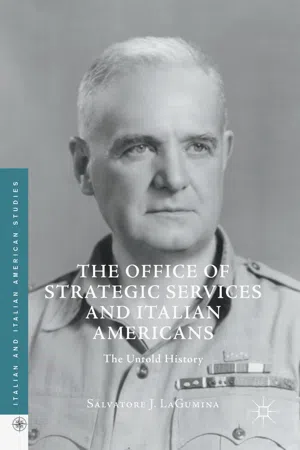
This book explores the contributions of Italian Americans employed by the Office of Strategic Services (OSS) during World War II. Italian Americans fluent in Italian language and customs became integral parts of intelligence operations working behind enemy lines. These units obtained priceless military information that significantly helped defeat the Axis. They parachuted into frozen mountains tops to link up with Italian guerilla units in northern Italy or hovered in small patrol torpedo boats and row boats across the Mediterranean Sea in pitch black darkness to destroy railroad junctions.
eBook - ePub
The Office of Strategic Services and Italian Americans
The Untold History
- English
- ePUB (mobile friendly)
- Available on iOS & Android
eBook - ePub
About this book
Information
Topic
HistoriaSubtopic
Historia militar y marítima© The Author(s) 2016
Salvatore J. LaGuminaThe Office of Strategic Services and Italian AmericansItalian and Italian American Studies10.1007/978-3-319-33334-2_11. Introduction
Salvatore J. LaGumina1
(1)
Nassau Community College, Massapequa Park, USA
“What did you do during the war?” a frequently heard query in the heady post-World War II years invariably elicited proud martial associations while citing battlefront participation and/or military service. The issue was particularly relevant for Italian Americans, mostly of the first and second generation who were either born in Italy or whose parents were from the country that during the war became the face of the enemy. In this worrisome and apprehensive atmosphere a number of solemn questions arose. Were they loyal to America or to Italy? Would they welcome assignments to fight in Italy? Would they take up arms against Italian relatives? Why are they speaking Italian? (In point of fact against a worrisome atmosphere many Italian-speaking parents refused to speak Italian to their children in their homes.) Why did they listen to Italian-language radio broadcasts? Why do they continue to display the Italian flag? Why do they insist on Italian feast celebrations? Why are they reading Italian-language newspapers? Why should they want to study Italian? Could they be trusted? Did they support the war effort? Did they show their patriotism by volunteering for the armed services? Are they buying war bonds? Are they donating blood?
Although it is impossible to obtain verifiable figures, it seems that for a staggering number of Italian Americans, apparently much larger than their proportion of the population, the answer to the question was to declare proudly and unabashedly the branch of service—Army, Navy, Marines, Coast Guard, Merchant Marine, Womens Army Corps (WACS), Women Accepted for For Volunteer Emergency Service (WAVES), and so on—in which they served. A limited but growing literature in the form of autobiographies, biographies, family and local recollections, and oral histories have recounted the partaking and sacrifices of many ranging from the little known to the more celebrated figures such as Congressional Medal of Honor recipient John Basilone and air ace Don Gentile. Scarcer, however, is knowledge about their role in clandestine activity and espionage. The purpose of this volume is to review the unique involvement and the extraordinary deeds of handpicked Italian Americans who served in covert operations of the Office of Strategic Service (OSS) and who have received only partial and occasionally contentious and misleading attention.
This tome strives to illuminate the contributions made by a selected cohort of Italian Americans in that great and heroic struggle against terrible totalitarian forces which threatened this nation and the world during World War II. It offers for posterity a record of remarkable and astonishing successes, but also of the perils encountered, the sufferings endured, and the martyrdom of the nameless who were recorded in histories of the conflict, in salient published biographies and autobiographies, and in the numerous unpublished oral and written testimonies that continue to unfold the secret history of unheralded brave, vigorous, and once youthful participants.
This is written not only because the events in which OSS Italian Americans were engaged were true, but also because I feel it a duty to bring to light the mundane and heroic sacrifices they endured for freedom’s sake. The hazardous adventures and exploits of behind-the-enemy-lines operatives may seem to stretch credulity and a reluctance to believe their decision to place their lives in jeopardy, but it is the undeniable historical record. This work is needed because the “greatest generation” is passing away and a new generation is arising who do not know what the preservation of liberty cost in blood and suffering.
I was young when the events revealed in this work were occurring but as a student of American history I came to learn of the secret war not only from the printed word, but also from the spoken words, the oral authentication, and the private writings of key participants. While teaching at Wesleyan University in Middletown, Connecticut, in the 1970s I had the honor and privilege to meet Frank Tarallo, a humble, self-effacing OSS veteran who was my student and who acquainted me with the subject via his firsthand account of the perilous work undertaken by young men and women volunteers to be part of a new American organization that dealt in stealth, secrecy, and surreptitiousness. The very knowledge of their encounters in often terribly dangerous places—their very magnitude—overpowers me. I have tried to render their struggle worthy to hand down to future generations and trust they will earn the reader’s esteem and respect.
While this work rests on a chronological framework for the discussions, projects, and analyses of OSS activities undertaken by Italian Americans, that framework may be punctured at various points to explain a prior historical setting that may be anticipated later.
It is fascinating and indubitably interesting to raise questions that a review of the research reveals, some of which will be offered here. Who was the 21-year-old OSS high school dropout whose pioneering and innovative ideas evoked such interest that many generals and other high-ranking military officials sought him out to confer with him? Who was designated by President Roosevelt to be the OSS linkage between the USA and Great Britain’s intelligence service? Who was credited for introducing the James Bond concept? Who was the Italian immigrant who became a star Notre Dame University football player and worked for the OSS to infiltrate enemy lines? Who was the most decorated soldier of World War? Who was the OSS operative who married the beautiful and resourceful 18-year-old partisan woman Walkiria Terradura, whose harassing activities became the bane of German enemy troops? Who was the Italian American from San Francisco whose expertise in Japanese found him on vital OSS missions in the Pacific Theater of war? Who was the journalist/printer who oversaw the printing of tens of thousands of propaganda literature? Who was the OSS officer who played a prominent role in saving much of Italy’s works of art? Who was the 24-year-old OSS agent entrusted with the sober responsibility of arranging for the surrender of the Italian dictator and other high Italian military officials? The answers to these intriguing questions and much other information that unfolds demonstrates the remarkable role Italian Americans played in America’s intelligence service during a critical period in history.
© The Author(s) 2016
Salvatore J. LaGuminaThe Office of Strategic Services and Italian AmericansItalian and Italian American Studies10.1007/978-3-319-33334-2_22. Intelligence Agency in Embryo
Salvatore J. LaGumina1
(1)
Nassau Community College, Massapequa Park, USA
The genesis of the OSS harkens to that period between the outbreak of World War II (September 1, 1939) and America’s entry in the war on December 7, 1941, when it became evident to President Franklin D. Roosevelt and his key advisors that conflict was imminent. What had passed for American intelligence operations until the outbreak of hostilities were random efforts that relied on the imperfect operations of rival, incongruent, and sometimes competing government Departments of State, Treasury, Army, and Navy, as well as information obtained from British intelligence sources. In operation since early in the twentieth century, by the beginning of World War II Great Britain’s MI5 controlled English national security secret intelligence activities thereby becoming the chief British Security Service initiative responsible for protecting the UK. Its intelligence-gathering skills had become both legendary and the envy of other nations including the USA. If it was to assume a major and decisive role given the exigencies of modern warfare, Americans would have to develop a vastly more cohesive and interrelated intelligence initiative. From the outset of war Great Britain sedulously cultivated all forms of American aid including secret intelligence. To that end, the British opened the innocuous-sounding British Security Coordination (BSC) headquarters in New York City, which, although originally manned by amateurs, was strengthened by professional agents like the celebrated William Stephenson, the master spy code-named “Intrepid” whose exploits inspired Hollywood to make the James Bond genre. As Stephenson put it, “I had been twenty years in the professional secret-intelligence service when in 1940 London sent me to British Security Coordination headquarters in New York to help maintain that secrecy. BSC had been manned by amateurs, and it was thought my special experience was required there.” 1 In utmost secrecy he then proceeded to draw up a blueprint for an American intelligence operation with detailed tables of organization and specified relationships between various internal offices. By the spring of 1940 it was clear that President Roosevelt was determined that the USA would assist Great Britain and that there should be a firm understanding of cooperation between the Federal Bureau of Investigation and the British Secret Service. 2 Churchill went out of his way to cultivate OSS chief William Donovan and Ernest Cuneo, the president’s special liaison officer, who was in fact an OSS agent. 3
Accordingly, it was deemed imperative that the USA create its own information-gathering agency that would undertake covert activities to obtain vital military knowledge about the nation’s enemies. Ever the nimble leader Roosevelt excelled in selecting outstanding personnel to carry out his vision or parenthetically be cast aside if one became a political liability. In July 1941 the president appointed William J. Donovan Coordinator of Information (COI) that in 1942 would transition into the OSS, the super spy organization. The son of a poor Irish Catholic family from Buffalo, New York, who worked his way through law school, Donovan achieved exceptional fame in World War I as he bravely led a battalion of the famed 42nd Division composed primarily of Irish Americans and known as the “fighting Irish” or the “fighting 69th.” For his service he was awarded a Congressional Medal of Honor and in the process acquired the “Wild Bill” appellation. (The 1940 Hollywood film The Fighting 69th is based on the exploits of New York City’s 69th Infantry Regiment, headed by battalion commander William Donovan and portrayed by actor George Brent.) In addition to his military fame, Donovan’s immense success as a Wall Street lawyer, his extensive worldwide travels and familiarity with European leaders, and his friendship with President Roosevelt rendered him an outstanding choice to oversee espionage and sabotage operations in Europe and parts of Asia. (Although Roosevelt and Donovan were not very intimate friends and in fact were in opposing political parties—Republican Donovan ran for New York State governor in 1932—they were acquainted with each other. They simultaneously attended Columbia Law School.) It was said that while at Columbia Roosevelt admired Donovan because of his football prowess. “At a time in American social history when Ivy League football heroes were stars of their generation, Donovan not only was excellent as a runner and in crew but clawed his way into college lore as a quarterback with the Columbia lions. Men who succeeded at Columbia’s Baker Field became idolized, and the idolatry often lasted for life—as in the case WJD.” 4 That said, from the outset rivalry and contention plagued Donovan and the COI from jealous traditional intelligence departments which brazenly resisted any moves that might duplicate the work of their agencies thereby diminishing their own importance. This produced “turf wars” that found, for example, FBI Director J. Edgar Hoover becoming an implacable and bitter foe whose enmity was demonstrated in assigning FBI agents to spy on Donovan throughout the war years. General George V. Strong, of an imperious and cerebral nature, epitomized how intense the opposition of branches of the armed forces could be. As head of G-2, the Army’s intelligence arm whose unswerving allegiance was to the professional Army establishment, he had nothing but utter disdain for the OSS which he considered “a band of civilian amateurs that had to be broken up or it would take over his agency.” He began to refer to the OSS director as “Wildman Donovan.” 5
Intelligence arms of the armed forces were hampered by a long and potentially deleterious tradition that precluded meaningful cooperation between the services. Albeit a degree of collaboration was finally established between the Army’s Military Intelligence Division (MID) and the Navy’s Office of Naval Intelligence (ONI), it was not until 1945 that they created an effective joint intelligence committee. “Although MID was willing to work with its Navy counterpart, it regarded cooperation with other players in the intelligence arena with distaste. Both military services distrusted the civilians especially those in Donovan’s organization.” The rivalry, furthermore, did not abate after COI was phased out in favor of the OSS which now saw a rapid increase in its budget and in the number of agents under its control as well as a heavy augmentation of military personnel (detachments). Notwithstanding that Donovan himself ultimately received promotion to a general’s rank, the MID never allowed OSS analysts access to high-grade Communications Intelligence (COMINT). 6 The opposition succeeded in confining the scope of OSS by specifically excluding its activity in domestic affairs as well as the entire western hemisphere. Although rivalry persisted on a departmental level, it was attenuated on the battlefield as noted by historian John Patrick Finnegan. “Army commanders in Europe found the OSS a useful organization. In fact, the Army personnel provided the bulk of OSS strength.” 7
Donovan was not to be deterred; he met the challenge of staffing his new OSS agency by tapping into people he knew best: prestigious bankers, lawyers, industrialists, conservative academics, and their contacts. He thus produced an OSS personnel roster top-heavy with representation from Ivy League and the “Seven Sisters” colleges. With at least 42 members of its Class of 1943 engaged in the OSS, Yale University is a conspicuous example; appropriately it remained for a Yale historian to provide an absorbing account of the espionage-attraction phenomenon: faculty members who adjusted their research to assist in military intelligence; the connection of faculty, students, and close familial relationships that led to a large recruitment of Yale graduates into the OSS. 8
The Yale/OSS connection was plain throughout operations in Italy in the person of Donald Downes who had a varied intelligence career and who was named to direct OSS personnel assigned to the Fifth Army. Lacking experience in Italy, Downes relied heavily on Vincent Scamporino and also collaborated with Irving Goff in a plan to enlist Italian prisoners of war to infiltrate behind enemy lines in order to obtain information. But Downes had problems of fitting in and clashed with other OSS colleagues leading to his departure from the spy organization in order to w...
Table of contents
- Cover
- Frontmatter
- 1. Introduction
- 2. Intelligence Agency in Embryo
- 3. Recruitment and Training Strategies
- 4. Corvo and the Connecticut Connection
- 5. Agents Extraordinaire
- 6. Operation Husky
- 7. Conquering the Islands: Sicily, Sardinia, Corsica, Lipari, Ventotene
- 8. From Salerno to Anzio
- 9. Italian Mainland Operational Groups
- 10. OSS and Partisans
- 11. Conclusion
- Backmatter
Trusted by 375,005 students
Access to over 1.5 million titles for a fair monthly price.
Study more efficiently using our study tools.
Frequently asked questions
Yes, you can cancel anytime from the Subscription tab in your account settings on the Perlego website. Your subscription will stay active until the end of your current billing period. Learn how to cancel your subscription
No, books cannot be downloaded as external files, such as PDFs, for use outside of Perlego. However, you can download books within the Perlego app for offline reading on mobile or tablet. Learn how to download books offline
Perlego offers two plans: Essential and Complete
- Essential is ideal for learners and professionals who enjoy exploring a wide range of subjects. Access the Essential Library with 800,000+ trusted titles and best-sellers across business, personal growth, and the humanities. Includes unlimited reading time and Standard Read Aloud voice.
- Complete: Perfect for advanced learners and researchers needing full, unrestricted access. Unlock 1.5M+ books across hundreds of subjects, including academic and specialized titles. The Complete Plan also includes advanced features like Premium Read Aloud and Research Assistant.
We are an online textbook subscription service, where you can get access to an entire online library for less than the price of a single book per month. With over 1.5 million books across 990+ topics, we’ve got you covered! Learn about our mission
Look out for the read-aloud symbol on your next book to see if you can listen to it. The read-aloud tool reads text aloud for you, highlighting the text as it is being read. You can pause it, speed it up and slow it down. Learn more about Read Aloud
Yes! You can use the Perlego app on both iOS and Android devices to read anytime, anywhere — even offline. Perfect for commutes or when you’re on the go.
Please note we cannot support devices running on iOS 13 and Android 7 or earlier. Learn more about using the app
Please note we cannot support devices running on iOS 13 and Android 7 or earlier. Learn more about using the app
Yes, you can access The Office of Strategic Services and Italian Americans by Salvatore J. LaGumina in PDF and/or ePUB format, as well as other popular books in Historia & Historia militar y marítima. We have over 1.5 million books available in our catalogue for you to explore.