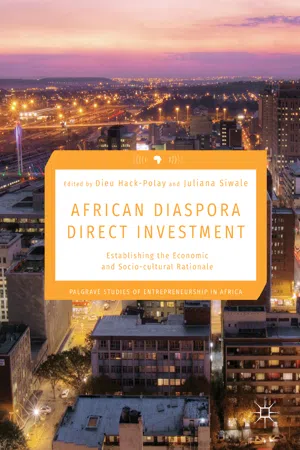
Examining the experiences of Africans setting up businesses back home, the main focus of this book is to establish the economic, social and psychological reasons for such 'home direct investment'. Despite the personal sacrifices that are often needed in order to set up new ventures, the diaspora invests relentless effort and motivations in the pursuit of home ventures. The authors explore critical areas such as the social and psychological pressures that African Diasporas experience when investing in their home countries, as well as the management of diaspora businesses and the impact of such investment to local economies.
eBook - ePub
African Diaspora Direct Investment
Establishing the Economic and Socio-cultural Rationale
- English
- ePUB (mobile friendly)
- Available on iOS & Android
eBook - ePub
African Diaspora Direct Investment
Establishing the Economic and Socio-cultural Rationale
About this book
Information
Topic
Negocios y empresaSubtopic
Emprendimiento© The Author(s) 2018
Dieu Hack-Polay and Juliana Siwale (eds.)African Diaspora Direct InvestmentPalgrave Studies of Entrepreneurship in Africahttps://doi.org/10.1007/978-3-319-72047-0_11. Introduction: Overview of the Book
Dieu Hack-Polay1 and Juliana Siwale2
(1)
Lincoln International Business School, University of Lincoln, Lincoln, UK
(2)
Nottingham Business School, Nottingham Trent University, Nottingham, UK
The Making of the African Diaspora
The existence of the diaspora is as old as human history. Migration is therefore inherent to human existence and societies. These continuous migratory movements happen for a diversity of reasons: subsistence, augmentation of wealth , safety, etc. (Price and Benton-short 2008; Hack-Polay 2016). This has been sustained from primitive societies to Roman times till today. The diaspora is formed as some groups of migrants stay for a protracted amount of time in the host country and some do not return to the homeland .
In the case of Africa , painful events such as slavery and colonialism have sent a greater number in the diaspora than any other continent has. For example, it is argued that during slavery time C1500–1865, over 20 million Africans were taken to the Americas. The number of those displaced during the main colonial period (1860s–1960s) is not always agreed on. However, estimate figures from various sources point to somewhere around 10 million. The African migration out of Africa continued in the post-independence period. These recent migrations are largely due to poverty , unceasing wars, unemployment and further education . The United Nations (2016) estimates the number of Africans in the diaspora to be in the region of 160 million. However, this figure could be contentious because it is dependent on the meaning that one attributes to diaspora . The African Union (AU) defines the African diaspora anyone of African descent who lives in a country outside of Africa . This definition is arguable because on this premise Black Americans, Caribbeans and established Black Europeans (British, French, Dutch, Portuguese, etc.) are included in the figure. However, it can be argued that the aforementioned groups are now distinct groups, some of whom no longer associated themselves with Africa , or at least do not keep in touch with Africa and its contemporary affairs.
Reconceptualising the Diaspora
In the context of this book, we found it indispensable to revisit the definition of diaspora and consider a meaning that is more relevant and meaningful for the modern world with changing identities. We perceive the diaspora as a group of people who have left their country of origin (COO) to settle for a protracted period or indefinitely in a foreign country and have recent ties or maintain ties with the COO . In this perspective, the diaspora includes economic migrants and dependants who have been abroad for a number of years (we suggest five years and more), and refugees. This definition excludes diplomats and students as well as tourists. It will also exclude third or later generations of migrants settled in foreign countries who become citizens since these are likely to identify with the host collectivities, for example referring to themselves as Black Americans, Black British, Caribbean, etc. This perspective is supported by Crush (2011) who argues that a more realistic definition of diaspora will include those who contribute to Africa or have the potential to do so. In the case of the African diaspora , if our definition is applied, the figures will be around 25 million which, though significantly lower than the UN’s earlier stated 160 million, represents a sizeable population .
The African diaspora has grown over time. This spans through slavery times to the present. It is clear that part of this diaspora has emerged to become ‘natural’ citizens of other geographical spaces, e.g. African Americans, Black British whose fore parents were taken to the UK many centuries ago and they identify themselves as fully fledged parts of the British ethnic architecture. For the purpose of this book, we consider the African diaspora to comprise people who are recent comers to the host countries outside of Africa and maintain ties with the COO .
Such a diaspora plays a critical role in the African Renaissance. This is exemplified in Kajunju’s (2013) article which terms the diaspora ‘Africa ’s secret weapon’. Many African countries and African families look up to the diaspora for ideas and economic support . This stems from the belief that being in the diaspora signifies better lives and enhanced learning opportunities placing the migrant in a position to transfer knowledge and economic capabilities . It is estimated that over 25 million people of African descent within our diaspora definition live outside of Africa . However, the African diaspora in the broader sense accounts for over 170 million people (World Bank 2012).
Part of the literature has characterised the African diaspora as ‘brain drain ’. This signifies the loss of talent from Africa to other socio-economic and culture spheres of our globe (Network of African Science Academies (NASAC 2009)). However, more and more voices are emerging to acclaim the same migratory movements as vital to the reconstruction and development of African economies and politics (Boyo 2013; Mugimu 2010; Easterly and Nyarko 2007). This reversing trend in the perception of migration out of Africa is referred to as brain gain , to show the extent to which the diaspora could be a resource to development and peace initiatives in Africa . This trend repositions the diaspora a key player and match maker in terms of the continent moving forward (Starkab et al. 1997; Lee and Kim 2010; Batistaab et al. 2012).
Diaspora Direct Investment and Remittances
It is well established that many African migrants living abroad make significant investments in their countries of origins (COO) (Plaza and Ratha 2011). The issue of remittances is well documented. This area of investment , i.e. remittances , provides direct support for the living cost of relatives left back home, e.g. left-behind children and spouses but also the extended families comprising cousins, grandparents and parents. According to a World Ban...
Table of contents
- Cover
- Front Matter
- 1. Introduction: Overview of the Book
- Part I. Diaspora Direct Investment: Rationalities and Impact
- Part II. Management of Diaspora Businesses
- Part III. Gender and Diaspora Investment
- Back Matter
Trusted by 375,005 students
Access to over 1.5 million titles for a fair monthly price.
Study more efficiently using our study tools.
Frequently asked questions
Yes, you can cancel anytime from the Subscription tab in your account settings on the Perlego website. Your subscription will stay active until the end of your current billing period. Learn how to cancel your subscription
No, books cannot be downloaded as external files, such as PDFs, for use outside of Perlego. However, you can download books within the Perlego app for offline reading on mobile or tablet. Learn how to download books offline
Perlego offers two plans: Essential and Complete
- Essential is ideal for learners and professionals who enjoy exploring a wide range of subjects. Access the Essential Library with 800,000+ trusted titles and best-sellers across business, personal growth, and the humanities. Includes unlimited reading time and Standard Read Aloud voice.
- Complete: Perfect for advanced learners and researchers needing full, unrestricted access. Unlock 1.5M+ books across hundreds of subjects, including academic and specialized titles. The Complete Plan also includes advanced features like Premium Read Aloud and Research Assistant.
We are an online textbook subscription service, where you can get access to an entire online library for less than the price of a single book per month. With over 1.5 million books across 990+ topics, we’ve got you covered! Learn about our mission
Look out for the read-aloud symbol on your next book to see if you can listen to it. The read-aloud tool reads text aloud for you, highlighting the text as it is being read. You can pause it, speed it up and slow it down. Learn more about Read Aloud
Yes! You can use the Perlego app on both iOS and Android devices to read anytime, anywhere — even offline. Perfect for commutes or when you’re on the go.
Please note we cannot support devices running on iOS 13 and Android 7 or earlier. Learn more about using the app
Please note we cannot support devices running on iOS 13 and Android 7 or earlier. Learn more about using the app
Yes, you can access African Diaspora Direct Investment by Dieu Hack-Polay, Juliana Siwale, Dieu Hack-Polay,Juliana Siwale in PDF and/or ePUB format, as well as other popular books in Negocios y empresa & Emprendimiento. We have over 1.5 million books available in our catalogue for you to explore.